
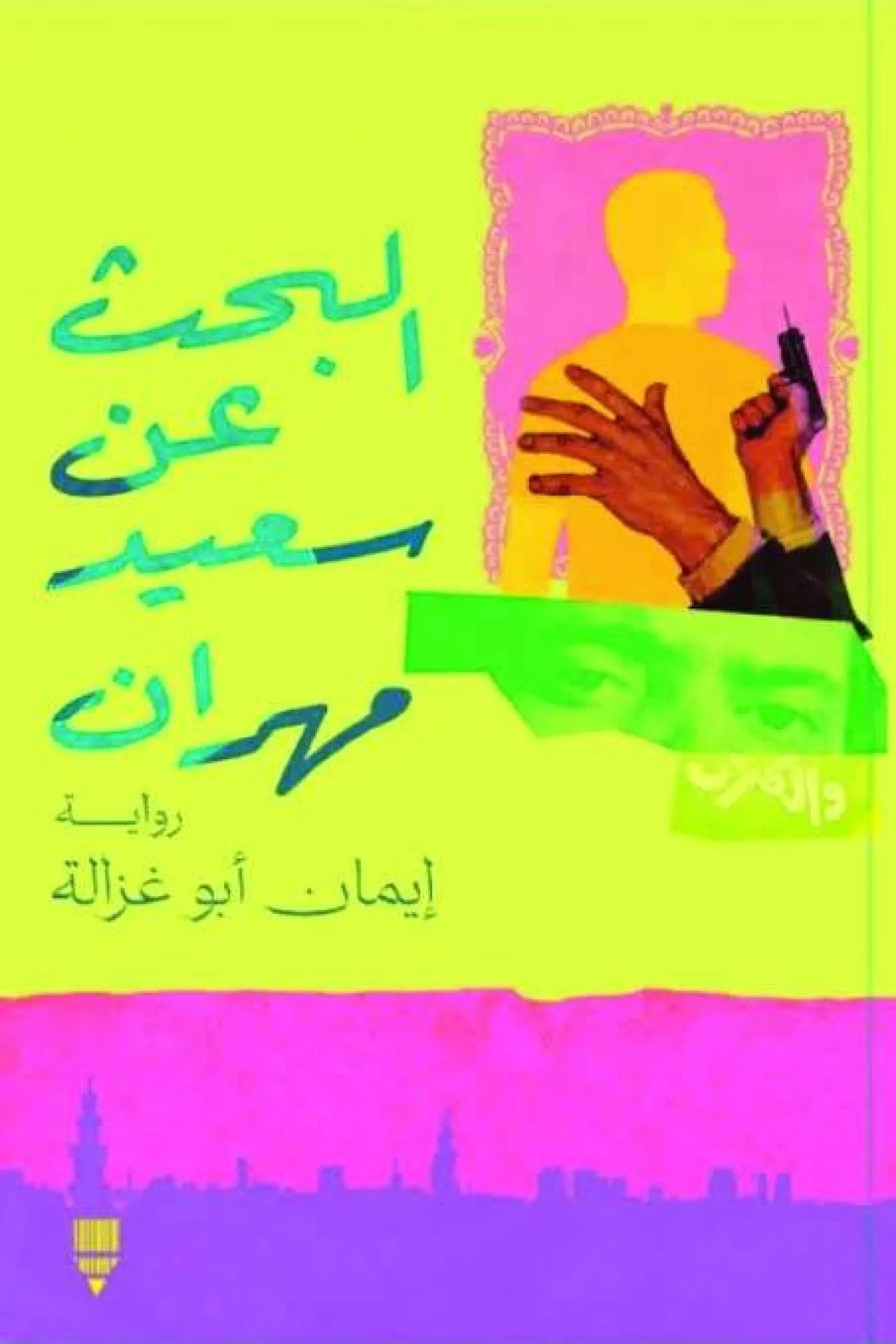
From its very title, Iman Abu Ghazala’s novel Searching for Said Mehran establishes a direct textual relationship with Naguib Mahfouz’s The Thief and the Dogs, bringing Mahfouz’s protagonist, Said Mehran, back into the foreground of a new narrative structure. This textual presence is reinforced by the novel’s epigraph: “I will not forget the past for one simple reason: it is present—not past—in me,” a quotation from Mahfouz’s The Thief and the Dogs itself.
This textual threshold is particularly significant because it places the concept of the persistence of the past within the present at the center of the novel. The past is not treated as a completed historical period, but as an active force that continues to shape the characters’ consciousness, behavior, and choices. At the same time, the invocation of Mahfouz can be read as a statement about the author’s relationship with the Arab literary tradition. Abu Ghazala approaches Mahfouz’s novel not as a closed classical reference, but as a living component of her literary memory. Her novel therefore does not sever its relationship with the literary canon; rather, it rereads and reconfigures that canon within a different social and psychological context.
Published in Cairo by Dar al-Muharrir, the novel opens with an extraordinary narrative moment that functions simultaneously as a dramatic climax and as a key to the novel’s interpretation. From its opening sentence, the reader encounters an event of a distinctly uncanny nature: “Damiana swears by the living Christ that she saw Said emerge from his grave like a savior who had returned from death and found his resurrection...” This sentence establishes the event from which the remainder of the narrative unfolds. Hakima informs her two children, Said and Nour, that the body of their father, Said al-Rifai Mehran, has emerged from its grave and that the villagers have found the grave open and empty.
The return of the body does not merely serve as a device for generating suspense. It becomes a central metaphor for a past that refuses to die. The body emerging from the grave embodies the return of what the characters believed had ended, as well as the resurfacing of psychological wounds and traumatic experiences that were never truly resolved, but merely pushed aside or symbolically buried. The search for the body thus becomes, simultaneously, a search for the family’s history and for the origins of the violence that has governed its internal relationships across generations.
Intertextuality with Mahfouz: From Quotation to the Reproduction of Fate
The novel does not invoke Mahfouz’s Said Mehran merely as a cultural reference. Rather, the character becomes a structural element in the formation of Abu Ghazala’s own protagonist, Said al-Rifai Mehran. The story begins with his father, al-Rifai Mehran, a simple peasant who longs for a son after having several daughters. When the boy is finally born, the father names him “Said,” influenced by the film The Thief and the Dogs and moved by the plight of its protagonist, whom he regards as an unjustly treated figure deserving sympathy.
Yet the name chosen as an expression of admiration and compassion gradually becomes an instrument for producing destiny. From childhood, the boy who bears the name Said Mehran becomes the target of ridicule and accusation, as his classmates and other villagers associate his name with the image of the thief portrayed in Mahfouz’s novel. The name consequently ceases to be merely an identifying marker and becomes a social and narrative burden imposed upon its bearer.
The novel thus moves beyond conventional intertextuality, in which a writer simply invokes a character or event from an earlier text, toward a more complex form of reproducing character and fate. Abu Ghazala’s protagonist does not merely bear the name Said Mehran; he gradually becomes imprisoned by the image that the name represents both to himself and to those around him.
At this point, The Thief and the Dogs ceases to be merely a text that the protagonist has read and becomes an active force within the new narrative. As Said al-Rifai Mehran grows older and becomes increasingly familiar with Mahfouz’s novel, he becomes more conscious of the parallels between his own life and that of the literary character whose name he carries. The earlier literary character consequently becomes a kind of model through which the contemporary protagonist constructs his own identity, even when that construction takes the form of rejection and revenge.
The Ghost of Said Mehran and the Concept of Hauntology
The notion of ghosts occupies a central position in the novel and can be read in light of the concept of hauntology, particularly as developed by the French philosopher Jacques Derrida. Within this framework, the past is never entirely absent. It continues to exist through its traces and returns to influence the present despite the passage of time.
The novel therefore contains not a single ghost, but a chain of interconnected ghosts. Said al-Rifai Mehran is haunted by the ghost of Mahfouz’s Said Mehran. He then becomes, in turn, a ghost haunting his own children after becoming a source of violence and fear in their lives. The first father, al-Rifai Mehran, likewise remains present in his son’s consciousness as the origin of his suffering, before the son himself becomes a source of suffering for the next generation.
The result is a cycle in which the past produces the present, while the present eventually becomes a past that haunts the future. The ghost is therefore not merely an image of death or absence. It represents unresolved experience and wounds that have never found a path toward reconciliation.
Revenge Against the Father and the Reproduction of the Thief and the Dogs Tragedy
The conflict between Said al-Rifai Mehran and his father carries a symbolic dimension that extends beyond an ordinary family dispute. It is the father who gives him the name that, in the son’s eyes, becomes the source of his suffering. Anger over the name consequently develops into anger toward the father himself, and eventually into a desire for revenge.
At this point, the contemporary protagonist’s life begins to intersect with that of Mahfouz’s Said Mehran. Just as Mahfouz’s protagonist returns to his past driven by a desire to take revenge on those he believes betrayed and wronged him, Abu Ghazala’s protagonist seeks revenge against the father whom he holds responsible for the tragedy of his own life.
The novel, however, reconfigures this revenge within a different context. Rather than limiting his revenge to particular individuals, Said directs his anger against his father’s entire world. He destroys his father’s agricultural land, creating a clear symbolic contrast with a father who loves cultivation, greenery, and the land itself. Turning the land barren therefore becomes an act of symbolic destruction directed against the father’s legacy.
Over time, this destructive impulse comes to encompass Said’s own life. He becomes involved in gambling and brothels, secretly marries Hakima, and uses his relationship with her and with their children to reconstruct the image of “Said Mehran” that had been imposed upon him since childhood. The identification reaches its climax when he tells his father that he wanted him to become “Said Mehran” and that he has indeed chosen to follow that path.
Here the novel reaches one of its central paradoxes: the attempt to escape a destiny becomes a means of reproducing it. Said rejects being a copy of Mahfouz’s character, yet ultimately reproduces elements of that character’s fate—not because the novel presents destiny as inevitable, but because he becomes unable to construct an identity outside the model imposed upon him from childhood.
From Victim to Perpetrator
The cycle of violence expands when Said transfers his psychological inheritance to the next generation. Having himself been a victim of ridicule, rejection, and parental violence, he becomes a source of violence toward his own son and daughter. He names his son “Said” as well and gives his daughter the name “Nour,” reinforcing the references to The Thief and the Dogs while simultaneously reproducing the very structure that produced his own tragedy.
The novel consequently raises a question that extends beyond Said as an individual: How does the victim become a perpetrator, and how are the effects of violence transmitted from one generation to the next?
Said and Nour inherit from their father more than their names. They inherit fear, hatred, and psychological instability. They grow up under a father who subjects them to violence, confinement, and humiliation. The situation culminates in Nour being married off to her father’s acquaintance as part of an arrangement linked to an economic project. The family thus becomes a space in which relations of power and oppression are reproduced rather than a space of protection and security.
Significantly, the novel does not portray Said as either a pure perpetrator or a pure victim. He occupies the ambiguous space between the two: a victim of a history he did not choose who subsequently becomes an agent in reproducing the violence to which he himself was subjected. This duality gives the character considerable analytical depth because it places individual responsibility within a broader system of relationships that produces and perpetuates violence.
The Returning Body: The Return of the Past, Not the Return of the Dead
When Said and Nour receive news that their father’s body has emerged from the grave, the event is not merely uncanny. It represents a direct return to the source of their pain. The father they believed had disappeared through death returns, both symbolically and materially, to reopen wounds that had never healed.
Their journey back to the village therefore becomes more than a search for a body. It becomes a journey into family memory. Although the search itself takes place over only a few days, the narrative expands through flashbacks to encompass decades of family history, returning to the 1960s in order to reveal the origins, causes, and transformations of the family’s crisis.
Through this temporal structure, the novel connects the present event to its distant history. The present cannot be understood independently of the past, while the past does not appear merely as an archive of events. It functions as a force that continues to operate within the characters.
Burying the Body or Burying the Curse?
The novel reaches one of its most significant symbolic moments when Said’s body is eventually found lying in the bed of his father, al-Rifai Mehran. The location is not arbitrary. It returns the body to the point of origin: the first father, the land, the family, and the original source of conflict.
The scene can be interpreted as an attempt to return the past to its proper place, not by denying it but by confronting it. The body that has symbolically moved from one generation to another finally returns to the father at the point where the cycle began.
This psychological trajectory is contrasted with another within the local community. The villagers interpret Said’s return as the return of a saint or a figure endowed with miraculous powers, and they prepare to build a shrine for him. The novel thereby juxtaposes individual memory and collective memory: what represents a history of violence and psychological turmoil to Said’s family can become, within the collective imagination, a myth of sanctity.
This contradiction is particularly significant because the same community that helped shape Said’s identity from childhood—through ridicule, stigmatization, and the association of his name with The Thief and the Dogs—ultimately reconstructs him in a different form, as an extraordinary figure worthy of veneration. The community thus continues to reshape the character according to its own symbolic needs.
The Novel as a Critique of the Cycle of Oppression
Searching for Said Mehran ultimately extends beyond the rewriting of a Mahfouzian character to examine broader mechanisms involving memory, violence, identity, and the reproduction of oppression. The family functions almost as a miniature laboratory in which the effects of violence pass from one generation to another: the father suffers from the past and consequently inflicts suffering upon his children, while the children carry the effects of that suffering even after leaving the place where it occurred.
From this perspective, the novel can be read as a metaphor for societies that are unable to come to terms with their past and therefore continue to reproduce their crises in different forms. The problem is not simply the existence of a painful past, but the absence of genuine mechanisms for processing it and transforming it into a form of memory that can be lived with, rather than allowing it to remain an active force directing behavior.
Within this framework, Said and Nour’s inability to have children after marriage can be read as a possible symbolic indication of a desire to break the chain of inheritance. After the family has become a mechanism through which violence is transmitted from one generation to another, the cessation of reproduction can signify the cessation of the cycle itself, or at least a refusal to reproduce it.
The novel’s central question, therefore, concerns not merely the fate of Said Mehran, but the fate of the legacy he leaves behind: Can the past truly be buried, or will every attempt to bury it without confronting it merely cause it to return in another form?
Ultimately, the search for the body is not so much a search for the dead as a search for the meaning of death itself: When does the past actually end? When does the dead cease to exercise power over the living? The novel appears to suggest that the past does not die simply because its historical moment has ended. It must be confronted, interpreted, and reconciled with before it can lose its power to shape the present.
This is where the novel’s relationship with The Thief and the Dogs acquires its broader significance. Iman Abu Ghazala does not invoke Said Mehran merely to celebrate Naguib Mahfouz’s literary legacy. She uses the character as a means of exploring how characters, names, and narratives move from one literary generation to another and become embedded in the social and psychological memory of later generations. Between the ghost of Mahfouz’s Said Mehran and the ghost of Said al-Rifai Mehran, the novel constructs a narrative about a past that refuses to remain past, about a human being who attempts to avenge a wound only to reproduce it, and about the necessity of breaking the cycle before inherited suffering becomes a new form of destiny.
Most read