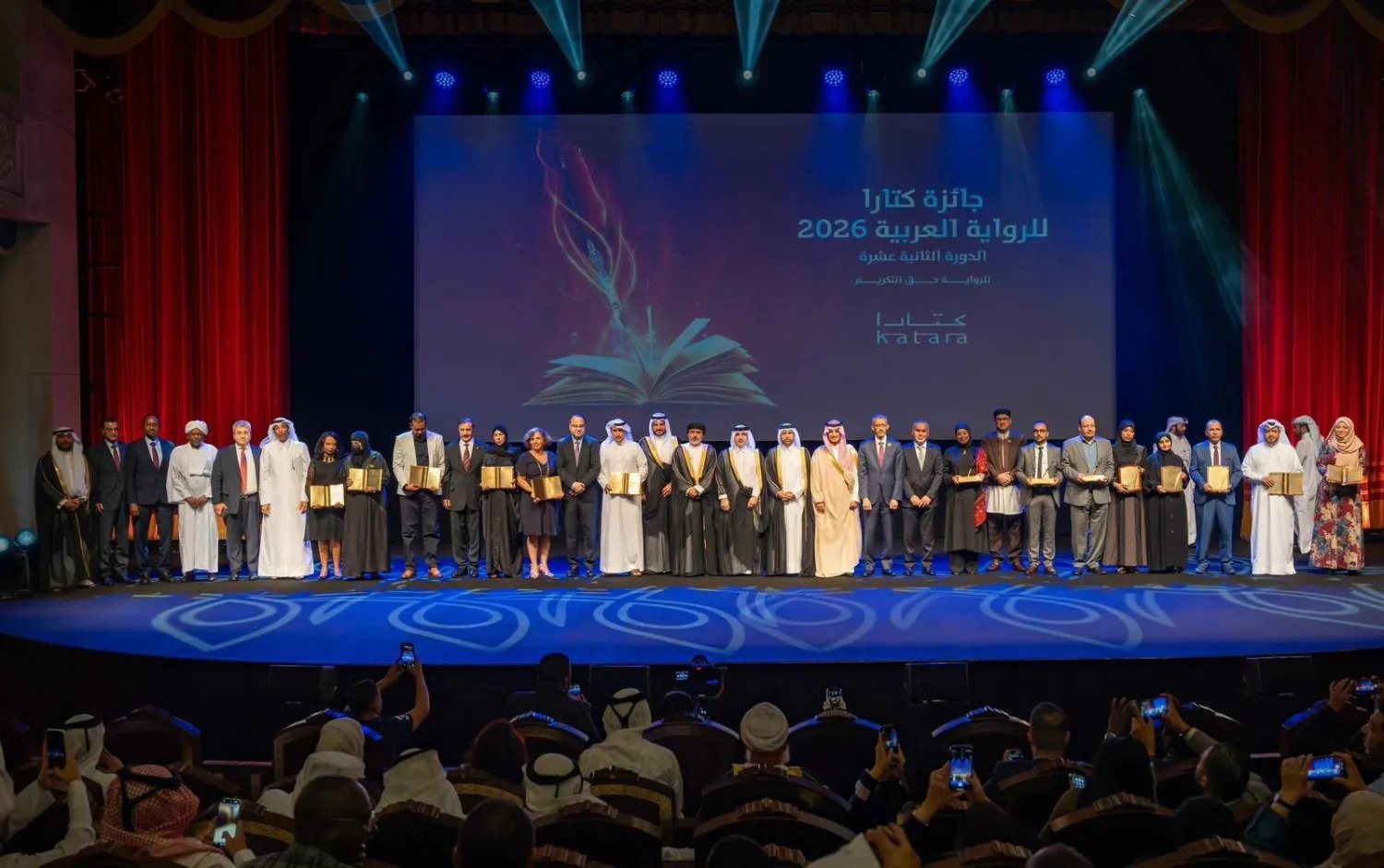
Qatar’s Cultural Village Foundation (Katara) has announced the winners of the 12th edition of the Katara Prize for Arabic Novel for 2026. The awards ceremony, held on Thursday evening at the Opera House in Doha, honored 14 writers and literary critics from nine Arab countries. Egypt topped the list with four awards, while Saudi Arabia secured two, in an edition that recorded the highest number of submissions since the prize was launched in 2014.
According to the award’s organizers, the competition received a total of 2,610 submissions, including 1,488 unpublished novels and 245 entries from Gulf countries. The figures reflect the expanding reach of the competition and the diversity of Arabic literary production represented in this year’s submissions.
Winners in the Published and Unpublished Novel Categories
In the published novel category, Saudi writer Maha Al-Yamani won for her novel My Hands Do Not Tremble, alongside Egyptian writer Samar Nour for Asha the Scarab and the Moon and Sudanese writer Muhannad Al-Dabi for The Siege of Al-Ghazala, Waw.
The unpublished novel category recognized three authors: Saudi writer Nasser Al-Sharif for The Voice That Ziryab Never Heard, Algerian writer Sarah Salti for We May Meet Again, and Palestinian writer Huda Al-Mashharawi for Death Has Another Day.
Each winner in the two categories receives a cash prize of $30,000. The winning novels will also be translated into English, while unpublished winning works will be printed and published, providing their authors with an opportunity to move from manuscript to publication and wider circulation.
Literary Criticism and Young Adult Fiction
In the category dedicated to literary research and criticism, three scholars were recognized for their studies. Palestinian scholar Amal Erhim won for Contemporary Arabic Fiction and the Fascination with Cinema: The Novel Destinies: A Holocaust and Nakba Concerto as a Case Study. Moroccan scholar Hamid Al-Kettani received the award for The Arabic Novel on the Threshold of Development: A Study of Periodization from the Perspective of Critical Classification Terminology. Egyptian scholar Mahmoud Farghali won for Representations of the Environment in the Novel: An Ecocritical Reading of the Works of Zahran Al-Qasimi.
Each winner in this category receives $30,000. Katara will also print, publish, and market the winning studies, as part of its efforts to support literary scholarship and strengthen its presence in the Arab cultural landscape.
In the young adult fiction category, the winners were Algerian writer Khadija Tellie for The Tailor of Tolga, Yemeni writer Manal Al-Jarash for Sunglasses, and Egyptian writer Hani Al-Qatt for The Kingdom of Stone. Each winner receives $15,000, with the winning works to be printed and published.
The edition also recognized Egyptian writer Noha Fahim, who won the unpublished historical novel category for Sunset over the Alcázar. Meanwhile, the award for a published Qatari novel went to Khalaf Al-Khalaf for The Covenant and the Pledge.
Katara Bets on Publishing and Translation
Commenting on the results, Khalid Al-Sulaiti, Director-General of the Cultural Village Foundation (Katara), said the record number of submissions reflected the award’s growing appeal among Arab writers. He also highlighted the foundation’s efforts to develop an integrated framework for publishing, translation, and the promotion of literary works.
Al-Sulaiti linked the award’s activities to the celebration of World Novel Week, held from October 13 to 20, following an initiative submitted by Katara to the United Nations Educational, Scientific and Cultural Organization (UNESCO), with the support of the Arab League Educational, Cultural and Scientific Organization (ALECSO).
For his part, ALECSO Director-General Mohamed Ould Amar stressed the importance of investing in books and translation and expanding the reach of Arabic literature among readers beyond the region. He also underscored the role of literary awards in supporting novel production and strengthening the cultural and creative industries.
Literary Awards and the Wider Circulation of Arabic Fiction
The results of the 12th Katara Prize for Arabic Novel highlight the competition’s expanding geographical reach and the diversity of literary and critical fields it covers, ranging from published and unpublished novels to young adult fiction, literary criticism, and historical fiction.
The substantial number of unpublished novels is particularly significant, highlighting the role literary competitions can play in creating opportunities for writers whose work has yet to reach publishing houses. By combining financial recognition with printing, translation, and marketing, the award extends beyond the act of honoring literary achievement to help winning works reach readers across the Arab world and internationally.
As the Arabic book industry continues to face challenges, initiatives that bring together talent discovery, publishing opportunities, and the promotion of literary production are becoming increasingly important, particularly those seeking to strengthen the presence of Arabic fiction in international reading markets. In this context, the Katara Prize represents one of the cultural initiatives seeking to connect literary competition with the development, publication, and distribution of Arabic books.
Most read




Read also