From the Expansiveness of Life to the Intimacy of the Heart: The Aesthetic Structure and Ecological Dimensions of Basma Sheikho’s Doors

Introduction
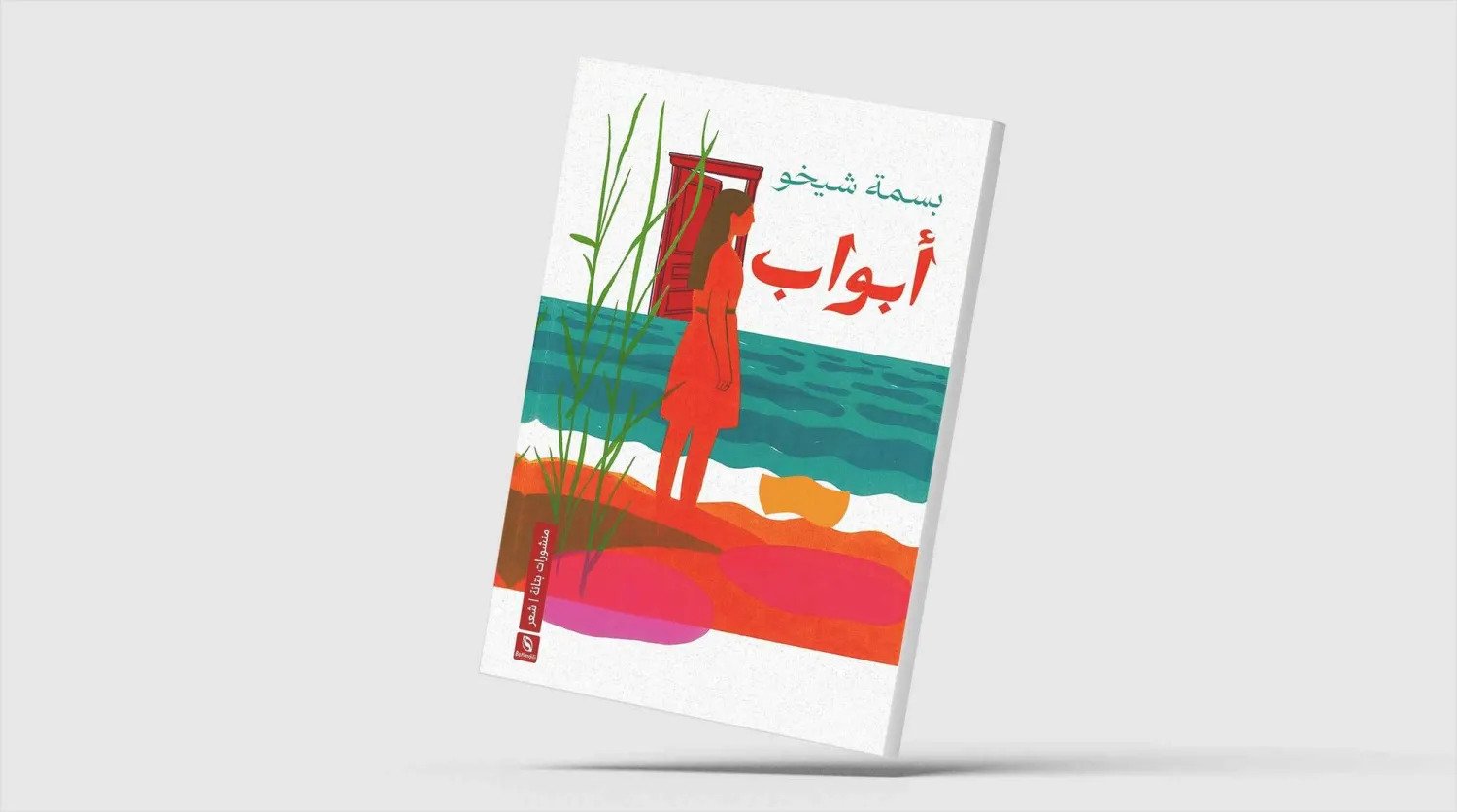
Doors, a poetry collection by Syrian poet Basma Sheikho, presents a poetic experience built around a gradual movement from the external world to the inner self, and from contemplating the details of life to exploring personal identity and its emotional depths. This progression is reflected not only in the collection’s thematic content but also in its artistic structure. Comprising thirty-six poems divided equally into three sections—“A Large Door: Life,” “A Medium Door: Self,” and “A Small Door: My Heart”—the collection employs an interconnected symbolic architecture in which the poetic self moves from the vastness of existence to the intimacy of individual experience, eventually arriving at the heart as a center of emotion, longing, and the possibility of recovering meaning.
Published in Cairo by Betana Publishing House, the collection traces, through its three sections, a contemplative journey in which nature intersects with the self, aesthetic expression with social criticism, and personal experience with broader human, political, and ecological questions. Accordingly, a reading of Doors extends beyond an examination of its poetic themes to encompass its visual and artistic structure, its relationship with nature and the environment, and its critique of contemporary civilization and war. It ultimately explores love as a potential means of restoring balance and rebuilding the relationship between human beings and the world.
First: The Architecture of Doors and the Journey from the General to the Particular
The organizational structure of Doors rests on a clear progression, beginning with life, moving through the self, and culminating in the heart. The significance of these titles lies in the relationships they establish. The large door opens onto the world in its breadth and diversity; the medium door redirects the gaze toward the self, which interacts with that world and reinterprets it; while the small door leads into the most intimate sphere, where emotions, aspirations, and emotional needs converge.
This movement is not merely a thematic transition between three sections. Rather, it functions as a mechanism for organizing the poetic vision itself. In the first section, the self turns outward, exploring the elements and details of existence. In the second, it becomes an object of contemplation, examining its relationship with itself and the surrounding natural world. In the final section, the experience takes on a more concentrated emotional character, as the heart becomes a space for recovering love, longing, and meanings absent from the external world.
This progression can therefore be understood as a movement from expansiveness to concentration, rather than simply from the general to the particular. Each inner circle within the collection retains its connection to the larger circle and never becomes entirely detached from it. The self that contemplates life in the first section is the same self searching for its place in the world in the second, before attempting, through love, to rebuild its relationship with that world in the third.
From this perspective, the title Doors serves a function that extends beyond naming the collection: it helps establish its internal logic. Each door represents a distinct level of perception while allowing passage into another, more intimate dimension of experience. Throughout this journey, the poetic self resembles an observing eye that begins by surveying a broad landscape before gradually narrowing its field of vision, ultimately reaching the subtle details that constitute its inner world.
Second: Nature and Visual Art in the Poetic Reconstruction of the World
The first section, “A Large Door: Life,” is structured around the contemplation of the world and its constituent elements. Its poems bear direct titles identifying their subjects, including “Light,” “Sound,” “Sun,” “Sea,” and “Soil,” alongside abstract concepts such as “Hope,” “Silence,” and “Dream.” These titles, however, do more than describe the poems’ subjects. They serve as starting points for rediscovering things and ideas through the poetic self’s consciousness and personal experience.
Sheikho does not simply present natural elements in their familiar forms. Instead, she reshapes them through metaphor, personification, and the construction of sensory scenes. A clear relationship emerges between poetic writing and the techniques of visual art, as the poem becomes a space in which image, mass, movement, and negative space interact. Meaning thus arises not solely from the abstract idea but also from the way the scene is constructed.
This approach is evident in the poem “Light,” which opens with the following lines:
With its fingers, it gathers the curtains of darkness
Opens the windows of the universe
Stretches
Yawns
And the day emerges from its mouth like a giant.
Here, light is presented as an active entity capable of movement and transformation. It gathers darkness as though drawing curtains together, opens the windows of the universe, and then awakens to release the day. The image transforms an abstract natural phenomenon into a dynamic, interconnected scene in which metaphor and personification work together, while the sequence of actions gives the image a distinct visual rhythm.
This visual tendency is not confined to the depiction of physical elements; it also extends to abstract concepts, as demonstrated in the poem “Silence”:
Silence
Opens its papers on the table
White, untouched by harm
Nods its head
And a heavy rain pours down
Over the heads of words
Drowning the story.
The image is built around a paradox between silence and speech. Silence initially appears as a set of blank pages, seemingly ready to be written upon, before transforming into rain that overwhelms the words and drowns the story. Silence is thus no longer merely the absence of sound; it becomes a force that acts upon language itself, capable of interrupting narration and reshaping the relationship between what is said and what remains beyond expression.
The image also draws on elements of surrealist composition by combining sensory elements from different domains—paper, rain, and words—within a single scene whose relationships exceed ordinary logic without losing their semantic coherence. In this way, visual techniques become instruments for producing poetic meaning rather than mere linguistic ornamentation.
Third: The Female Self, Nature, and the Horizon of Ecofeminism
Whereas the first section directs the gaze toward the external world, the second, “A Medium Door: Self,” turns inward without severing the self’s connection to nature. Instead, nature becomes part of the framework through which individual identity takes shape. The poet draws on natural elements to portray the self’s states and transformations, while also exchanging attributes and images with the natural world, thereby softening the boundaries between the human being and the surrounding environment.
This interplay takes several forms throughout the collection. Sheikho writes:
I bet on myself and run
Like a horse seasoned in races.
Elsewhere, she writes:
Among the stars
I left my eyes
A speeding meteor passed one eye
And extinguished the sparkle of the other.
She also writes:
With a bird’s eyes
I gaze at a eucalyptus tree
The rain has soaked her hair, just like mine.
These examples reveal the multiple forms of the relationship between the self and nature. At times, the self compares itself to an animal endowed with movement and competitive strength. At others, it connects with the cosmos through images of stars and meteors. Elsewhere, it adopts a bird’s perspective to look at a tree that shares its experience of the rain. This relationship goes beyond direct simile and sometimes takes the form of symbolic exchange, in which nature becomes an extension of the self, while the self becomes a means of perceiving nature anew.
Nevertheless, nature does not appear exclusively as a nurturing or secure refuge. It can also emerge through images of harshness and destruction. The meteor that extinguishes the brightness of the eyes and the rain that drenches both the tree’s foliage and its human counterpart complicate the relationship between the self and nature, bringing intimacy into proximity with threat, and identification with vulnerability.
This interplay opens the collection to an interpretive framework associated with ecofeminism, a field of literary and critical thought that examines the relationships between women’s experiences, nature, and structures of domination affecting both, while recognizing the diversity of approaches within the field. In Sheikho’s work, the centrality of nature allows the female self to be understood as part of a network of living relationships rather than as an entity isolated from its environment.
This dimension becomes more pronounced when the collection shifts from celebrating natural elements to depicting their distortion under the pressures of urban expansion and contemporary civilization. At this point, the relationship with nature becomes a means of critiquing social reality, and poetic imagery moves beyond the exploration of beauty to question the forces threatening both ecological and human balance.
Fourth: The City and War as Expressions of a Disrupted Relationship Between Humanity and the World
The collection’s critical dimension emerges through its depictions of the modern city and the urban and social patterns it imposes, as well as its references to war and military power. In the poem “Details,” Sheikho writes:
A low sky
And a nearby sun
People with bowed heads
Saying yes
And smiling.
Above the body of the city
Buildings stand like thorns
And streets stretch like wounds across its expanse.
The image constructs a scene in which natural and human elements undergo transformations that exceed their ordinary limits. The sky descends, the sun draws near, heads bow, and buildings become thorns while streets turn into wounds. These transformations express a critical vision of the city, not merely as an urban settlement but as a space in which alienation, pressure, and the erosion of individual agency can take shape.
The metaphors of thorns and wounds are particularly significant. Buildings, which are supposed to provide shelter and structure, become sources of harm, while streets, which ordinarily connect places, appear to tear the city’s body apart. Through this personification, the city ceases to function as a neutral backdrop to human life and instead becomes an entity bearing the marks of a profound disruption in the relationship between humanity and its surroundings.
The image of people with bowed heads, content to agree and smile, adds a social dimension to the critique of urban life. The issue is no longer simply the distortion of nature; it also concerns the decline of individual agency and the submission of human beings to the pressures of their surroundings. Environmental degradation and the crisis of the self thus converge in a vision of civilization that has lost its ecological and human balance.
This critique expands to encompass military power and war in the following passage:
I fill my pocket with light
And scatter it through the dark nights
The sky is empty of stars
They are all upon the shoulders of generals.
The image establishes a contrast between light, as a symbol of hope and possibility, and a sky emptied of its stars. The poet then reinterprets this emptiness through the image of generals who have appropriated the stars. The metaphor invites a critical reading of a world in which military power accumulates at the expense of beauty, freedom, and life.
The passage’s implications extend beyond condemning war as violence directed against human beings. It also invites reflection on war’s broader consequences, including the destruction of natural environments, the subordination of public space to the logic of force, and the undermining of the conditions necessary for stable and sustainable life. Political criticism and ecological criticism thus converge in a poetic vision that connects humanity’s disrupted relationship with nature to its troubled relationship with power and the wider world.
In this context, the collection’s ecological dimension is best understood as an interpretive horizon supported by its imagery and metaphors, rather than as a definitive classification of the poetic experience. The strength of these images lies in their ability to bring together multiple layers of meaning, allowing the distortion of nature to be read as a sign of a broader civilizational and ethical crisis extending beyond the physical environment.
Fifth: The Heart, Love, and the Possibility of Recovering the World
In the third section, “A Small Door: My Heart,” the collection arrives at its most intimate circle. Having contemplated life in its breadth and explored the self’s relationship with nature and the world, the poetic gaze turns toward the heart as a home for love, longing, and nostalgia, as well as a space for recreating meanings that human experience has lost.
The heart in this section is not merely a site of individual emotion. It becomes a potential point of departure for restoring the relationship with the world. Love, even when directed toward an imagined person or a presence existing only within the realm of fantasy, retains the power to generate meaning, revive aspiration, and resist the emptiness left by painful experiences or absent relationships.
From this perspective, the movement toward the smallest door does not end in withdrawal into the self. Although the heart represents the collection’s most private sphere, the feelings and desires formed within it retain the potential to return outward and transform the self’s perception of life. The collection’s structure thus acquires a reverse movement: the private returns to the public, and the restoration of the relationship with the self becomes an imaginative starting point for rebuilding the relationship with the world.
The poem “Waiting,” which concludes this section, is particularly significant in this regard. Sheikho writes:
Like dust upon an abandoned threshold
Love kneels quietly
Before my house
Waiting for your footsteps
To scatter.
The image brings stillness into contact with anticipation, and fragility into contact with the possibility of movement. Love appears like dust on an abandoned threshold, suggesting stagnation and neglect, yet it retains its capacity to respond to an anticipated presence. It waits for footsteps that might awaken what has settled and set it in motion once more.
The image of scattering at the poem’s conclusion carries implications beyond the possible restoration of a romantic relationship. It can also be interpreted as an expression of the desire to free emotions from stagnation and reopen the possibility of new beginnings. If the collection begins with the wider world before moving toward the self and the heart, this ending allows for the possibility of a return from the heart to the world, carrying the potential to recover a sense of innocence, freedom, and connection.
Nevertheless, the poem does not present love as a guaranteed practical solution to the political, ecological, and social crises suggested throughout the collection. Rather, its poetic logic positions love as a symbolic horizon of resistance and restoration, or as an imagined possibility for recovering the connection between human beings, themselves, and their surroundings in a world increasingly marked by violence and alienation.
Conclusion
Basma Sheikho’s Doors offers a poetic experience grounded in the relationship between artistic structure and multiple layers of meaning. Through its three sections, the collection moves from contemplating the external world to exploring the self and finally concentrating on the heart as a center of emotion, longing, and renewal. This structural progression is inseparable from the aesthetic techniques employed by the poet, particularly visual imagery, personification, and metaphor, which lend tangible and transformative presence to natural elements and abstract concepts alike.
The recurring relationship between the self and nature also opens the collection to interpretation through several questions associated with ecofeminism, particularly the intersections between female experience and the environment, and the critique of civilizational patterns that threaten ecological and human balance. This dimension is reinforced by the distorted imagery of the city and the metaphors of war and military power, through which environmental and human crises converge within a critical vision of the contemporary world.
Against this backdrop, the final section assigns love a significance that extends beyond individual experience, presenting it as a symbol of the possibility of recovering meaning and renewing the relationship with life. The journey of Doors therefore does not end within its narrowest circle—the heart—but instead opens up the possibility of returning from that intimate space to the wider world. One of the collection’s central insights lies in this movement between the inner and the outer, between diagnosing disruption and searching for ways to overcome it. Through this movement, the poetic experience becomes a space for reflecting on the relationship between human beings, themselves, nature, and life.
Most read