

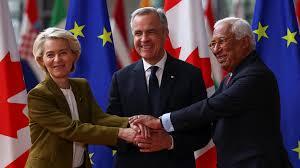
The accelerating transformation of the international environment, the rise of geopolitical competition, and the erosion of some pillars of the liberal global order have raised fundamental questions about the future of the European Union, the limits of its expansion, and the nature of its political and legal identity. Among these questions is one that was once regarded as a remote theoretical proposition but is now being discussed with greater seriousness: could Canada become a member of the European Union?
At first glance, the idea may appear unrealistic given the geographical distance between the two sides and the traditional association of the Union with the European continent. Yet a careful legal and political reading reveals a more complex reality. The concept of “Europe” itself is neither fixed nor closed; rather, it has historically been shaped by political, legal, and civilizational interpretations as much as by geography.
First: Europe’s Boundaries Between Geography and Law
Article 49 of the Treaty on European Union states that any “European State” that respects the Union’s values and is committed to promoting them may apply for membership. However, while procedurally clear, the treaty offers no definitive definition of what constitutes a “European State,” nor does it precisely determine where Europe begins or ends.
This open-textured formulation is not a minor legal detail. It reflects the historical reality that the borders of Europe have never been entirely natural or immutable, but rather the result of accumulated political, cultural, and military developments. The European Union itself already extends, through overseas territories belonging to members such as France and Netherlands, into regions outside continental Europe, including territories in the Pacific Ocean and the Caribbean.
Accordingly, membership is not determined by geography alone. It also involves questions of political identity, commitment to democratic values, and the institutional and economic capacity to integrate.
Second: Canada as a European Partner Without Membership
Over recent decades, relations between Canada and the European Union have developed beyond conventional partnership. The Comprehensive Economic and Trade Agreement (CETA), signed in 2016 and provisionally applied since 2017, established one of the most advanced frameworks of cooperation between the Union and a non-member state.
The agreement eliminated most tariffs, expanded investment opportunities, opened public procurement markets, and introduced advanced provisions concerning labor rights, environmental protection, and trade dispute settlement. As a result, Canada has become partially integrated into the European economic and regulatory sphere to a degree exceeding that of many external partners.
This level of interdependence makes Canada, in practical terms, a partner closely aligned with the European system, even while remaining outside its formal institutions.
Third: Would Canada Meet the Conditions of Membership?
Under the Copenhagen Criteria, any aspiring member state must possess stable democratic institutions, a functioning market economy, and the capacity to implement EU law and assume the obligations of membership.
In theoretical terms, Canada would face little difficulty in satisfying these requirements. It is a stable democracy with a strong rule of law, effective institutions, and an advanced economy. Its regulatory and legal frameworks already overlap with European standards in numerous sectors.
Moreover, Canada’s cultural and linguistic composition arguably places it closer to Europe than many other Western powers. It is a bilingual federation built around English and French, two languages central to the European public sphere, in addition to sharing constitutional and institutional traditions with Western Europe.
Fourth: The Practical Obstacles to a Canadian Scenario
Despite the theoretical appeal of the idea, turning it into a practical process would face major obstacles. The first is geography: the Union has never admitted a state located entirely outside the conventional European space. Accepting Canadian membership could also create precedents for other closely aligned countries to make similar claims.
The second obstacle concerns internal European balances. Many member states remain cautious even about further enlargement within the Balkans and Eastern Europe, let alone expansion across the Atlantic. This caution is reinforced by existing challenges related to migration, energy security, defense, and economic disparities among members.
The third obstacle lies on the Canadian side itself. Canada is deeply integrated economically and strategically with the United States within the wider North America framework, making any strategic shift toward full European membership politically and economically complex.
Fifth: What Does This Debate Reveal About the EU?
The real significance of this debate lies less in whether Canada could join tomorrow or in ten years, and more in what it reveals about the nature of the European Union itself. Is the Union merely a geographical regional bloc, or is it a political and normative project open to states that embrace democracy, rule of law, and socially regulated markets?
If the Union aspires to be a global normative power, then its definition of itself may become more important than its traditional geographic borders. In this sense, the Canadian case becomes an intellectual and political test of Europe’s future rather than a direct membership file.
Conclusion
In the foreseeable future, Canadian accession to the European Union does not appear to be a near practical possibility. Yet it can no longer be dismissed as legally or theoretically inconceivable. European treaties do not entirely close the door, and bilateral relations have reached an unprecedented level of closeness.
More importantly, this hypothetical scenario highlights a deeper question: what is Europe in the twenty-first century? A geographical continent, or a political space built upon shared values and institutions? The answer to that question may shape the Union’s future more profoundly than any upcoming enlargement negotiations.
Most read



Read also