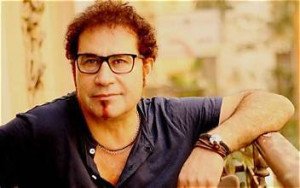

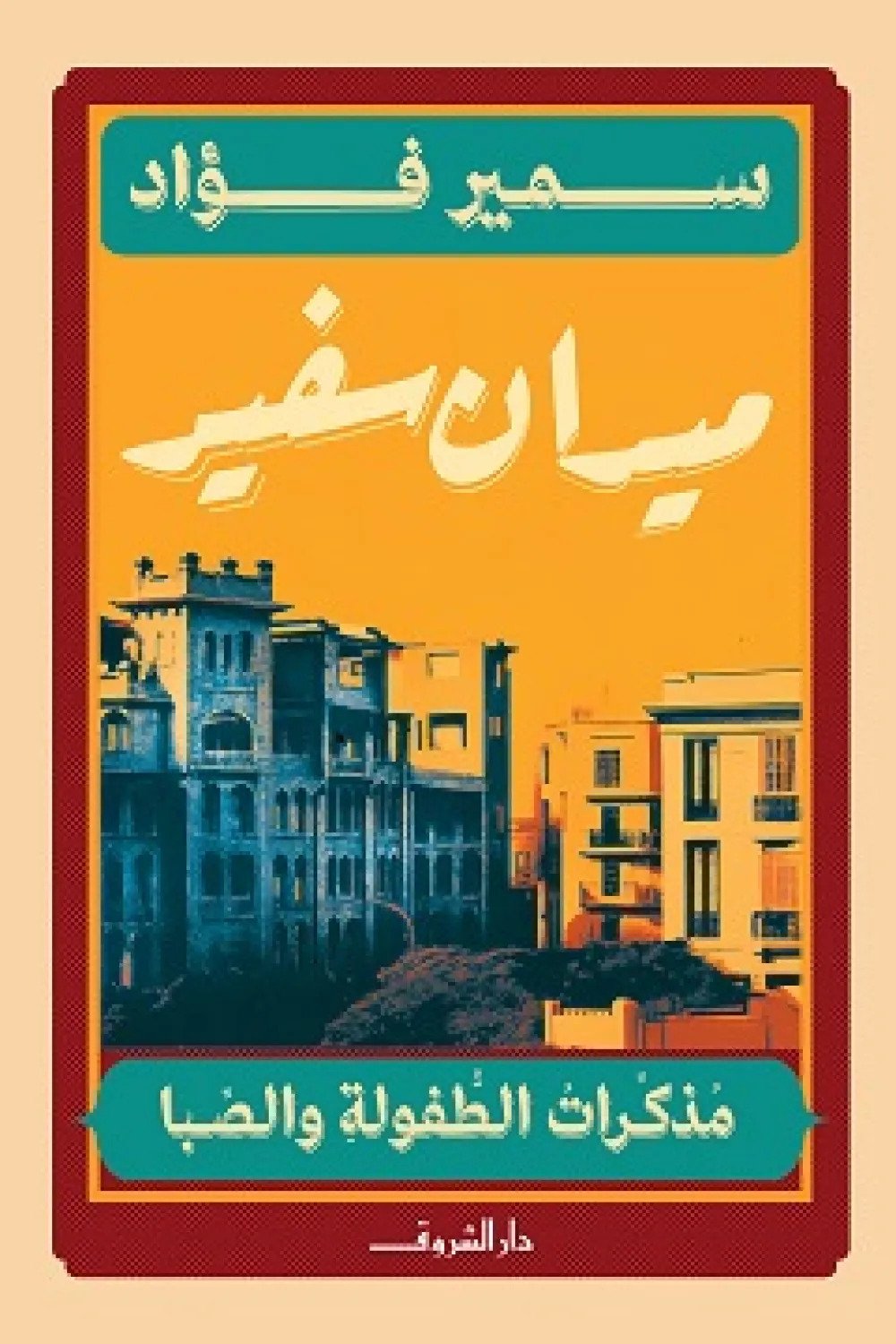
For Egyptian visual artist Samir Fouad, memory is not merely a recollection of events that have passed, nor simply an attempt to return to childhood as a personal stage of life. It is closer to an artistic act through which he reconstructs an entire world—with its details, people, places, and emotions. In his book Midan Safir: Memoirs of Childhood and Adolescence, published in Cairo by Al-Shorouk, Fouad revisits the years of his upbringing from the balcony of his apartment overlooking the square, offering a panoramic portrait of a time when beauty was an integral part of everyday life, before the city's features changed and its growing noise overwhelmed its former tranquility.
From the same balcony where he was born in 1944, the artist looks out over Midan Safir in Heliopolis, not merely as a geographical location, but as the focal point of an entire memory. In his narrative, the place carries the faces of people, the sounds of the streets, the scents of gardens, the lights of shops, the movement of the metro, and the cinemas, while also bearing the marks of the transformations that have reshaped both the city and society.
In that memory, the streets were open spaces where children could play, while public transportation offered them the opportunity to discover the city without the fear that often defines later generations' relationship with public space. Cinema, meanwhile, was more than a screen showing films. It was a social ritual around which families gathered, an occasion for entertainment and social interaction, and an integral part of Cairo's rhythm of life.
Yet these memories are not a romantic escape detached from history. Fouad's recollections also contain moments of turmoil and violence, most notably the events of 1952, when the Cairo Fire erupted in January, followed by the Free Officers' Revolution in July, ushering Egypt into a new historical phase that profoundly affected both society and the image of the city itself.
When Cairo Burned
One of the book's most powerful scenes begins with the moment when Samir Fouad's father returned home from work earlier than usual and told the family: “They are burning downtown!”
The young boy could not fully comprehend the scale of what was happening, but the scene remained imprinted on his memory, particularly as reports continued to arrive about cinemas, hotels, and shops burning in the heart of Cairo. His father was anxious to check on his daughter's husband, “Soso,” and on his shop on Emad El-Din Street, especially because the shop's name contained the word “Danish,” which might suggest that its owner was among the foreigners who were associated with some of the targets during the unrest.
Martial law was imposed after the fire, shops closed their doors, and the metro stopped operating after sunset, while people were still allowed to go out. But what remained in the father's memory was not merely the security measures. It was the sight of downtown Cairo, a place where he had spent many years and which had suddenly been transformed.
He mourned the destruction of the Shepheard Hotel and the loss of Groppi on Adly Street, one of his favorite places. Yet his deepest sadness was reserved for the Rivoli Cinema, where the family used to spend winter evenings. The cinema was not simply a building in which films were shown; it was part of a social life in which family members gathered and later sat together in the tea lounge on the first floor.
Here lies one of the central ideas running through the book: places do not disappear only when their buildings are demolished. They also disappear when our relationship with them—and with the memories that made them part of our lives—is severed.
The Night of the Suez War
A few years later came another experience that would remain deeply etched in the artist's memory: the Tripartite Aggression against Egypt in 1956, following the nationalization of the Suez Canal.
The atmosphere across the country was charged with enthusiasm and mobilization. Radio broadcasts and newspapers followed developments with a constant sense of urgency, while Fouad's father was among those enthusiastic about Gamal Abdel Nasser and his confrontation with Britain. The children, meanwhile, experienced the events with varying degrees of awareness. Some remained preoccupied with their ordinary lives, while others were swept along by the prevailing patriotic fervor.
For Samir Fouad, however, the war soon ceased to be something heard about on the radio and became an intensely physical experience.
His cousin, Ragaa Bakry, was visiting the family, and everyone was sitting in the western room overlooking Midan Safir. Autumn had arrived, the season of outdoor cinemas had ended, and the Riviera Cinema had closed its doors. Outside the window, the square lay in stillness beneath the scattered lights of the surrounding shops.
Then the silence was suddenly shattered.
Air-raid sirens began to sound, followed by the noise of aircraft overhead. Anti-aircraft guns opened fire, and the sky filled with the lights of illumination flares dropped from the planes. Soon afterward, explosions shook the house.
Almaza Airport, located nearby, was among the principal targets, making the source of the explosions seem frighteningly close to the family. The sky illuminated the square in flashes resembling lightning, followed moments later by explosions so powerful that the house shook violently, as though its walls themselves were about to collapse.
At such moments, war ceases to be an abstract political event. It becomes a sound, a light, a vibration, and a fear—and turns into an image that can remain in the memory for decades.
A School That Shaped Taste
Yet Midan Safir is not merely a book about wars and political events. Perhaps the most significant part of Samir Fouad's memory lies in the everyday life that shaped his cultural and artistic identity.
He recalls schools housed in historic palaces and teachers who were far more than transmitters of information. They were figures who helped shape their students' intellectual and artistic sensibilities and opened new windows onto the world.
His art teacher was capable of identifying emerging talent, encouraging it, and introducing students to international art. His language teacher expanded his cultural horizons to the point of leading him to Abbas Al-Aqqad's literary salon. His music teacher, meanwhile, transformed the music lesson into something that went beyond notes and melodies, making it part of the students' emotional formation.
This aspect of the memoir highlights the role of the school as an institution that shapes personality, rather than merely providing instruction. A teacher who possesses culture and the ability to inspire can alter the course of a student's entire life, even if neither realizes at the time the magnitude of the influence being exerted.
The Cairo That Once Was
Throughout the book, Heliopolis emerges as a model of a different kind of city. Its Art Deco architecture, Baron Empain Palace, gardens, streets, cinemas, and shops form a single portrait of a lifestyle that, in the author's recollection, was more balanced and tranquil.
Yet the importance of these details lies not simply in documenting architectural or social beauty. They also create an implicit comparison between two images of the city: the one Fouad experienced during his childhood and adolescence, and the one he sees in the present, after profound urban, social, and cultural transformations have altered its character.
Memory therefore becomes a form of resistance to forgetting. When places change rapidly, memory can become an alternative archive, preserving what buildings alone cannot retain.
A Meeting with Al-Aqqad
Perhaps one of the most revealing chapters of the book is Samir Fouad's encounter with Abbas Al-Aqqad, reflecting the cultural environment in which he grew up.
As a teenager, Fouad had begun reading widely across science, philosophy, and literature, but Al-Aqqad occupied a special place in his intellectual development. He was fascinated by the writer's style and his ability to employ logic in defending his arguments. By the late 1950s, circumstances allowed him to attend Al-Aqqad's weekly salon while he was still a secondary-school student.
The opportunity came through his French-language teacher, Abdel Wahab El-Masry, who recognized his student's fascination with Al-Aqqad's writings. Rather than simply discussing the books with him, the teacher promised to take him to the writer's weekly Friday morning gathering.
Fouad's excitement grew after he had read Al-Aqqad's book In My House, in which the writer described his home, books, and paintings. The young reader wanted to see with his own eyes the place he had encountered through words and compare Al-Aqqad's literary description with reality.
He and his teacher went to Al-Aqqad's home on Shafik Ghorbal Street in Roxy Square, in a beautiful building that still stands today, although it suffers from neglect rather than being preserved as a museum or cultural landmark commemorating its former resident.
Al-Aqqad occupied the entire first floor. The young visitor entered a spacious hall with a reception room on the right, where Al-Aqqad sat at the head of the room. The writer shook their hands without appearing surprised by the young age of his new visitor, while several of his followers sat nearby and discussions unfolded across a range of subjects.
For Fouad, the visit was an extraordinary experience. He was seeing, in person, the writer whose works he had spent so much time reading, inside his own world, surrounded by books, paintings, and people engaged in intellectual discussion.
On one occasion, he brought one of his paintings with him to show Al-Aqqad, who was known for his interest in art criticism. Fouad no longer remembers the details of the writer's response, recalling only that it was a general comment.
What intrigued him even more, however, was Al-Aqqad's home itself. He was free to move around, discovering bookshelves scattered throughout the rooms. He wondered how Al-Aqqad managed to find the book he wanted amid such abundance, particularly since he could see no obvious signs of a classification system.
The walls were decorated with a collection of paintings, including two portraits of Al-Aqqad by Salah Taher: one a large oil painting and the other a side-profile portrait in pastel. Another painting caught the young visitor's attention: a slice of cake with a fly standing on it. According to Al-Aqqad's own account, the painting was connected to an unsuccessful romantic relationship with the artist Madiha Yousry, which inspired his only novel, Sarah.
The Book as an Act of Resistance
Ultimately, Samir Fouad's memoirs are more than a personal recollection of childhood and adolescence. They are an attempt to reconstruct a world through the small details that usually disappear from the grand narratives of history.
Official histories tend to focus on revolutions, wars, and political decisions, while personal memory preserves something far more intimate: a cinema the family used to visit, a shop on an old street, a teacher who discovered a talent, a book that led a young reader to a literary salon, a balcony overlooking a square, or a wartime night that shattered the tranquility of autumn.
From these details emerges a portrait of Cairo as experienced by an entire generation—not merely as recorded in history books.
This is why Fouad's return to the past is more than nostalgia. It is an attempt to protect memory from erosion and to preserve what remains of a city that continues to change. An artist who turns the world into paintings finds in writing another way of painting: he paints with words the places that have changed, the faces that have disappeared, and the sounds that have faded, giving them another chance to survive.
In this sense, Midan Safir is not simply a square in Cairo, nor merely the title of a book about an artist's childhood. It is a point at which personal memory intersects with the memory of a city, transforming an individual memoir into a testimony to an entire era.
When Samir Fouad recalls that world, he is not necessarily claiming that the past was perfect or free of crises. Rather, he reminds us that cities possess souls shaped by the details of everyday life, and that losing those details can be no less significant than losing the buildings themselves.
That is why writing becomes an act of resistance: resistance to forgetting, resistance to reducing history to simplified narratives, and an attempt to restore the image of a city that remains alive in memory, even as its physical features continue to change.
Most read