Transformations of the U.S.–Japan Alliance in a Changing Strategic Environment

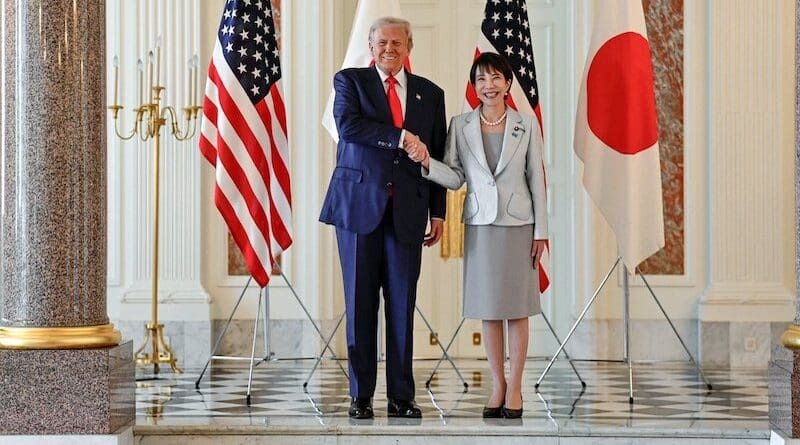
The alliance between the United States and Japan has represented one of the most important pillars of the security architecture in East Asia since the signing of the mutual defense treaty between the two countries in 1952. This alliance has played a crucial role in maintaining the regional balance of power, particularly in confronting growing security challenges posed by China and North Korea. With Donald Trump’s return to the White House, questions have emerged regarding the future of this alliance and whether the new administration’s policies will maintain the trajectory of military and strategic cooperation or reshape it in light of evolving U.S. foreign policy priorities.
This article aims to analyze the nature of transformations in U.S.–Japan relations under the second Trump administration, focusing on three main dimensions: security and military cooperation, the regional environment and geopolitical challenges, and finally the economic and trade tensions between the two countries.
Despite political rhetoric that has occasionally cast doubt on U.S. commitments to its allies, the second Trump administration has largely maintained initiatives launched during the Biden administration to strengthen the military alliance with Japan. The process of reorganizing U.S. forces in Japan has continued, including the development of a joint command structure aimed at improving operational coordination with the Japan Self-Defense Forces.
These developments come amid an increasingly complex regional security environment, in which the United States and Japan seek to deepen their military integration in order to address strategic challenges, particularly China’s expanding military capabilities and North Korea’s missile tests.
At the same time, Japan has begun reassessing its traditional defense doctrine. The Japanese government has announced plans to increase defense spending to around 2% of GDP by 2027, while accelerating this target to 2026 in response to escalating regional threats. Tokyo is also seeking to develop limited offensive capabilities, including acquiring long-range missiles such as the U.S. Tomahawk system to enhance what is described as a “counterstrike capability.”
These developments indicate a gradual shift in Japan’s defense policy, as Tokyo aims to assume a greater security role within the alliance with the United States rather than relying solely on its traditional defensive posture.
Geopolitical Challenges in East Asia
China’s rise remains the most influential factor shaping the nature of the U.S.–Japan alliance. Growing tensions in the East China Sea, along with the potential for escalation over Taiwan, have prompted both countries to strengthen their strategic coordination.
Japan–China relations experienced notable tensions after statements by Japanese Prime Minister Sanae Takaichi suggesting that a potential Chinese attack on Taiwan could pose a direct threat to Japan’s survival. In response, Beijing adopted a series of economic and political countermeasures against Tokyo, including bans on Japanese seafood imports and restrictions on exports of critical minerals.
More broadly, this escalation reflects a growing recognition in Tokyo that Japan’s national security is closely linked to the strategic balance in the Taiwan Strait.
In addition, trilateral relations between the United States, Japan, and South Korea have expanded significantly in recent years. The three countries have strengthened security cooperation through mechanisms such as real-time missile warning data sharing regarding North Korea and conducting joint multi-domain military exercises. This growing cooperation reflects an effort to build a more cohesive regional deterrence framework in response to shared security challenges.
Economic and Trade Tensions
Despite strong security ties, economic relations between the United States and Japan are not without tension. The Trump administration has adopted a more protectionist trade policy, imposing tariffs on several trading partners, including Japan.
Under a bilateral economic framework announced in 2025, the United States imposed a 15% tariff on most imports from Japan—lower than the initially proposed 25% but still higher than tariff levels in 2024. The U.S. administration also imposed additional tariffs on key sectors such as steel and automobiles, raising concerns within Japanese industries.
In return, Japan committed to increasing purchases of U.S. agricultural products, aircraft, defense equipment, and energy resources, while also pledging to invest up to $550 billion in strategic sectors within the United States, including semiconductors, energy, artificial intelligence, and critical minerals. This arrangement aims to strengthen joint supply chains and reduce reliance on China in sensitive industries.
Despite ongoing military and economic cooperation between the two countries, certain U.S. policies have raised concerns in Japan regarding the reliability of the United States as a long-term security partner. U.S. tariffs, along with what some perceive as limited American support for Japan in its tensions with China, have prompted Japanese policymakers to question the future direction of U.S. policy toward its allies.
Nevertheless, strategic imperatives in the Asia-Pacific region make a significant weakening of the alliance unlikely, particularly given the shared security challenges and deep economic interdependence between the two countries.
Overall, current developments suggest that the U.S.–Japan alliance under Trump’s second administration combines two seemingly contradictory dynamics: strategic continuity on the one hand and economic and political tensions on the other. While military cooperation continues to expand in response to regional challenges, U.S. trade policies and mixed political signals may raise concerns in Japan about the future reliability of American commitments to its allies.
Nevertheless, shared security interests—particularly in confronting China’s rise and North Korea’s threats—are likely to remain the decisive factor in sustaining the strength of this alliance in the coming years.
Most read