
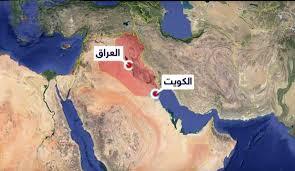
Iraq’s decision to deposit its maritime maps and coordinates with the United Nations represents a political moment that goes beyond a purely procedural step. It signals the reactivation of a boundary file that had, for years, remained under quiet diplomatic management between Iraq and Kuwait. The issue is not merely about navigation lines or technical coordinates; rather, it touches the core of a relationship reshaped after the Gulf War and rebuilt on international decisions intended to close the border dispute permanently.
Since the adoption of UN Security Council Resolution 833 in 1993, the land borders between the two countries have been firmly established within a binding international framework, sending a clear message that the era of revisiting territorial sovereignty had ended. However, leaving certain maritime files for bilateral handling created a latent legal space that remained dormant until Baghdad revived it through a unilateral move. This, in turn, resurfaced long-standing Gulf concerns about the potential politicization of borders whenever Iraq’s internal circumstances shift.
Strategically, Gulf states view any unilateral action on sovereignty-related issues as a sensitive precedent in a region whose modern history has seen border disputes escalate into direct military conflict. The 1990 Gulf War remains the clearest example of how territorial disagreements can spiral into comprehensive wars that reshape regional security for decades. Since then, consolidating borders and respecting international rulings has become a cornerstone of Gulf security doctrine.
This explains the swift and comprehensive Gulf response — not merely as support for Kuwait, but as a preemptive political and legal deterrence mechanism. The Gulf Cooperation Council, established in 1981 amid rising regional threats, operates on the principle that any infringement on a member state’s borders affects the collective security of the bloc. This unity was evident in the synchronized statements issued by Saudi Arabia, the United Arab Emirates, Qatar, Bahrain, and Oman, all reaffirming respect for sovereignty and adherence to international law.
The issue carries particular strategic weight for Saudi Arabia because the disputed maritime area borders the Saudi–Kuwaiti Divided Zone, a region of significant economic and strategic value. Covering approximately 5,770 square kilometers on land and at sea, the zone has been jointly administered since the 1922 agreement and hosts major oil fields such as the onshore Wafra field and the offshore Khafji field. Combined production capacity can reach nearly 500,000 barrels per day at full operation, making any legal ambiguity over its maritime extensions a direct concern for energy security.
Beyond hydrocarbons, the dispute is tied to maritime security in the northern Gulf, where shipping routes serve Iraqi and Kuwaiti ports. Roughly 20 percent of global oil trade passes through the Gulf and the Strait of Hormuz, while Iraqi ports such as Umm Qasr and the developing Grand Faw Port depend heavily on the stability of maritime corridors in Khor Abdullah. Any unresolved legal dispute could raise maritime insurance costs and undermine investment attractiveness in port infrastructure projects.
Accordingly, the Gulf approach does not stem from a narrow sovereignty lens but from a broader economic security perspective that treats border stability as a prerequisite for growth and investment. The combined GDP of Gulf economies exceeds two trillion dollars, relying on a low-risk regional environment to attract foreign capital and implement large-scale transformation agendas such as Saudi Vision 2030.
On the Iraqi side, the move cannot be separated from domestic political dynamics. The 2023 ruling by Iraq’s Federal Supreme Court annulling parliamentary ratification of the Khor Abdullah navigation agreement on constitutional grounds reopened debate over treaty approval mechanisms. This provided a legal platform for revisiting certain maritime arrangements and fueled a sovereignty narrative calling for reassessment of agreements perceived as having been concluded under exceptional political pressure.
Sovereignty and borders also carry symbolic weight in Iraqi political discourse, particularly amid economic hardship and social pressures. With oil revenues accounting for over 90 percent of public income, any file linked to maritime domains and potential resources becomes politically sensitive.
Nevertheless, Baghdad’s diplomatic language — emphasizing dialogue and reliance on the 1982 UN Convention on the Law of the Sea — reflects clear awareness of the costs of escalation. Iraq is currently seeking deeper economic integration with the Gulf, including electricity interconnection projects and Saudi and Emirati investments in energy and agriculture. Stable relations with Kuwait are also essential for facilitating trade flows through Gulf ports.
Thus, the Iraqi move can be interpreted as a legal and political test of available margins within the international framework rather than a prelude to open confrontation — an attempt to reinforce an internal sovereignty narrative while maintaining a low diplomatic ceiling that avoids a broader regional crisis.
Geopolitically, the issue gains further complexity amid the region’s shifting alignments. The past decade’s sharp polarization has gradually given way to de-escalation paths and new realignments, most notably the Saudi–Iranian rapprochement and the Gulf’s expanding economic engagement with Iraq. This reflects a growing regional consensus that prolonged conflicts have drained resources and hindered development, making stability a strategic necessity.
Within this context, reopening sensitive border files between Iraq and Kuwait risks disrupting wider de-escalation efforts — not only politically but in terms of economic trust. Iraq is increasingly viewed in Gulf capitals as a strategic connector linking the Gulf with the Levant and Turkey and as a key component of regional transport and energy corridors. Any sovereignty tension with Kuwait could undermine this integration vision.
This explains the Gulf preference for swift diplomatic containment rather than public escalation. For Saudi Arabia in particular, stability along the Gulf’s northern frontier is inseparable from its broader strategic and economic transformation, which depends on a secure, dispute-free regional environment.
From a wider strategic perspective, the dispute reflects a recurring post-conflict dilemma: how internationally imposed borders evolve into fully internalized political realities. History shows that legal demarcation does not automatically translate into psychological or political acceptance by national elites. While Kuwait and the Gulf regard post-1991 arrangements as definitively closing sovereignty debates with Iraq, some Iraqi currents still view that period as one of imposed solutions under extreme imbalance.
This divergence in political memory creates recurring opportunities for reopening files whenever domestic power balances shift or nationalist rhetoric intensifies — a phenomenon observed in multiple post-conflict regions where borders were redrawn through international intervention.
Looking ahead, negotiated containment remains the most likely scenario, driven by intertwined economic interests. Iraq needs Gulf capital for infrastructure, energy, and reconstruction, while Gulf states need a stable Iraq as a market and logistical corridor for regional connectivity projects. These mutual incentives make escalation a costly option for all sides.
Practical settlement is likely to emerge through technical and legal mechanisms, including joint maritime boundary committees, official clarification of overlapping coordinates, and renewed affirmation of UN reference frameworks — preserving existing arrangements while addressing technical ambiguities.
The real risk lies not in the current episode itself but in leaving the issue unresolved over the long term. Deferred border disputes tend to resurface as political leverage during domestic crises or regional shifts, turning technical questions into periodic flashpoints. In Iraq’s case, where sovereignty intersects with intense internal competition, the likelihood of future reactivation remains high.
In conclusion, the maritime coordinates crisis is far from a purely technical matter. It is a broader test of the post-conflict order in the Gulf and Iraq alike — a test of whether internationally defined borders can become politically stabilized realities, and whether the region can manage sovereignty disputes through law and shared interests rather than recurring tension cycles.
Although all parties currently favor de-escalation, the key lesson is clear: postponed files, however technical they appear, remain latent conflict triggers when legal calculations intersect with domestic political pressures. Sustainable stability will therefore require not just managing the present dispute, but closing this boundary issue definitively in a transparent and mutually binding manner — safeguarding Gulf–Iraqi relations against future shocks.
Most read



Read also