
Tunisia is hosting, from September 21 to 24, the 26th edition of the Arab Radio and Television Festival, in an event whose significance extends beyond competition among radio and television productions to become a broader Arab and international forum for media, culture, and the audiovisual industries.
With the participation of around 500 media professionals, artists, intellectuals, experts, and industry practitioners from the Arab world, Europe, Asia, and Africa, this year’s festival appears increasingly to be a space for examining the transformations that have reshaped the content industry in recent years—from the rise of digital platforms and podcasts to the integration of artificial intelligence into newsrooms and studios, and the changing relationship between media institutions and their audiences.
Held under the theme “The Pulse of the Image and the Echo of the Future,” the festival captures, in condensed form, one of the central dilemmas confronting contemporary media: how can institutions that emerged in the age of mass broadcasting adapt to an era in which everyone can produce images, while the production of sound, text, and video has become increasingly accessible, and platforms and algorithms have emerged as new intermediaries between content and audiences?
From this perspective, the importance of the festival lies not only in the number of participants or competing works, but also in its role as a space where the memory of Arab media intersects with questions about its future.
From a Production Festival to a Forum on Media Transformation
For more than four decades, the festival was primarily associated with competition among Arab radio and television productions. Yet changes in the communication environment have gradually expanded its functions, transforming it into a forum that brings together media, culture, technology, and the audiovisual industries.
This transformation is not merely an organizational detail. It reflects a fundamental change in the nature of the industry itself.
Radio is no longer confined to the traditional receiver, and television is no longer tied exclusively to the household screen. Content now moves across smartphones, digital platforms, social networks, and on-demand services, while media production increasingly intersects with technology, data, and artificial intelligence.
The festival itself therefore reflects the transformation of the concept of “media.” It is becoming increasingly difficult to draw clear boundaries between journalism and audiovisual production, between television and digital platforms, or between media producers and users, who are now capable of creating and distributing content and reaching large audiences without necessarily passing through traditional media institutions.
320 Works and a Test of Industry Transformation
The current edition features a competition involving 320 media works, including 161 radio productions and 149 television productions, in addition to 10 works in the new media competition associated with the use of artificial intelligence technologies.
These competitions retain the festival’s traditional function as a space for observing trends in Arab production across drama, programming, radio, and television. Yet the inclusion of new media and artificial intelligence carries a broader significance.
The festival is no longer simply evaluating what traditional media institutions have produced. It is also raising a more fundamental question: How should content be evaluated in an environment where the tools of production themselves are changing?
Media work that once required studios, sophisticated equipment, and large teams can now be produced, at least in part, using widely accessible digital tools. Artificial intelligence technologies can assist with writing, image generation, audio production, translation, editing, and the adaptation of content for multiple platforms.
This is therefore not merely a technological race. It is becoming a cultural and professional question concerning the boundaries of human creativity, the nature of media work, standards of originality, intellectual property rights, and responsibility for content.
Artificial Intelligence: When Technology Becomes an Ethical Question
The introduction of artificial intelligence into the new media competition may be one of the clearest indicators of the transformation currently taking place across the sector.
New technologies provide institutions and individuals with unprecedented capabilities in terms of production speed and the diversity of content formats. At the same time, however, they raise questions that have never been posed with such urgency.
Who is responsible for material produced by an automated system?
How can the authenticity of an image, audio recording, or video clip generated or modified using artificial intelligence be verified?
Where does legitimate adaptation end and intellectual property infringement begin?
And how should the industry distinguish between creative work that uses AI as an assisting tool and content whose production depends primarily on automated systems?
These questions concern more than media institutions. They also affect the broader culture of public communication because images and sounds can no longer necessarily be treated as reliable witnesses to reality in the way they were assumed to be at earlier stages of media history.
The inclusion of AI in the competition can therefore be understood as an acknowledgment that the future of media will not be determined solely by institutions’ ability to acquire technology, but also by their capacity to establish professional and ethical standards for its use.
Podcasts: The Return of Sound in a New Form
One of the striking paradoxes of digital transformation is that technologies once expected to marginalize traditional audio media have contributed to the emergence of new forms of audio content.
One of the festival’s main discussions focuses on “Podcasting: Content Trends and the Power of Influence,” reflecting the growing importance of digital audio content.
Yet podcasts are not simply digital versions of radio.
The fundamental difference lies in the relationship with the listener. Traditional radio operates according to a fixed broadcasting schedule, while podcasts allow audiences to listen on demand, give producers greater room for specialization and long-form storytelling, and make it possible to reach geographically dispersed audiences beyond the limits of conventional broadcasting.
Lower production and distribution costs have also opened the door to independent producers who might previously have had little opportunity to reach large audiences.
This raises a cultural question that goes beyond technology: Are we witnessing a return to the age of sound, but under entirely new conditions?
Perhaps this is not a return to radio as it once existed, but rather a rediscovery of the potential of sound in an increasingly crowded visual environment.
Audiences Are No Longer Merely Recipients
If podcasting represents a transformation in the relationship between audiences and sound, the festival’s second major discussion, “Audiences and Content Production: From Reception to Partnership,” addresses one of the most significant changes produced by the digital environment.
Audiences, once positioned at the end of the communication process, have now become part of that process.
Users select content, comment on it, share it, extract portions of it, add to it, and may create new content based on it.
In many cases, audiences themselves have become sources of news, photographs, and video footage, particularly during sudden events or in locations that professional media organizations cannot reach quickly.
This transformation requires media institutions to rethink the very concept of the audience.
It is no longer sufficient to know how many people watched or listened to a program. Institutions increasingly need to understand audience behavior, the reasons behind participation, levels of trust, preferred platforms, and the ways in which audiences reproduce and circulate content.
The challenge, therefore, is no longer simply reaching audiences, but building a sustainable relationship with them in an environment where they can move among dozens of content sources within minutes.
Tourism Media and the Construction of Place
The third major discussion, “Tourism Media: From Reporting the Event to Creating the Destination,” opens another cultural dimension concerning the image of cities, countries, and cultures.
Tourism is no longer promoted solely through brochures and conventional advertising. Digital imagery, storytelling, short-form video, influencers, and social platforms have become integral to the construction of a destination’s image.
Media thus moves from merely transmitting tourism information to participating in shaping audiences’ perceptions of places and cultures.
An archaeological site, for example, does not simply speak for itself. The image captured of it, the story told about it, and the way it is placed within a cultural and tourism context all contribute to the meaning audiences attach to it.
From this perspective, tourism media intersects with cultural diplomacy, as it participates directly or indirectly in presenting countries, their heritage, and their everyday cultural life.
From Media to Knowledge
The significance of the festival does not end with the competing works. Its intellectual and professional program places knowledge and expertise at the center of the event.
This dimension is particularly important in an industry where required skills are changing at an accelerating pace.
Journalists, presenters, directors, and producers no longer work solely within the boundaries of traditional professional specialization. They increasingly need to understand digital platforms, data, algorithms, audience behavior, digital production tools, and content-distribution strategies.
Developing a competitive media industry, therefore, is not simply a matter of purchasing modern equipment. It also requires building human capital capable of using technology creatively and professionally.
Here, festivals and professional conferences can play a role that goes beyond showcasing and competition to include knowledge transfer, networking, collaboration, and skills development.
The Chinese Presence: Expanding the Cultural and Technological Field
The program also includes activities related to cooperation in the audiovisual industries between China and Arab countries, alongside discussions on creativity and Arab–Chinese cooperation.
This component adds an important international dimension to the festival. Knowledge exchange is no longer confined to Arab institutions or to traditional European and American media models.
Engagement with the Chinese experience provides an opportunity to explore different approaches to production, distribution, and technology, while exposing Arab media industries to a massive media ecosystem that has developed within a distinct technological and cultural environment.
In this context, media and cultural cooperation could become an entry point for broader knowledge and technological exchange rather than simply an avenue for exchanging programs and productions.
Technology at the Heart of the Industry
At the industrial level, the ASBU exhibition of technology and equipment represents another important dimension of the festival.
According to the figures provided in the report, the exhibition brings together 85 exhibitors from five continents across 110 stands, alongside a program market and professional meetings.
This dimension demonstrates that modern media is no longer simply a content industry. It has become an integrated technological industry.
Cameras, studios, broadcasting systems, archiving technologies, platforms, computing infrastructure, editing tools, and digital solutions have all become interconnected components of the media-production ecosystem.
Specialized exhibitions provide Arab institutions with opportunities to explore new technologies, but they also perform another important function: bringing technology providers into direct contact with content producers and decision-makers within media organizations.
The future of the audiovisual industry will therefore depend to a considerable extent on institutions’ ability to connect technological investment with investment in content and human resources.
Culture and the Arts: The Memory That Keeps Media from Becoming Purely Technological
Amid the festival’s strong emphasis on technology, it retains its cultural and artistic dimension.
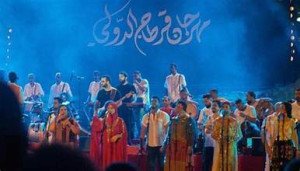
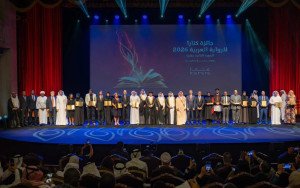
The opening ceremony, held at the historic Carthage Theatre, features the honoring of 12 artistic and media figures from nine Arab countries. This is a reminder that technological development does not diminish the value of the experiences that shaped the history of Arab media and culture.
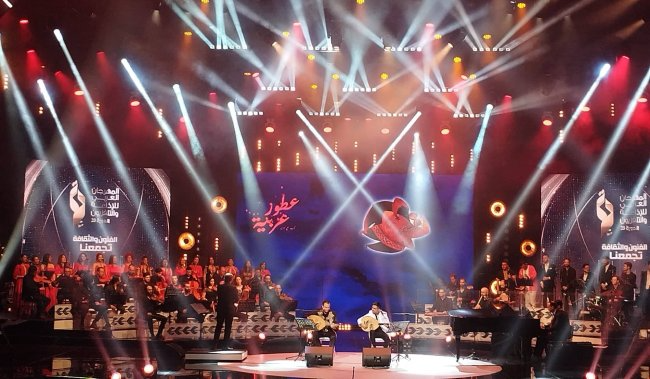
The closing ceremony at the Opera Theatre in the City of Culture will include the announcement of competition results, as well as a performance of “Travel to Yourself and Sing” by Tunisian composer Karim Thleibi.
The festival’s activities are distributed across the historic Carthage Theatre, the Mediterranean city of Yasmine Hammamet, and the City of Culture in Tunis, connecting the event with some of Tunisia’s most prominent cultural and tourism spaces.
This highlights the importance of place within the festival. Its events are not being held in culturally neutral functional spaces, but in locations carrying historical and cultural memory, adding a visual and symbolic dimension to the media event itself.
When Media Begins to Debate Its Own Future
Perhaps the deeper value of the 26th edition lies in the fact that it does not treat media as a stable industry that merely needs to upgrade its tools. Instead, it approaches media as a field whose very definition is being continuously reshaped.
The competition is no longer simply between radio and television stations. Traditional institutions now compete with global platforms, social networks, influencers, independent producers, and ordinary users.
At the same time, artificial intelligence has lowered the barriers to producing text, images, and sound. What once required an entire institution and substantial investment is now accessible, to varying degrees, to individuals equipped with relatively limited digital tools.
This transformation raises a fundamental question about the role of the media institution.
If content production has become accessible to almost everyone, what distinguishes the professional media organization?
The answer cannot be technology alone, because technology is becoming increasingly accessible to everyone. The real advantage may instead lie in credibility, verification, the ability to build trust, editorial distinction, cultural depth, and professional responsibility.
From “The Pulse of the Image” to “The Echo of the Future”
The festival’s theme, “The Pulse of the Image and the Echo of the Future,” takes on a broader meaning in light of these transformations.
The image is no longer merely a means of transmitting reality. Sound is no longer simply a broadcasting tool. Audiences are no longer passive recipients. And technology is no longer merely equipment operating in the background.
Every element of the media process is being reshaped.
The 26th Arab Radio and Television Festival can therefore be understood as a space for dialogue between two eras: an era shaped by radio, television, and major professional institutions, and a new era emerging around digital platforms, podcasts, artificial intelligence, and interactive content.
With around 500 participants from the Arab world, Europe, Asia, and Africa, 320 competing works, and dozens of exhibitors and companies, Tunisia becomes, for four days, a kind of compact cultural and professional laboratory in which the experience of the past intersects with the tools of the future.
Ultimately, the question raised by the festival is not simply whether radio and television can keep pace with the digital age. It is whether Arab media can redefine its cultural and intellectual role in a world where possessing the tools of publication is no longer sufficient to create influence.
The future will not necessarily belong to those who possess the most advanced camera or the fastest algorithm. It may instead belong to those capable of transforming technology into meaningful content, preserving trust at a time when machines are increasingly capable of producing images and sounds, and making culture and knowledge essential components of the new media landscape.
Most read