Chinese President Xi Jinping’s expected visit to Washington carries significance that extends well beyond the traditional agenda governing U.S.–China summits. Although trade, artificial intelligence, technology security, semiconductor supply chains, and strategic issues such as Taiwan are expected to dominate the discussions, one of the most sensitive dimensions of the visit lies within China’s domestic political landscape.
According to the report, Xi’s visit comes at a time when China is entering a new phase of internal personnel arrangements within the Chinese Communist Party, as the country approaches its next national party congress. Against this backdrop, the image Xi projects upon his return from Washington may become more than a matter of diplomatic protocol. It could serve as an important instrument for reinforcing his position as the leader capable of managing China’s relations with the world’s leading power from a position of strength.
The possibility of Xi remaining party leader for an unprecedented fourth term has attracted considerable international attention. Yet the more complex issue concerns how the political transition and personnel arrangements within the system will be managed. A successful summit—or even a high-level reception in Washington—could therefore carry domestic political value, allowing Xi to return to Beijing as a leader who has demonstrated his ability to manage relations with the United States effectively.
Washington as a Stage for Demonstrating Domestic Power
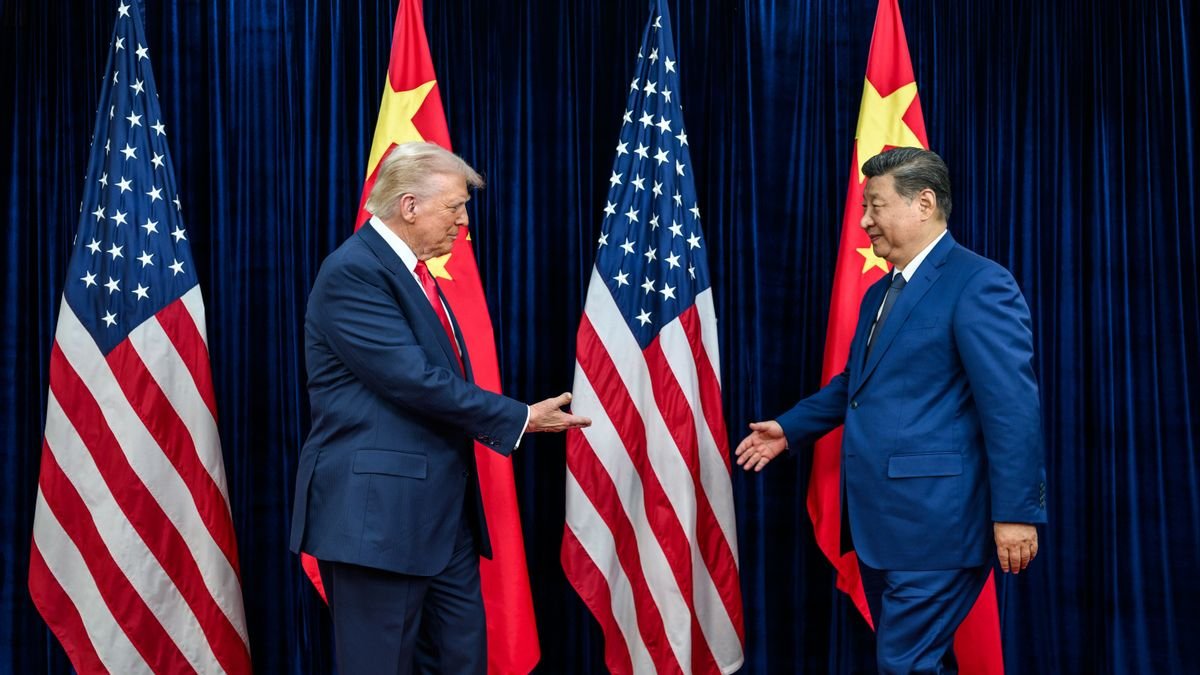
In political systems where foreign policy is closely associated with leadership authority, international summits can serve a purpose that goes beyond negotiating external interests. The appearance of a national leader alongside the president of the United States can become a domestic message about his ability to govern the country and represent its interests before a major global power.
This is one of the central dimensions emphasized in the report’s interpretation of Xi’s visit.
If the Chinese president succeeds in reaching understandings or demonstrating clear negotiating leverage during his meeting with Donald Trump, the images and footage broadcast by Chinese state media could reinforce his image as a leader capable of handling complex international issues. Foreign policy would therefore become part of the domestic equation of political authority.
The issue is not simply whether the summit produces a major agreement. It is also about how the meeting is presented to the Chinese public, party elites, and the military establishment. The diplomatic spectacle itself can become a tool for demonstrating political control at a sensitive moment of internal personnel arrangements.
The Business Delegation: Bringing Entrepreneurs Back Into the Diplomatic Spotlight
The possibility that Xi may bring a large delegation of Chinese business leaders to Washington is an important indication of Beijing’s attempt to make greater use of economic diplomacy in managing relations with the United States.
According to the report, the delegation could include senior business executives and would seek to address bilateral trade issues, including easing barriers to greater U.S. agricultural exports to China, as well as issues involving investment, energy, and trade.
The move is particularly significant given the transformation of China’s approach to the private sector in recent years. Since 2020, Beijing has undertaken a broad regulatory campaign affecting the technology, education, and real-estate sectors as part of a wider effort to strengthen state control over rapidly expanding areas of the economy.
Against this background, the appearance of a large number of business leaders alongside the Chinese president on an official visit to the United States could be interpreted as a signal that the private sector remains important in dealing with current economic pressures, even if it does not necessarily indicate a fundamental ideological shift in China’s economic model.
Indeed, the report itself notes that sending business leaders abroad appears inconsistent, in the view of some Chinese scholars, with the direction of Chinese policy over the past decade. The move may therefore reflect economic pragmatism more than a comprehensive ideological transformation.
The Economy as a Tool for Managing Tensions with Washington
Economic diplomacy cannot be separated from the broader strategic competition between China and the United States.
Amid continuing trade and technology tensions, increased Chinese purchases of U.S. agricultural products and energy, as well as Chinese investment in the United States, could serve as instruments for reducing bilateral friction.
At the same time, China possesses other bargaining tools, including rare-earth minerals and the supply chains associated with them. The report notes that some Chinese companies may be delaying deliveries of rare-earth products to the United States, making delivery schedules themselves part of the bargaining process.
The summit is therefore not taking place within a framework of purely economic cooperation. Rather, it reflects an exchange of bargaining leverage. Each side seeks to use its economic instruments to secure concessions or assurances on other issues.
This reflects the broader character of contemporary U.S.–China relations: strategic competition that does not prevent negotiations, and limited economic cooperation that does not eliminate the rivalry over technology, supply chains, and global influence.
Artificial Intelligence: From Risk Management to a Contest Over the Rules of the Future
Artificial intelligence is likely to be one of the most complicated issues on the summit agenda because it combines economic, security, and technological dimensions.
Competition between China and the United States is no longer limited to semiconductor production or ownership of advanced AI models. It has expanded to include the standards and rules that will govern the technology in the future.
Consequently, discussions about AI governance do not necessarily indicate that the two countries are close to establishing a common framework for managing technological risks. According to the report, China and the United States remain primarily engaged in a competition for technological leadership and for influence over the rules and industrial standards governing AI.
This issue is particularly sensitive because any agreement on AI could shape not only how risks are managed but also who has the authority to establish rules governing access to advanced computing, semiconductors, and sophisticated AI models.
Diverging Definitions of Technological Security
The negotiations over AI reveal a deeper divergence between the American and Chinese approaches to technological security.
According to the report, the U.S. approach focuses more heavily on risks such as uncontrolled model behavior, cyberattacks, human safety, military applications, and corporate responsibility.
China, meanwhile, incorporates concerns related to information dissemination, ideology, and the security of the ruling Communist Party into its understanding of AI governance. It places greater emphasis on national regulation and “autonomous control” of technology.
This divergence makes it difficult to construct a genuinely common governance framework because the two sides do not begin with the same definition of what “AI security” should mean.
The issue is further complicated by competition over semiconductors and advanced computing. The United States seeks to preserve its technological position, while China views access to advanced technology as an essential component of technological self-reliance.
Distillation and the Limits of Technological Understanding
One of the most complicated areas of disagreement concerns the use of American AI models by Chinese companies to train their own models, a process known as “distillation.”
According to the report, Washington argues that Chinese companies should comply with the rules governing the use of American AI models. Beijing, however, sees a contradiction in being required to comply with U.S. standards while simultaneously facing restrictions on access to advanced chips and technological services.
This dispute reflects a larger question: Who has the authority to set the rules of the global technology system?
If the United States retains significant influence over advanced semiconductors and technological services, China will continue seeking to reduce its dependence on that system. Washington, meanwhile, is concerned that uncontrolled technology transfers or access could undermine its technological advantage.
For this reason, the prospects for a comprehensive agreement on the issue appear limited, even if the two sides manage to formulate general principles for cooperation.
Taiwan: The Issue That Goes Beyond Trade and AI
If trade and artificial intelligence provide areas for negotiation, Taiwan remains a far more sensitive issue for Beijing.
The report points to concerns in Taiwan that Washington could place issues such as arms sales, official exchanges with Taiwan, and Taiwan’s security within the broader negotiating framework with China, alongside commitments related to purchases, tariffs, and AI cooperation.
These concerns reflect the exceptional sensitivity of the issue. Beijing regards Taiwan as one of the questions touching what it considers core red lines in relations with the United States.
The issue becomes even more delicate if economic negotiations coincide with new U.S. decisions on arms sales to Taiwan. The report cites sources claiming that Beijing may have threatened to cancel the summit if Washington approved new arms sales before the meeting, while reiterating that Taiwan is a “red line” in bilateral relations. The report also notes that neither China nor the United States has confirmed these claims.
Stability with Washington as a Chinese Imperative
Despite the intensity of the rivalry, the report suggests that maintaining a degree of stability in U.S.–China relations is a genuine necessity for Beijing.
This does not mean that China is abandoning its strategic objectives or changing its positions on Taiwan and technology. Rather, it reflects an understanding that uncontrolled confrontation with Washington could increase pressure on the Chinese economy, technology sector, and foreign policy.
The summit should therefore be understood as an instrument for managing competition rather than ending it.
China may seek to reduce certain forms of economic friction, preserve channels of communication, and prevent competition from escalating into levels that become difficult to control, while retaining its core bargaining leverage.
This helps explain why apparently contradictory issues can appear on the same summit agenda: trade and agricultural cooperation on one side, and semiconductors, AI, and Taiwan on the other.
At its core, this is an attempt to manage a relationship characterized simultaneously by economic interdependence and strategic competition.
The Military Dimension: The Summit as a Message to the Military Elite
The domestic dimension of Xi’s visit extends beyond the party and political sphere to the military establishment.
According to the report, the People’s Liberation Army has experienced continuing changes among its senior leadership during Xi’s third term. Against this backdrop, Xi’s ability to leave China, travel to the United States, and return with diplomatic achievements could send an additional message to the military elite.
A return from Washington with results that can be presented as a diplomatic success would reinforce Xi’s image as the central decision-maker capable of managing relations with the world’s most powerful economic and military power.
The visit would therefore become more than a foreign-policy event. It would also serve as a test of the strength of central leadership over the different political and security components of the Chinese system.
The Summit Across Three Levels of Negotiation
Xi’s Washington visit can be understood through three overlapping levels.
The first is bilateral negotiation.
This includes trade, purchases, investment, energy, tariffs, and supply chains.
The second is technological competition.
This concerns artificial intelligence, semiconductors, advanced chips, computing capacity, and regulatory standards.
The third is strategic balance.
This includes Taiwan, military stability, and the limits of competition between the two powers.
Yet there is a fourth, less openly acknowledged level: the domestic use of foreign policy.
Xi needs to manage relations with Washington, but he also needs that management to be perceived by Chinese party, military, and economic elites as evidence that he remains capable of controlling the key levers of the state.
Chinese Diplomacy Between Pragmatism and Strategic Firmness
The expected visit reflects a delicate equation in contemporary Chinese policy.
On one hand, Beijing needs economic cooperation and reduced friction with the United States.
On the other, it does not appear prepared to make major concessions on issues it considers linked to national security, technological independence, or Taiwan.
Chinese policy therefore appears closer to a form of selective pragmatism: cooperation where mutual gains are possible, bargaining where leverage exists, and firmness where issues are regarded as central to sovereignty, security, and strategic autonomy.
Washington, for its part, is also unlikely to approach China solely as an economic partner. Technology, security, and supply chains have become fundamental components of the relationship.
The summit, therefore, does not represent the end of competition. Rather, it represents an attempt to establish boundaries around it.
Conclusion: Washington as a Dual Test for Xi Jinping
Xi Jinping’s expected visit to Washington illustrates the complexity of U.S.–China relations more than it demonstrates the prospect of a comprehensive settlement.
Trade can provide room for negotiation. Artificial intelligence can open channels for dialogue over risk management. Investment and energy can provide tools for reducing tensions. But semiconductors, Taiwan, technological capabilities, and military power impose clear limits on the scope of any potential understanding.
At the same time, the visit carries domestic significance for the Chinese president. The way the summit is conducted, the level of reception Xi receives, and the nature of the results he brings back to Beijing could all become part of the political calculations surrounding personnel arrangements within the party, the state, and the military establishment.
The significance of the visit should therefore not be measured solely by whether Xi and Trump sign a major trade agreement or issue a joint statement on artificial intelligence.
The more consequential question is whether the two sides can manage their competition without allowing it to evolve into open confrontation, while Xi simultaneously uses external diplomacy to reinforce his image as the central leader capable of protecting China’s interests and managing its relationship with the United States.
In this sense, the Washington summit represents a dual test: a test of the relationship between the world’s two leading economic and technological powers, and a test of Xi Jinping’s ability to translate external influence into political authority at home.
Most read




Read also