
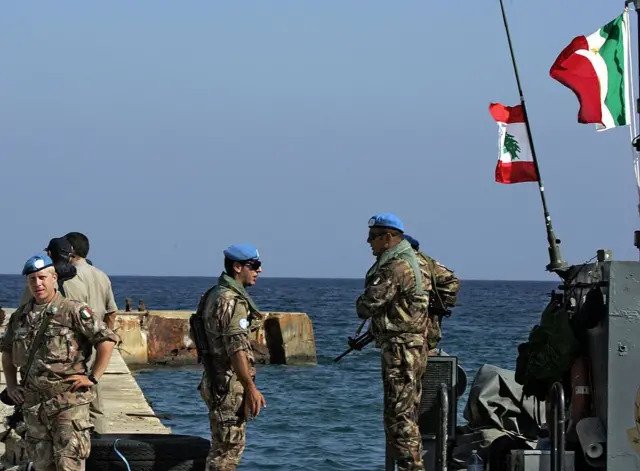
Security arrangements in southern Lebanon are entering a highly complex phase, amid the overlap of three interconnected tracks: the future of the Israeli presence in the south, the mechanism for verifying compliance with security commitments, and the future of the international role following the expiration of the mandate of the United Nations Interim Force in Lebanon (UNIFIL). The dispute over these issues appears to extend beyond the technical details concerning the composition of the force that would undertake the verification mission. Rather, it reflects a deeper disagreement over the nature of the security arrangements expected to govern the next phase and the limits of Lebanese sovereignty within them.
Available information indicates that Israel has reservations regarding three main tracks: expanding the scope of the “pilot areas,” accepting the participation of an Italian force in verification operations, and reaching a stable formula for an international presence that could partially or fully replace UNIFIL after the expiration of its mandate. If these objections persist, they may indicate an Israeli preference for retaining a broad degree of influence over the nature of the security arrangements and the mechanisms for implementing them, rather than moving quickly toward a stable framework that clearly defines the responsibilities of the parties.
The Dispute Goes Beyond the Identity of the International Force
At first glance, the current dispute appears to revolve around the nationality of the force that would participate in the verification process, particularly Israel’s objections to the proposed Italian force. However, the substance of the issue goes beyond choosing Italy, France, or any other European country.
The more important questions concern the nature of the mandate that would be assigned to the international force. Would its role be technical, limited to verifying compliance with agreed commitments? Or would it possess broader field powers, including inspections and verification of facilities and homes? Would it operate independently or in coordination with the Lebanese Armed Forces? And who would have the final say in the event of disagreements over the interpretation of the commitments?
These questions explain a significant part of the difficulty facing the negotiations. Each party is seeking, through the design of the verification mechanism, to influence the security rules that will govern the next phase.
For Lebanon, expanding the powers of any international force in a manner that directly affects the sovereign domain of the state is a sensitive issue, particularly if its role were to extend beyond verification to the exercise of executive security functions. For Israel, meanwhile, a verification mechanism that does not provide a high level of security reassurance may be viewed as insufficient to deliver the guarantees it considers necessary.
Accordingly, the current dispute can be understood primarily as a disagreement over the definition of security guarantees rather than simply over the identity of the international force.
The “Pilot Areas” and the Test of Mutual Trust
The failure to move into additional pilot areas roughly two months after the framework agreement was reached is an indication of the limited level of trust between the parties.
The logic behind pilot areas is to provide a testing phase that allows practical problems to be identified before the arrangements are extended more broadly. Consequently, the failure to move into new areas does not necessarily mean that the understandings have collapsed, but it does indicate a lack of agreement over the criteria for assessing the initial phase.
This raises a fundamental question: Who determines whether a pilot area has been successful?
According to the prevailing account, Israel’s assessment focuses on the performance of the Lebanese Armed Forces and the extent to which they implement measures that Israel considers necessary. The Lebanese side, by contrast, views the issue within a broader framework linked to national sovereignty and the principle that security responsibilities on Lebanese territory should remain under the authority of the Lebanese state.
This divergence in assessment criteria could produce a vicious circle: Israel demands additional security measures before withdrawing or expanding the arrangements, while Lebanon argues that such measures must be implemented within a framework that respects the state’s authority and prevents the verification mechanism from becoming an instrument for managing Lebanese security from outside.
Israel and the Attempt to Preserve an Independent Security Margin
If reports concerning Israeli reservations about the Italian force and the expansion of the pilot areas are accurate, they may reflect an Israeli desire to retain a broader margin for security and military action in southern Lebanon.
This margin is among the most sensitive elements of the negotiations. From the Israeli perspective, any future arrangements are linked to the ability to prevent the reconstitution of Hezbollah’s military capabilities and contain security risks along Israel’s northern border. From the Lebanese perspective, however, Israel’s continued ability to conduct extensive or relatively independent military operations after its withdrawal would conflict with the stated objective of restoring the Lebanese state’s full sovereignty over the south.
The disagreement, therefore, is not limited to post-withdrawal arrangements. It also concerns the nature of the security framework that will govern southern Lebanon: will it be based on strengthening the authority of the Lebanese state as the principal security actor, or on arrangements that provide Israel with guarantees and intervention capabilities extending beyond the mechanisms of Lebanese sovereignty?
This issue will be critical in determining whether the next phase leads to sustainable de-escalation or to a new form of low-intensity mutual deterrence.
Washington as the Actor Capable of Narrowing the Gap
The United States occupies a central position in this process, not only because of its role in the negotiations, but also because of its ability to communicate directly with Israel and influence its calculations.
Lebanese-American contacts indicate that Beirut views Washington as the actor capable of helping overcome Israeli objections. However, this role places the United States before a delicate test.
If the mediator clearly aligns itself with the Israeli conception of security, it could lose some of its ability to persuade Lebanon to accept long-term arrangements. Conversely, pressure on Israel to accept a formula that does not provide what it considers adequate security guarantees could encounter resistance rooted in its domestic and military calculations.
Washington’s ability to succeed, therefore, depends not only on its capacity to exert pressure, but also on its ability to design a formula that provides Israel with an acceptable level of security, Lebanon with sovereignty, and the international force with operational effectiveness.
The UNIFIL Question and the Post-Mandate Framework
These disputes are unfolding as UNIFIL’s mandate approaches its expiration, making the debate over a replacement more consequential than ever.
However, moving from the UNIFIL model to a European force or a new international mechanism is not simply a matter of replacing one institution with another. The previous experience raises questions concerning the limits of the international mandate, its capacity to implement the tasks assigned to it, and the extent to which local and regional actors would accept its powers.
Israel appears concerned about repeating the UNIFIL model, which it believes did not provide sufficient guarantees at earlier stages to prevent the rebuilding of Hezbollah’s military capabilities. Beirut, by contrast, may have reservations about any alternative force possessing broad powers extending beyond verification into intervention in internal security affairs.
The creation of a post-UNIFIL mechanism therefore requires addressing the trust deficit that affected the previous model rather than simply changing the name or composition of the force.
The Lebanese Army at the Center of the Equation
The role of the Lebanese Armed Forces is one of the key elements in any future arrangement. New arrangements will not be sustainable if the army remains merely a secondary participant in the security mechanism. At the same time, they will not be able to reassure Israel if the army lacks the capacity to fulfill its commitments according to clear and verifiable standards.
Strengthening the capabilities of the Lebanese Armed Forces could therefore become one of the most important elements of any settlement. The greater its operational, logistical, and intelligence capabilities, the less need there would be for international arrangements with exceptional powers, making it possible to move gradually toward a model in which the Lebanese state is the principal actor responsible for managing security in the south.
This would require sustained international support for the army, not only through military assistance but also through capacity-building in border monitoring, intelligence, crisis management, and civil-military coordination.
Three “Vetoes” or Negotiations over the Rules of the Game?
The current Israeli objections can be interpreted from two different perspectives.
The first sees them as reflecting a policy of obstruction aimed at delaying the transition to post-UNIFIL arrangements and preserving Israel’s freedom of movement.
The second interprets them as an attempt to negotiate stricter conditions before committing to the next phase, particularly in light of continuing Israeli concerns regarding Hezbollah and military capabilities in southern Lebanon.
The reality is likely to combine both factors. Israel is seeking to improve its negotiating position and obtain stronger security guarantees, while it may also have an interest in prolonging the transitional phase as long as the proposed alternative does not provide the level of confidence it seeks.
This is where the danger of the current trajectory lies: the transitional phase could shift from being a tool for reaching stable arrangements into an arrangement in its own right.
Potential Implications for Lebanon
Continuing disagreements without reaching a clear formula carries a number of risks for Lebanon.
The first is the continuation of Israeli military operations, keeping the south unstable and limiting the state’s ability to restore normal activity.
The second is the possibility that the verification mechanism itself could become a new point of contention between Israel and Lebanon rather than an instrument for reducing disputes.
The third is the complication of efforts to rebuild state authority in the south if Israel continues to regard itself as having an independent right to assess threats and undertake military measures on the basis of its own assessment.
The broader risk is that failure to establish stable arrangements could reproduce the previous security equation, albeit in different forms, leaving southern Lebanon as a continuing arena of testing between Israeli deterrence and Hezbollah’s military capabilities.
Possible Scenarios
Three principal scenarios can be envisaged for the next phase.
Scenario One: Reaching a Compromise Formula
This scenario would involve accepting an international mechanism with clearly defined powers, operating in close coordination with the Lebanese Armed Forces, alongside clear and measurable criteria for verifying compliance with commitments. This would be the most stable option, but it would require reciprocal concessions as well as American and European guarantees.
Scenario Two: Continued Stalemate
Under this scenario, the existing understandings would not collapse, but neither would they move toward full implementation. Limited pilot areas would continue, while the international force and the scope of its powers would remain subject to negotiation. This could result in continued instability and limited military operations.
Scenario Three: Collapse of the Arrangements and Renewed Escalation
This would be the most dangerous scenario and could emerge if the parties fail to agree on a verification mechanism or if military operations expand to a degree that causes the existing understandings to collapse. In such a case, southern Lebanon could enter a new cycle of escalation, making it more difficult to rebuild an effective negotiating framework.
Conclusion
The negotiations over the future of southern Lebanon demonstrate that the next phase is not simply about replacing UNIFIL with another force. Rather, it involves redefining the security framework that will govern the south after the expiration of the UN mandate.
The dispute over the Italian force, the expansion of pilot areas, the powers of the verification mechanism, and the role of the Lebanese Armed Forces reflects a broader disagreement over the distribution of security responsibilities among the Lebanese state, Israel, and the proposed international force.
The success of any future arrangements appears likely to depend on reaching a three-way formula: verifiable security guarantees for Israel, effective sovereignty for the Lebanese state, and an international mechanism with clearly defined and implementable powers.
In this context, the United States appears to be the actor best positioned to bridge the gap between the parties. However, its success would require moving beyond the management of disagreements toward the design of clear and sustainable arrangements.
If mutual objections continue without addressing the underlying sources of mistrust, the post-UNIFIL period could become an open-ended transition rather than a pathway toward a new form of stability. The central dilemma is that any arrangement that fails to give the Lebanese state a central role in managing security in the south will remain vulnerable to questions of legitimacy, while any arrangement that fails to provide Israel with verifiable security guarantees will remain vulnerable to rejection or obstruction.
Ultimately, the future of southern Lebanon will be determined not only by the identity of the force entrusted with verification, but by the parties’ ability to agree on clear rules governing security, sovereignty, and the use of force after the end of the UN-led phase.
Most read


Read also