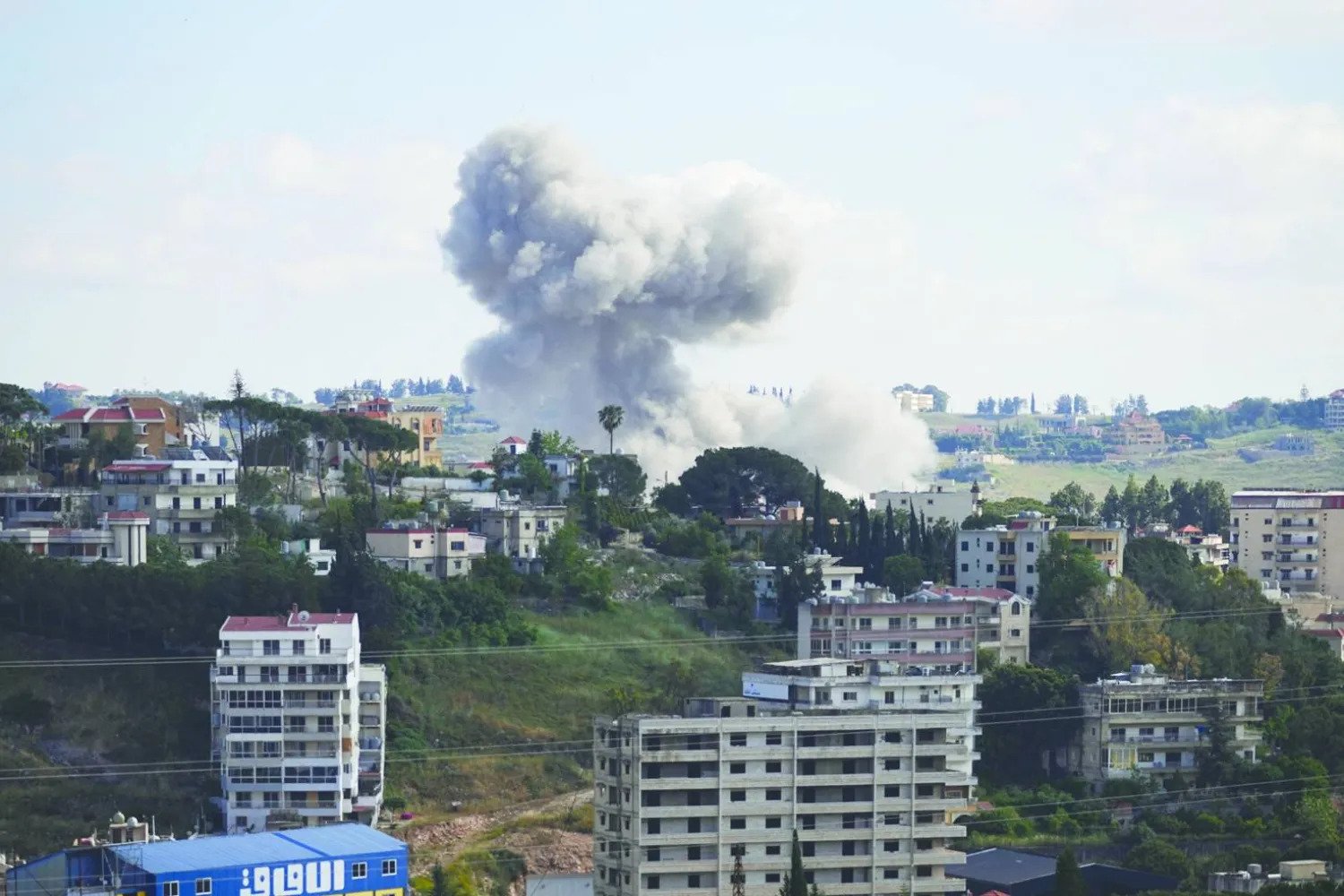
Political and military reviews acquire their real value when they go beyond identifying mistakes to examine the decisions that produced them, the assumptions on which those decisions were based, and the consequences that followed. When a review is limited to operational performance while leaving the underlying decision itself outside the scope of scrutiny, it risks becoming a means of explaining outcomes without reassessing the choices that produced them.
This is the question that has returned to the forefront of Lebanon's political debate following remarks by Mohammad Raad, head of Hezbollah's Loyalty to the Resistance parliamentary bloc, concerning the party's review of its conduct during the war in support of Gaza since October 8, 2023.
According to Lebanese reports on Raad's remarks, Hezbollah conducted a review of its actions, identifying what it considered areas of strength and shortcomings in performance, while describing some of what occurred as a "partial tactical failure." At the same time, Raad continued to defend the decision to support Gaza. (lebanese-forces.com)
Regardless of one's political position toward Hezbollah or the decision to open the support front, the formulation raises a broader question concerning the nature of the review itself: Was this a review of performance, or a review of the decision?
From Reviewing Performance to Reviewing the Decision
There is a fundamental difference between asking an institution, "Where did we make mistakes in implementing a decision?" and asking, "Was the decision itself correct from the outset?"
In the first case, the basic premise of the decision remains valid, and the task is to correct the tools and tactics used to implement it. In the second, the institution reexamines the assumptions that preceded the decision, its assessment of risks, and the alternatives that were available.
A serious review of any strategic decision should therefore address a sequence of questions: What objective was the decision intended to achieve? Who made it? What information and assessments informed it? What results were expected? What actually happened? And what was the gap between the expected and actual outcomes?
Then comes the most sensitive question: Who bears responsibility for that gap?
If a review concludes that the strategic decision was correct and that the problems were confined to implementation, that is a position that can be defended politically. But it requires evidence and explanation. Simply describing failures as tactical without explaining how that conclusion was reached leaves the underlying decision largely outside the process of scrutiny.
The Support Front: Military and Political Calculations
The sensitivity of the Lebanese issue lies in the fact that the decision to open a support front was not merely a technical military decision. It formed part of a broader political and security assessment.
Its evaluation therefore cannot be limited to whether military units were capable of carrying out the required operations. It must also consider the calculations that preceded the decision: What was expected of the Israeli response? What scenarios were considered in the event that the conflict expanded? What level of cost could Lebanon sustain? And what political and military outcomes did Hezbollah expect to achieve?
These questions become more important as the cost of a decision increases.
Strategic decisions cannot be evaluated solely on the basis of whether their stated objective appears legitimate from the perspective of those who made them. The relationship between objectives and means, and between expected gains and potential costs, must also be examined.
This is where an important distinction emerges between the legitimacy of an objective as understood by its proponents and the effectiveness or soundness of the means chosen to pursue it. The two are not necessarily the same.
The Arms Question and the Defense Strategy
The issue extends beyond the assessment of a particular war to one of Lebanon's longstanding political questions: Who has the authority to decide when and how military force is used?
Hezbollah's weapons have for years been linked to the debate over Lebanon's national defense strategy. The issue was discussed in national dialogue following the 2006 war, with Lebanese political forces differing over the relationship that should exist between the Lebanese Armed Forces and Hezbollah's military capabilities. (studies.aljazeera.net)
The debate over a national defense or security strategy has resurfaced repeatedly in recent years. Official Lebanese positions have emphasized that the state should hold authority over decisions concerning war and peace, while a national security strategy should encompass diplomatic, military, and economic dimensions. (general-security.gov.lb)
Hezbollah, for its part, has continued to link discussion of its weapons to the establishment of a national defense or security strategy, keeping the issue of its arms within the framework of a broader political and security settlement. (studies.aljazeera.net)
This creates a political dilemma that is difficult to avoid: Should a national defense strategy be established first, with the role of weapons determined within that framework, or should existing weapons be maintained first, with the strategy subsequently designed to accommodate their role?
The answer is not merely technical. It bears directly on the nature of the state, the centralization of decisions concerning war and peace, and the independence of national decision-making.
The State and the Party: Overlapping or Conflicting Responsibilities?
One of the most sensitive aspects of the debate concerns the relationship between Hezbollah and the Lebanese state.
Hezbollah participates in Lebanon's political institutions and has a parliamentary bloc and a political presence in government. At the same time, it maintains military capabilities separate from those of the Lebanese Armed Forces.
This produces a complex relationship between the party as a political actor and the state as a formal institution. When the issue is political decision-making, Hezbollah is part of the political system. When the issue is military decision-making, however, questions remain about the extent to which its military decisions are independent of state institutions.
This does not necessarily mean that the relationship can be reduced to a simple dichotomy between "Hezbollah" and "the state." Lebanon's political system is considerably more complex, and Lebanese political forces remain divided over Hezbollah's weapons and the appropriate defense strategy.
Yet the institutional question remains: How can a single state accommodate more than one center of authority for decisions concerning the use of force?
That question extends beyond Hezbollah itself to the structure of Lebanon's political system.
Accountability Does Not Necessarily Mean Rejecting Resistance
One of the most important distinctions in this debate is between political accountability and one's position on the concept of resistance.
Accountability does not necessarily imply denying any group or political movement the right to defend its position. Nor does it necessarily diminish the sacrifices made by fighters or civilians in southern Lebanon.
Accountability means something more specific: decisions that carry public costs should have identifiable decision-makers and should be subject to mechanisms through which those decisions and their consequences can be examined.
In modern states, this principle does not contradict recognition of military sacrifice or acknowledgment of security threats. On the contrary, recognizing sacrifice also requires that decisions sending people into war be subject to an appropriate degree of political responsibility.
The question, therefore, is not simply: Were there reasons for taking the decision to support Gaza?
It is also: Were there alternatives? What was the risk assessment? Did the assessment change as the war evolved? And was the decision modified when circumstances changed?
Southern Lebanon Is More Than a Geographic Space
The question of accountability becomes particularly sensitive when the consequences of a decision are concentrated in a specific region.
Southern Lebanon is not merely a military theater. It is a populated region with its own social, economic, and political characteristics. Its residents therefore cannot be viewed simply as a geographic extension of a military decision.
This gives social and political participation in the debate particular importance.
Lebanese citizens living in conflict-affected areas, regardless of their political or sectarian affiliations, have a legitimate interest in understanding how decisions affecting their lives, security, and property were made.
This does not mean assuming a unified position among Lebanon's Shiite community or among residents of the south toward Hezbollah or its choices. On the contrary, reducing an entire community or region to the position of a single political organization can obscure the diversity of views within it.
This is precisely where the debate over accountability becomes a debate about political citizenship: Can citizens support resistance while opposing a particular military decision or demanding an explanation for it, without those positions being treated as tests of political or sectarian loyalty?
The Problem with Defining the "Failure"
Describing something as a "tactical failure" can be useful if it forms part of a comprehensive review that identifies the nature and causes of the mistakes and assesses their consequences.
But defining the problem as tactical also implicitly establishes boundaries for the review: the underlying decision remains outside the scope of doubt, while the tools used to implement it are examined.
The methodological question therefore becomes more important than the political one: What criteria determine whether a failure is tactical rather than strategic?
If outcomes differ substantially from the original expectations, the assumptions underlying the decision may need to be reassessed. If a decision achieves some of its objectives while simultaneously producing costs greater than those initially anticipated, it requires a multidimensional assessment rather than a single label.
In other words, the nature of a failure cannot be determined solely by the scale of casualties, just as the success of a decision cannot be determined by the achievement of one objective alone.
What Should a Review Include?
If Hezbollah has indeed conducted a review of its conduct since October 2023, the political value of that review will depend largely on its ability to answer a number of specific questions.
First, an assessment of the original assumptions: What did Hezbollah expect to happen when it opened the support front?
Second, an assessment of alternatives: Were there other options for pursuing its stated objectives at a lower cost?
Third, an assessment of outcomes: What was achieved militarily and politically, and what was not?
Fourth, an assessment of responsibility: How was responsibility distributed between political and military leadership?
Fifth, an assessment of the relationship with the state: How can the duplication of decision-making authority be prevented in matters involving war and peace?
And sixth, a forward-looking assessment: Will the lessons of the war lead to changes in military doctrine or decision-making, or will they be limited to improving operational performance?
These questions do not presuppose that the decision to support Gaza was wrong, nor do they assume that it was correct. They simply move the debate from the level of political slogans to the level of testing decisions against evidence and outcomes.
The Real Test: Can the Decision Itself Be Reviewed?
Ultimately, the value of a review does not lie simply in an institution acknowledging that mistakes occurred. That may be necessary, but it is not sufficient.
A deeper review is one that allows the original decision itself to be examined, even if the final conclusion is that the decision was correct.
This is the difference between a review designed to learn and one designed primarily to protect an established political narrative.
If the review concludes that the decision to support Gaza was justified, that conclusion still requires explanation: What objectives were achieved? What criteria were used to determine success? And how should the costs and losses be assessed in light of those objectives?
If, on the other hand, the review identifies strategic errors, its real value lies in the ability to adjust the course accordingly.
In either case, the central issue remains the establishment of a clear mechanism of political and military responsibility for decisions that affect the lives of millions of citizens.
Lebanon has spent years debating weapons, defense strategy, and the authority to decide questions of war and peace. The developments since October 2023 have made the issue even broader. The question is no longer only about the future of Hezbollah's weapons, but also about how decisions leading to war are made, who has the authority to make them, and what mechanisms exist to hold decision-makers accountable for their consequences.
That may ultimately be the real test of any review: not merely asking how a decision was implemented, but asking the more fundamental questions: Why was the decision made in the first place? What was expected of it? What did it actually achieve? And who bears responsibility for its consequences?
Only then can a review move beyond reinterpreting the past and become a genuine instrument for making clearer and more accountable decisions in the future.
Most read




Read also