
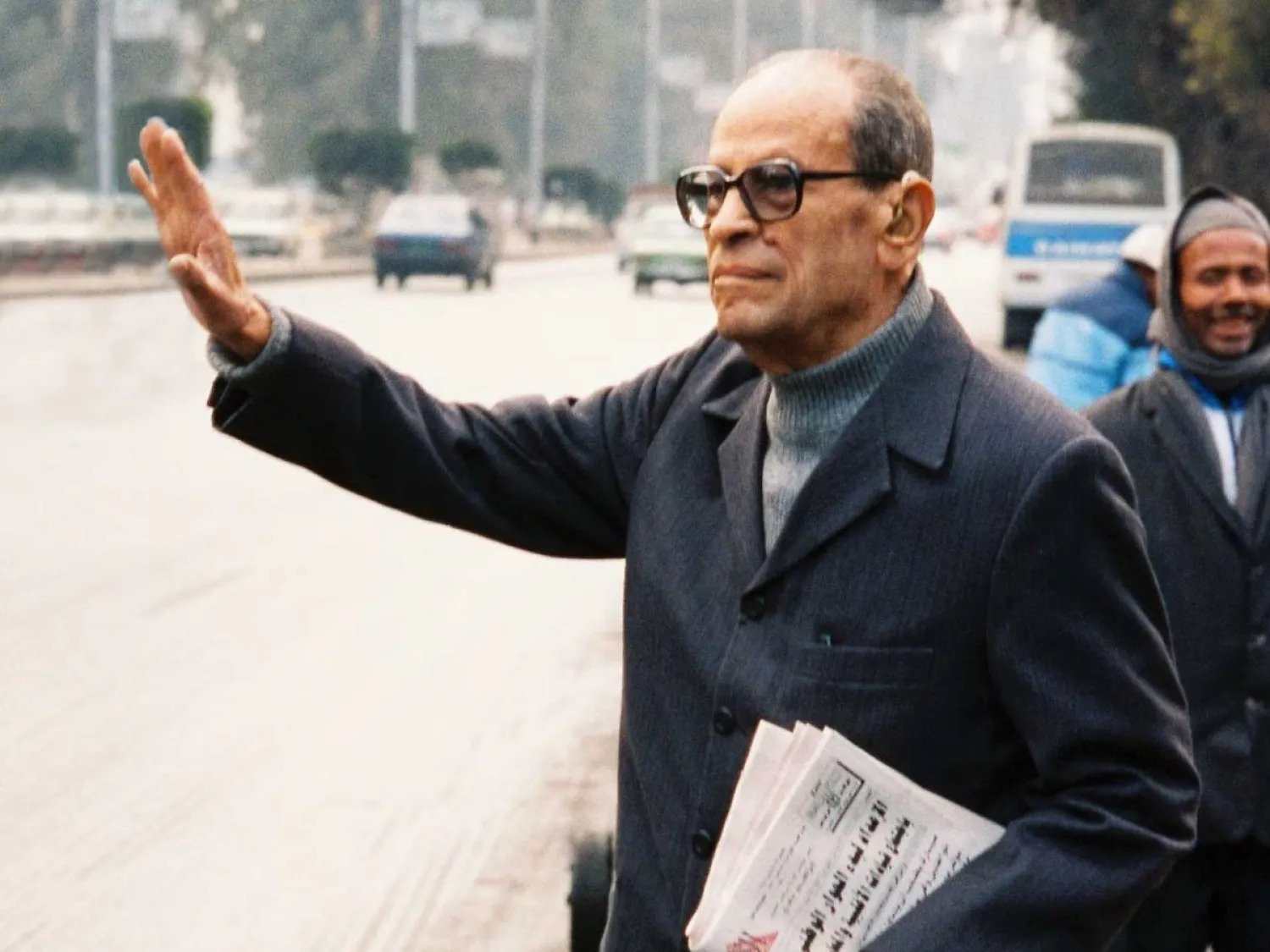
On this day in 2006, Naguib Mahfouz passed away. Yet his was never the kind of absence that closes a chapter or brings an author’s presence to an end. Twenty years after his death, the author of The Cairo Trilogy and Children of Gebelawi remains firmly present in books, academic studies, literary criticism, and public debate—as well as in the memory of readers. His death seems less like an ending than a transition from everyday life into a far more expansive realm: the realm of literature, where time itself imposes no final boundaries.
Born in 1911, Mahfouz left behind an immense body of novels, short stories, and essays produced over several decades, establishing him as one of the most important literary voices of the Arab world in the twentieth century. In 1988, his career reached its highest international recognition when he was awarded the Nobel Prize in Literature, becoming the first Arab writer and the fourth African recipient of the prestigious prize. It was not simply an honour bestowed on an Egyptian or Arab author; it was also a recognition of the ability of Arabic literature to speak to a global audience through an experience rooted in local detail yet universal in its questions.
One of the secrets of Mahfouz’s enduring relevance is that his works do not present themselves as texts confined to the era in which they were written. The Cairo he described is no longer the same Cairo, and the neighbourhoods, characters, and social transformations that shaped his fictional world have changed profoundly. Yet the questions he raised remain open: power and freedom, religion and society, justice and injustice, the individual and the collective, dreams and defeat, and the fear of the future alongside the desire to change it.
That is why hardly a year passes without the publication of a new book or study devoted to Mahfouz, or a fresh critical reading of his work from a different perspective. The continuing volume of writing about him is not merely a form of homage to a great writer. It is evidence that his literary legacy continues to generate new interpretations. Every time Mahfouz is reread, his work seems to reveal itself to a new generation of readers, uncovering another layer that may not have been visible on a first reading.
Children of Gebelawi remains perhaps the clearest example of this extraordinary capacity to provoke questions. The novel, which generated intense controversy from the time of its publication and remains the subject of debate and interpretation, demonstrates how a literary work can transcend its historical moment and become a lasting object of reinterpretation. It was no coincidence that the Swedish Academy, in its recognition of Mahfouz, highlighted the importance of this novel within his literary achievement.
Yet reducing Mahfouz to his fiction alone would be to overlook an important dimension of his career. He was a writer with broad intellectual interests who also worked as a journalist and remained deeply engaged with Egypt’s cultural life for decades. One of his most notable journalistic contributions was a weekly column in Al-Ahram, which he wrote from 1974 until 1994. Journalism was not merely a secondary activity for him; it offered another space from which to observe society and engage with its questions and transformations. He stopped writing regularly after he was attacked in 1994.
There is an irony in the fact that a man who was such a prominent presence in Egypt’s cultural life became, after his death, an even more powerful presence in its cultural memory. Mahfouz is no longer simply a writer belonging to the twentieth century. He has become something closer to a cultural reference point, to which successive generations return whenever they seek to understand aspects of Egyptian identity, the history of the city, or the transformations of society.
Twenty years after his death, therefore, the question is not whether we still read Naguib Mahfouz. That is beyond dispute. The more important question is: Why does Mahfouz continue to speak so powerfully to generations that never experienced the world in which he wrote?
Perhaps the answer lies in the fact that Mahfouz was not writing about Cairo alone, nor about Egypt at a particular historical moment. He was writing about human beings as they confront reality and struggle to find their place within it. That is why his characters can still feel familiar to readers born decades after his major works were written, and why their dilemmas remain recognisable across radically different eras.
Ultimately, Naguib Mahfouz does not need an annual anniversary to bring him back to life. He is already present every time one of his novels is opened, every time Egyptian or Arab literature is discussed, and every time someone attempts to understand the relationship between the writer and his society.
Mahfouz died in 2006, but the literature he left behind did not die with him. Perhaps this is the truest form of literary immortality: the writer disappears, while his work continues to live—and the passage of time, rather than distancing him from his readers, gives them new reasons to discover him.
Most read