Lebanon’s Reconstruction Bill: The War Tests the State and Exposes Hezbollah’s Dilemma

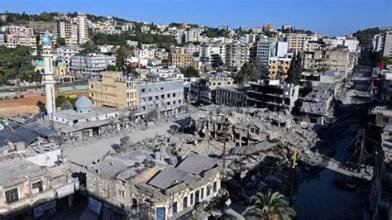
Amid widespread destruction, a deepening displacement crisis, and Lebanon’s declining economic capacity, reconstruction has become a political and financial test of the country’s future. At the heart of this challenge lies a dispute over who should bear the cost of the war, the extent of the government’s responsibility, and Hezbollah’s role in compensating those affected—all against the backdrop of an absent comprehensive funding mechanism and a lack of guarantees against renewed destruction.
The reconstruction of Lebanon’s war-damaged areas is no longer merely a matter of repairing homes and restoring essential services. It has become a new arena for political confrontation over responsibility for the destruction, sources of funding, and the relationship between the state and armed forces operating outside its institutions. As human and material losses mount and the number of displaced people grows, Lebanon faces an increasingly complex equation: how can reconstruction be financed amid a prolonged economic crisis, a state with limited resources, and unresolved political divisions over who should bear the cost?
Hezbollah’s position, calling on the government to assume primary responsibility for shelter, reconstruction, and support for displaced people, has reignited this debate. While the party maintains that it will work to contribute to these efforts when financial resources become available, opposition lawmakers argue that this stance reflects a declining ability to shoulder the burden and an attempt to transfer a substantial share of the war’s cost to the public treasury. Between these competing positions lies a deeper crisis: the absence of a comprehensive national framework for reconstruction that clearly defines responsibilities, funding sources, and priorities while linking rebuilding efforts to lasting stability.
Destruction Beyond the State’s Capacity to Absorb
Available figures reveal the scale of the challenge facing Lebanon. According to data compiled by Statistics Lebanon, direct material damage caused by the 2024 war amounted to approximately $6.8 billion, including $4.6 billion in the housing sector. Recovery and reconstruction needs were estimated at around $11 billion. Lebanon had not completed addressing these losses when the new war broke out, adding further burdens to an economy already suffering from a profound financial crisis and declining state capacity.
As for the 2026 war, the overall cost of the damage and reconstruction requirements has yet to be determined, as hostilities continue and assessments remain incomplete. Nevertheless, preliminary data available through April 2026 indicate that direct damage to buildings exceeded $1.745 billion in southern Lebanon, Beirut, and Mount Lebanon. More than $1.38 billion of this amount was recorded in the south alone, while damage in Beirut and Mount Lebanon exceeded $365 million.
These figures do not represent the war’s final cost, nor can they be directly compared with the comprehensive national assessment of damage caused in 2024. They nevertheless provide a clear indication of the scale of the new financial burden before the full extent of the destruction has been established.
The picture becomes even more alarming when the housing sector is considered. Assessments recorded the complete destruction of 11,095 buildings in the area south of the Litani River, in addition to 146 buildings in Beirut and Mount Lebanon. The number of housing units completely destroyed reached 17,891 in southern Lebanon and 3,168 in Beirut and Mount Lebanon, bringing the total to more than 21,000 units across the areas assessed at that stage.
The challenge extends beyond destroyed buildings. Approximately 3.1 million cubic metres of rubble have accumulated in southern Lebanon, compared with around 649,000 cubic metres in Beirut and Mount Lebanon. Reconstruction, therefore, cannot begin simply by allocating money to rebuild houses. It requires a sequence of measures, including rubble removal, road rehabilitation, repairs to water and electricity networks, and the restoration of essential services before residents can return on a sustainable basis.
Reconstruction has thus become a long-term economic and public-service undertaking. Its true cost extends beyond replacing destroyed buildings to include restoring the urban and social environments damaged by the war.
Displacement Turns a Housing Crisis into a Social Emergency
Physical destruction is compounded by a widespread humanitarian crisis. According to the international data cited in the report, approximately one million people were internally displaced at the beginning of the escalation, while around 100,000 crossed into Syria. As of September 1, 2026, a total of 329,240 people remained internally displaced.
These figures demonstrate that the crisis affects not only those who have lost their homes, but also families unable to return because infrastructure has been damaged or their communities lack the minimum services necessary for daily life. Temporary shelter is therefore not a lasting solution; it is an essential interim measure until conditions permit residents to return and rebuild their lives.
The situation becomes more serious when assistance for displaced people turns into an instrument of political bargaining, or when its delivery is delayed by disputes over which party should finance it. The longer displacement continues, the greater the pressure on affected families, host communities, and public services—and the wider the gap between humanitarian needs and available resources.
From this perspective, reconstruction cannot be separated from social protection. Nor can shelter be treated as a temporary form of assistance disconnected from a broader economic recovery plan and the rebuilding of communities devastated by war.
Why Has Hezbollah Turned Back to the State?
Hezbollah’s position on the government’s responsibility lies at the centre of the current political dispute. The party’s secretary-general, Naim Qassem, has stated that the government is responsible for shelter, reconstruction, and support for displaced people. He also announced that Hezbollah would contribute to a shelter initiative, although no details have yet been provided regarding the amount of funding, implementation mechanisms, or timetable.
Within the limits of its public commitments, this position reflects a move towards assigning the state the leading role in managing a task whose scale makes it difficult for any single entity to address independently. Its political implications, however, remain contested, particularly in light of criticism concerning Hezbollah’s ability to honour its commitments to those affected and its responsibility for the decisions that led to the war.
MP Ibrahim Mneimneh argues that Hezbollah has previously benefited from the political credit accumulated by the government and from Arab assistance allocated to reconstruction, particularly after the 2006 war. In his view, the party sought to exploit shortcomings in the government’s response to appropriate some of that credit for itself. He considers the current return to the state an acknowledgment of its importance, at a time when, according to his assessment, Hezbollah is no longer capable of shouldering the reconstruction burden on its own.
Yet the issue is not simply a transfer of responsibility from one party to another. It concerns the nature of the system that should govern reconstruction. If the state is responsible for all its citizens, institutional principles require it to serve as the central authority for setting priorities, distributing assistance, managing funding, and supervising projects, rather than allowing multiple centres of decision-making or competing political calculations to determine how aid is allocated.
Nevertheless, assigning responsibility to the state does not automatically solve the problem. A country facing a deep financial and economic crisis cannot generate billions of dollars merely by affirming its legal and political obligations. Recognition of the state’s role must therefore be accompanied by a realistic funding plan, a political understanding that ensures its implementation, and oversight mechanisms to prevent waste and guarantee that resources reach those who need them.
A Dispute over Responsibility—or over the Conditions for Reconstruction?
The disagreement between Hezbollah and its opponents is not confined to identifying who should pay. It also extends to the political conditions that should govern the rebuilding process.
While Hezbollah emphasises the government’s responsibility towards all citizens, Mneimneh argues that any serious effort must begin within constitutional institutions and include implementation of government decisions concerning the restriction of weapons to state authority. From this perspective, reconstruction cannot be separated from questions of sovereignty and the state’s exclusive authority over decisions of war and peace.
This position overlaps with that of MP Mark Daou, who has argued that Hezbollah’s demand that the government assume responsibility reflects the party’s inability to meet the consequences of the war. He has also criticised what he sees as a contradiction between asking the state to lead reconstruction and failing to recognise it as the sole authority in matters of sovereignty.
These positions, however, remain part of a broader political dispute and are not, by themselves, sufficient to determine how reconstruction should be financed or when it should begin. Linking assistance to political and security conditions may reflect a desire to address the causes of instability, but it also raises questions about whether those affected risk becoming hostages to disagreements among political forces.
The central challenge is to pursue two parallel objectives: responding urgently to humanitarian needs while addressing the political and security factors that could lead to another war. Disputes over the terms of a political settlement should not obstruct essential shelter assistance, but neither should reconstruction become a purely financial exercise disconnected from a serious discussion about long-term stability.
Who Will Pay the Bill? The State, Hezbollah, and External Actors
MP Adib Abdel Massih has proposed several alternatives to placing the entire cost on Lebanon’s public treasury. He has called on Hezbollah’s two ministers in the government to work towards securing a cabinet decision on reconstruction and building the necessary consensus. If that proves impossible, he argues that the party should bear part of the responsibility, while also seeking compensation from Iran for the damage and exploring international legal avenues to pursue compensation from Israel, which he identifies as the party directly responsible for the destruction.
These proposals highlight the range of potential funding channels, but they also involve significant differences in feasibility and the time required to produce tangible results.
Funding from the Lebanese state remains constrained by its resources and its capacity to borrow and spend. Contributions from donor countries, meanwhile, depend on political and economic considerations, as well as confidence that a clear plan and a stable environment will protect their investments from renewed destruction. Claims for compensation from Iran or Israel would require complex political and legal processes and cannot be treated as readily available funds for meeting urgent needs.
A realistic strategy should therefore avoid relying on a single source of financing. Instead, it should combine domestic resources, international assistance, direct contributions, and feasible legal mechanisms, while distinguishing between the funds needed for immediate relief and those required for long-term reconstruction.
In this context, it is not enough for different parties to declare their willingness to contribute. They must clearly specify the scale of their commitments, when the funds will become available, which groups will benefit, and which authority will manage and monitor the process.
Donors, Funding, and the Risk of Another War
The position of international donors will be decisive in determining the future of reconstruction. According to Mneimneh, donor countries appear reluctant to inject substantial funds into rebuilding efforts that could be destroyed again if a new war erupts.
This reveals one of the crisis’s central dilemmas: Lebanon needs funding to rebuild damaged areas, but it also needs stability to convince donors that their money will not be invested in projects vulnerable to renewed destruction. The absence of political and security guarantees makes it more difficult to mobilise resources and prolongs the period during which residents must wait to return to their homes.
Reconstruction is therefore not merely a technical or financial undertaking. It also depends on the state’s ability to enforce its decisions, provide a stable environment, and establish a national plan that commands sufficient domestic and international confidence.
At the same time, affected residents cannot reasonably be expected to wait for a comprehensive political settlement before receiving basic assistance. The real challenge is to design a mechanism that allows shelter provision and essential repairs to begin while work continues to establish the guarantees needed for larger reconstruction projects.
An Exhausted Economy Faces a New Bill
These challenges come at a time when the Lebanese economy is under mounting pressure, limiting the government’s ability to absorb additional costs. Figures cited in the report point to an expected contraction of 6.4 per cent in real gross domestic product in 2026. Meanwhile, reconstruction needs stemming from the 2024 war remain estimated at approximately $11 billion, even before the cost of the new war is added.
The state is therefore facing simultaneous pressures on several fronts: financing shelter and relief, removing rubble, rehabilitating infrastructure, compensating for housing losses, and restoring economic activity in affected areas. All this must be undertaken with limited fiscal resources and an economy that remains vulnerable to shocks.
The situation could become even more serious if reconstruction is financed by imposing additional tax burdens on citizens without a clear plan for distributing the cost, or if inadequate oversight leads to the waste of resources. Delays in rebuilding could also deepen economic losses by disrupting commercial and productive activities, reducing employment opportunities, and prolonging the displacement of residents from their communities.
The success of reconstruction should therefore not be measured solely by the number of houses rebuilt. It should also be assessed by the extent to which the process restores livelihoods, stimulates local economies, reinstates public services, and prevents damaged areas from becoming centres of persistent poverty and marginalisation.
Reconstruction as a Test of the Lebanese State
Lebanon’s reconstruction crisis exposes a dilemma that extends far beyond the dispute over who should pay the bill. The fundamental problem is how to establish a national mechanism capable of turning declared responsibilities into clear financial and operational commitments in a country constrained by limited resources, competing centres of decision-making, and unresolved disputes over sovereignty and security.
Holding the state responsible for its citizens is a fundamental principle of any political system. However, this does not exempt other parties from their responsibilities, nor does it make the public treasury an unlimited source of funding. Conversely, calls for Hezbollah to bear part of the consequences of the war remain central to the political debate over accountability, but they do not, on their own, provide a practical solution to the needs of hundreds of thousands of displaced and affected people.
What is needed, therefore, is a comprehensive plan that sets priorities according to the scale of damage and humanitarian need, allocates responsibilities among the state and contributing parties, guarantees transparent spending, opens channels for domestic and international financing, and links reconstruction to practical measures designed to reduce the risk of another war.
Reconstruction is not simply about rebuilding what has been destroyed. It is a test of the Lebanese state’s ability to restore its role in protecting citizens, managing resources, and making decisions. If the issue remains trapped in a cycle of mutual accusations, the principal losers will not be any single political party, but the residents waiting to return to their homes, an economy bearing the cost of destruction, and a state facing yet another test of its ability to fulfil its most basic functions.
Most read


Read also