
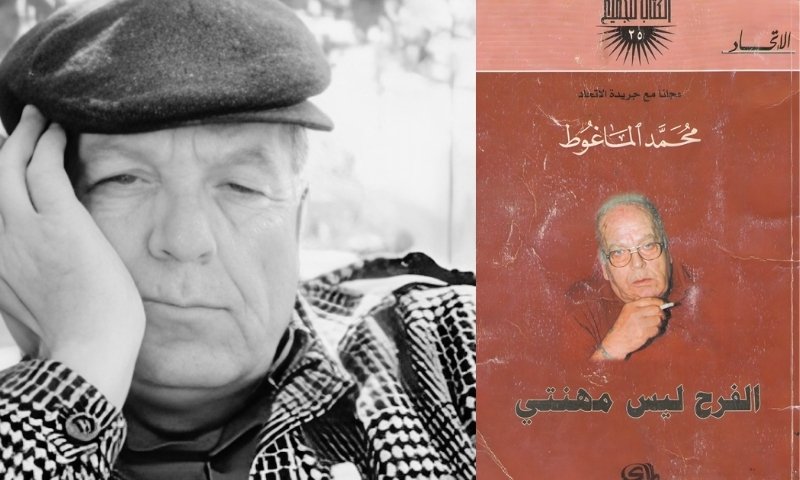
Through his poetry collection Joy Is Not My Profession, Syrian writer and poet Muhammad al-Maghut created a poetic world that bears witness to characters, scenes, and deeply human anxieties. Throughout the collection, he remained faithful to his engagement with the struggles of the Arab individual and the constant forces that confine him—fear, authority, poverty, and the sense of exile that can haunt a person even within their own homeland.
Published in 1970, following Sorrow in the Light of the Moon and A Room with Millions of Walls, the collection represents a pivotal stage in al-Maghut’s poetic career. It is here that his distinctive language fully emerges: a language that moved away from traditional meter and rhyme and embraced prose poetry as a means of expressing the condition of the defeated and marginalized individual.
The collection’s poems revolve around themes that al-Maghut repeatedly addressed throughout his different stages as a writer. He wrote about freedom, homeland, alienation, and fear, but in Joy Is Not My Profession he did not present these issues through direct political discourse or explicit political allegory. Instead, he approached them by portraying everyday life.
Images drawn from ordinary life—“the policeman, the station, the pavement, the window, the suitcase, the village, the city, the smell of bread”—become symbols of a life in which the individual feels pursued, marginalized, or incapable of achieving their dreams, or even securing the most basic conditions for a dignified existence.
Freedom occupies a central position in many of the collection’s poems. In al-Maghut’s work, the individual seeks the right to live an ordinary life, free from fear and repression. His poetry thus becomes the voice of a person living amid an oppressive silence that gradually closes in around him, until joy itself, as the title suggests, becomes a state that is almost impossible to attain.
The homeland is another recurring theme, yet it does not appear in the form of patriotic hymns or impassioned political speeches. Rather, it is portrayed as a place simultaneously associated with longing and disappointment. In al-Maghut’s poems, the homeland is a place one loves while also experiencing within it a profound sense of estrangement and helplessness. Love becomes intertwined with pain, and hope with frustration.
This vision is inseparable from al-Maghut’s own language. He avoids rhetorical ornamentation and writes in simple vocabulary drawn from the street and everyday life, before rearranging these ordinary words into understated poetic images. As a result, his poems appear remarkably accessible to the reader, even as they carry multiple layers of meaning and bring together irony and bitterness at the same time.
Several critical studies have noted that, through its everyday imagery, the collection reveals a critique of authoritarianism, corruption, and defeat, particularly in the period following the 1967 Arab defeat and the political and social reality that emerged from it, one burdened by a profound sense of loss.
The collection contains dozens of poems whose themes intersect and resonate with one another. In poems such as A Bedouin Searching for a Bedouin Country and An Arab Traveler at the Space Stations, al-Maghut evokes the Arab individual’s sense of disorientation and his search for a place to which he can truly belong.
Meanwhile, poems such as The Siege and Autumn of Masks confront the fears and constraints that surround and confine the individual.
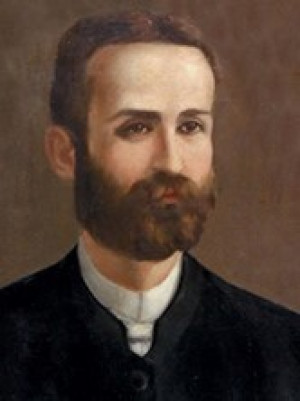
Muhammad al-Maghut
Muhammad al-Maghut (1934–2006) was a Syrian poet and writer born in the city of Salamiyah in Hama Governorate. He is regarded as one of the leading pioneers of Arabic prose poetry.
He published three poetry collections: Sorrow in the Light of the Moon, A Room with Millions of Walls, and Joy Is Not My Profession. He also wrote several renowned plays, including Exile, Your Cup, Homeland, and October Village, as well as his satirical book I Will Betray My Country, one of his best-known literary works.
Most read