Is Global Leadership Shifting from Washington to Beijing?

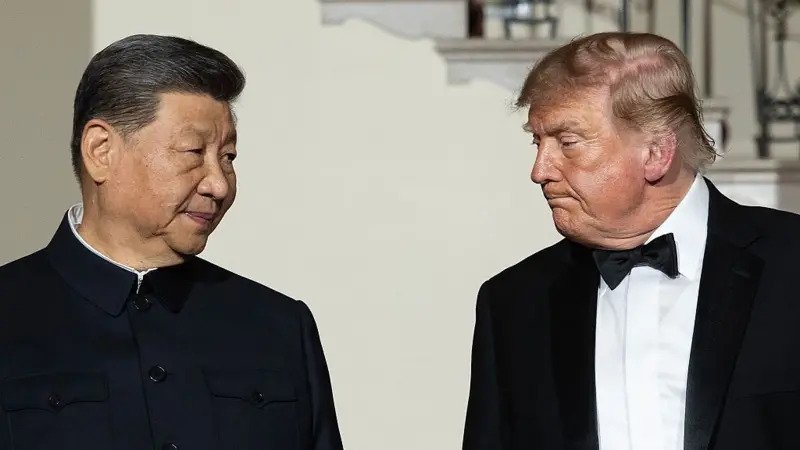
U.S.-Chinese summits are no longer merely occasions for photographs and diplomatic courtesies. They have become a reflection of broader transformations in the international system. Every detail of a meeting between U.S. President Donald Trump and Chinese President Xi Jinping—from the manner of the welcome to the staging of the encounter at the White House—can carry implications that go well beyond protocol. More importantly, such meetings raise a larger question: Is the world witnessing a gradual shift in the center of global power from Washington to Beijing, or are we simply seeing another stage in the redistribution of influence between two major powers?
The scenes surrounding Xi's visit to Washington reflected, in the reading of some Western newspapers, a striking paradox. At certain moments, the Chinese president appeared to be a guest receiving an unusually prominent welcome, while his American host seemed more eager than previous U.S. presidents to emphasize the significance of the encounter.
Even the symbolic details acquired political meaning. President Trump and First Lady Melania Trump's reception of Xi at Andrews Air Force Base, the red carpet laid out for the Chinese leader, and the manner in which the meeting was staged inside the White House all prompted questions about whether the relationship between the two powers has entered a new phase—one in which the United States is no longer automatically the actor that determines the terms of the international scene.
Yet interpreting global change through protocol alone would be misleading. The real significance of the Trump-Xi meeting lies not in the red carpet or the official photographs, but in the broader context in which the summit took place, the nature of the transformations that preceded it, and, most importantly, the difference between what Washington wants from the international system and what Beijing seeks to achieve within it.
From Trying to Change China to Competing with It
For decades, the United States approached China's rise on the assumption that integrating Beijing into the international system—economically and institutionally—could gradually encourage it to adopt more of the rules and practices associated with the Western liberal order.
Today, the relationship appears fundamentally different.
Washington no longer treats China primarily as a rising power that can simply be integrated into the system it leads. Instead, China is increasingly viewed as a strategic competitor with the capacity to challenge the United States across a growing number of domains.
Beijing, meanwhile, no longer approaches the international system merely as a framework to which it must adapt. It now possesses economic, diplomatic, and institutional tools that allow it to participate in reshaping some of its rules and institutions.
This helps explain Xi's reference to the possibility of avoiding what is known as the "Thucydides Trap"—the concept that a rising power's emergence alongside an established hegemon can create conditions for confrontation. The very use of the concept in Chinese discourse reflects an awareness of the competitive relationship between the two countries, even as both Beijing and Washington seek to keep that competition within manageable limits.
The issue, therefore, is not simply which country possesses greater power. It is whether the transition in power between the two can take place without turning into open confrontation.
China Is Not Rising Alone
One of the clearest indicators of China's changing position in the international system is the expansion of its diplomatic activity beyond its bilateral relationship with Washington.
Xi Jinping does not limit his international engagement to meetings with the U.S. president. China's presence extends through the Shanghai Cooperation Organization, BRICS, relations with the Global South, infrastructure and investment projects, trade networks, and an expanding web of bilateral partnerships.
The significance of this activity lies in the fact that it reflects a Chinese conception of international influence that differs from the traditional American model. Power is measured not only by the number of military bases or security alliances, but also by the scale of economic relations, the ability to provide financing and investment, participation in international institutions, access to markets, and the construction of long-term political and economic networks.
Through initiatives such as the Belt and Road Initiative and BRICS, China is expanding the space in which it can operate beyond the traditional Western framework.
But this does not necessarily mean that Beijing is preparing to inherit the American role in its entirety.
That is one of the central paradoxes of the current international landscape.
China Wants to Reshape the System—Not Carry All of Its Burdens
China today possesses far greater economic and political influence than it did two or three decades ago. Yet it does not necessarily possess all the attributes that enabled the United States to become the dominant power in the international system after the Second World War.
American global leadership was built not only on economic and military power, but also on an extensive network of alliances, international institutions, security guarantees, foreign assistance, military bases, the capacity to intervene in regional crises, and the central role of the U.S. dollar and the financial institutions associated with the Western-led order.
China is expanding its influence, but it has not demonstrated either the willingness or the need to assume all of these burdens in the same way.
The more precise question, therefore, may not be whether China wants to replace the United States, but rather: To what extent does China seek to redistribute global influence so that the United States is no longer at the center of the system?
That is a crucial distinction.
Beijing may not need to construct a Chinese version of the American-led order in order to become more influential. Its objective may instead be to build a more pluralistic international system in which the United States remains a major power among other major powers, rather than the power around which the rest of the system revolves.
"America First" and the Vacuums of International Politics
At the same time, the "America First" approach associated with Trump raises a different question about the nature of the U.S. role in the world.
The administration's emphasis on immediate national interests, bilateral deals, burden-sharing within alliances, and skepticism toward some traditional foreign commitments could alter the way other countries assess the guarantees historically provided by Washington.
This does not necessarily mean that the United States is withdrawing from the world. Rather, it suggests a redefinition of the terms of American engagement.
That creates room for China to maneuver.
International power depends not only on what a state actually does, but also on what others believe it is prepared to do. If U.S. allies and partners begin to question the durability of American guarantees, they will naturally seek to diversify their relationships and partnerships.
That does not mean they will automatically move into China's camp. It means instead that the world could become less dependent on a single center of power and more pluralistic in its alliances and relationships.
From "Wolf Warrior" to a More Pragmatic Diplomacy
China's approach to foreign relations has also evolved.
For a period, Chinese diplomacy suffered from the image of "Wolf Warrior" diplomacy, associated with an assertive nationalist rhetoric and more confrontational responses to Western criticism.
But expanding global influence requires different instruments.
A state seeking to become an acceptable partner to the widest possible range of countries cannot rely on economic power alone. Nor can it sustain an external discourse based permanently on confrontation.
Chinese diplomacy has therefore placed greater emphasis on building relationships, expanding partnerships, and demonstrating its ability to engage with diverse actors, particularly across the Global South.
Beijing may benefit from declining confidence in the United States, but it cannot simply assume that other countries will automatically move toward China. Most states act according to their own interests and seek to preserve room for maneuver among the major powers.
A World Beyond Unipolar Dominance
If the relative position of the United States is declining while China's influence is expanding, the outcome does not necessarily mean that Beijing will simply occupy America's former seat.
The reality is more complicated.
The world may be moving toward a system in which power is distributed among several centers: the United States, China, Russia, the European Union, India, and a range of regional powers. In such a system, the ability of any single power to impose its rules would be more limited than during the unipolar moment that followed the collapse of the Soviet Union.
But the transition from one system to another carries significant risks.
Periods of systemic transition are often more vulnerable to miscalculation, competing interests, regional conflicts, and attempts to test the limits of power. When a major power's ability to impose stability declines without another power being willing to assume the same role, spaces of uncertainty and strategic vacuum can expand.
This may be where the significance of the Trump-Xi relationship lies beyond any photograph or statement issued during the summit.
The two leaders are not merely negotiating trade, technology, or bilateral disputes. They are operating within an international system that is gradually changing, while each seeks to determine its own position within that emerging order.
Is the World Becoming a "Xi World"?
It may be an exaggeration to say that the world has already become a "Xi world," as one expert cited in the Western press suggested. Yet it is equally difficult to ignore the fact that China has become a power whose role cannot be excluded from any serious discussion about the future of the international system.
The real question is not whether China will become a "new America," but whether the United States will remain capable of maintaining the role it has played for decades as Beijing expands its influence across economic, trade, diplomatic, and multilateral institutions.
From this perspective, Xi's visit to Washington was more than a meeting between two presidents.
It was a moment that revealed a transitional phase in the international system. The United States still possesses extraordinary sources of power, while China continues to expand its influence. But the gap between the two is no longer what it once was, and the countries around them are increasingly unwilling to wait for Washington and Beijing to determine the future shape of their relationship on their behalf.
The world may not be heading toward a "Chinese century" so much as toward an era in which unipolar dominance becomes increasingly difficult, competition among major powers grows more complex, and middle and smaller powers gain greater room to maneuver among competing centers of influence.
And that may be the most important transformation of all: the question is no longer who will inherit the United States, but whether the world itself is moving toward a system in which no single power can become its sole successor.
Most read




Read also