Hezbollah After Hassan Nasrallah: Naim Qassem’s Leadership and the Crisis of Arms and Statehood in Lebanon

Introduction: From a Succession Crisis to a Question of Survival
The assassination of Hezbollah Secretary-General Hassan Nasrallah on September 27, 2024, followed by the killing of Hashem Safieddine, who was widely regarded as the leading candidate to succeed him, marked a turning point in the history of the organization. The consequences of Israel’s strikes extended beyond the loss of two prominent leaders, affecting Hezbollah’s command-and-control structure, its ability to conduct military operations, its position within Lebanon’s political system, and the nature of its relationship with Iran.
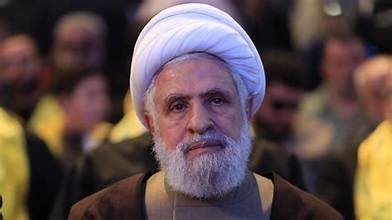
On October 29, 2024, Hezbollah announced the appointment of Naim Qassem as its new secretary-general. Qassem had served as Nasrallah’s deputy for decades and was one of the organization’s most prominent figures in organizational, political, and ideological affairs. His appointment represented a bet on institutional experience and continuity at an extraordinary moment of crisis. At the same time, it raised a question extending beyond the identity of the new leader: Can Hezbollah preserve its cohesion and influence amid declining military capabilities, growing domestic pressure for the state to establish a monopoly on arms, and continuing regional challenges?
Two years after Nasrallah’s assassination, the issue is no longer simply whether Qassem can fill his predecessor’s position. It also concerns the viability of the model on which Hezbollah was built—a model combining armed power, political representation, social-service networks, and a strategic relationship with Iran.
As of October 2026, the available picture does not suggest that Hezbollah has disappeared from Lebanon’s political landscape. Rather, it points to an increasingly complex environment in which the organization’s freedom of action is narrowing and the costs of its military and political choices are rising. Subsequent confrontations, disputes over Israeli withdrawal and Hezbollah’s weapons, and renewed debates about the relationship between Lebanese border security and state sovereignty have placed the future of the armed resistance at the center of the national debate.
I. Naim Qassem: From Institution-Building to Crisis Management
Background and Intellectual Formation
Naim Qassem was born in Beirut in 1953 into a Shiite family originally from the southern Lebanese village of Kfar Fila. He attended public schools before studying chemistry at the Lebanese University, where he earned a university degree and a master’s degree in 1977. He subsequently worked as a chemistry teacher while pursuing his interest in Islamic studies and jurisprudence.
Qassem’s background combines academic education, religious study, and early political activism. He participated in the Islamic student movement and joined the Amal Movement during its formative years. Following the disappearance of Amal’s founder, Imam Musa al-Sadr, in 1978, Qassem gradually distanced himself from the movement and moved toward the current that would subsequently take shape as Hezbollah.
Two major developments helped shape his political trajectory: the Iranian Revolution of 1979, which strengthened the appeal of Wilayat al-Faqih, or Guardianship of the Islamic Jurist, among its supporters; and Israel’s 1982 invasion of Lebanon, which created conditions conducive to the convergence of several Shiite Islamist groups under Iranian influence.
Within this context, Qassem emerged as a member of Hezbollah’s founding generation, although his role differed from that of the leaders who became prominent on the military front. He became associated with building organizational structures, developing ideological and educational programs, reinforcing internal discipline, and linking the movement’s political and social activities to its intellectual foundations.
This does not mean that Qassem alone shaped the organization or that his contribution can be separated from those of other founders. Nevertheless, he was among the figures who helped transform an emerging movement into an organization capable of operating through multiple institutions and sustaining itself over time.
From Deputy Secretary-General to Leader
Qassem became deputy secretary-general in 1991 and remained in the position for more than three decades. This gave him extensive experience of the organization’s political and institutional transformations, from the Lebanese Civil War and parliamentary participation to confrontation with Israel and intervention in the Syrian conflict.
Unlike Nasrallah, whose public speaking and personal appeal gave him a broad popular following, Qassem became associated primarily with administration, organization, and ideological interpretation. This experience provided him with an intimate understanding of Hezbollah’s internal mechanisms, but it does not necessarily mean that he possesses the same leadership qualities for which his predecessor was known.
Leading an armed political organization under relatively stable conditions is fundamentally different from leading it after the loss of senior officials, damage to its communications and operational capabilities, and growing pressure to reconsider its domestic and regional role.
Qassem’s appointment can therefore be understood as an attempt to preserve institutional continuity at a moment of profound disruption, rather than as evidence that Hezbollah has overcome its crisis or recovered its former capabilities.
II. Hezbollah Between Armed Resistance and Political Participation
One of the most significant episodes associated with Qassem was the internal debate over Hezbollah’s participation in Lebanon’s political system following the 1989 Taif Agreement.
The organization faced a dilemma over how to operate within a state whose political system is based on confessional power-sharing while its own ideological foundations are rooted in an Islamic political doctrine extending beyond national borders. Hezbollah ultimately chose to participate in the 1992 parliamentary elections while retaining its weapons and its commitment to armed resistance.
This decision represented a major transformation. Hezbollah was no longer simply an armed movement operating outside state institutions. It became a political actor participating in parliament, forming electoral alliances, negotiating government arrangements, and expanding its presence across social and service sectors.
The combination of political activity, military capabilities, and social-service networks helped Hezbollah build a broad support base, particularly among those who viewed it as a force capable of confronting Israel and representing the interests of communities that had historically experienced political and economic marginalization.
Yet this model also contained a structural contradiction that has remained central to Lebanese politics: How can a party participate in state institutions while retaining an independent military decision-making process and an arsenal that is not fully subordinate to the army’s command?
Hezbollah’s supporters argue that its weapons provide a deterrent capability that the Lebanese state cannot independently sustain, given the army’s limited resources and the military imbalance with Israel. They maintain that abandoning these weapons without guarantees of Israeli withdrawal and protection against future attacks would expose Lebanon to additional security risks.
Critics, by contrast, argue that the existence of an armed force independent of the state undermines national sovereignty and allows a partisan organization to make decisions with nationwide consequences without comprehensive institutional consent. They also point out that repeated wars impose substantial economic and humanitarian costs on all Lebanese, including those who have no role in determining Hezbollah’s military decisions.
This disagreement cannot be reduced to a confrontation between supporters and opponents of resistance. It also concerns the distribution of power, the limits of national decision-making, the state’s capacity to protect its citizens, and the guarantees required to prevent another war.
III. Relations with Iran: Between Ideological Allegiance and Strategic Dependence
Iran occupies a central position in Hezbollah’s ideological and strategic structure. The relationship extends beyond political cooperation or military and financial support; it is also rooted in the organization’s embrace of Wilayat al-Faqih, a doctrine that assigns Iran’s supreme leader a position of religious and political authority within the framework adopted by Hezbollah.
Qassem argues that participation in Lebanon’s political system is not incompatible with this ideological commitment. He distinguishes between overarching strategic and doctrinal principles and the administration of local and tactical affairs, which he maintains are the responsibility of the Lebanese leadership.
This interpretation, however, does not resolve the debate over the limits of Hezbollah’s decision-making autonomy. The issue is not simply whether the organization maintains its own Lebanese institutions, but whether it can make decisions concerning war, escalation, and political settlement independently of Tehran’s calculations.
From Hezbollah’s perspective, Iranian support is a source of deterrence, resources, and the capacity to counter Israel’s military superiority. From the perspective of its critics, the relationship exposes Lebanon to regional conflicts whose objectives do not necessarily coincide with the priorities of the Lebanese state or the interests of all its citizens.
Following the deaths of Nasrallah and Safieddine, the extent to which the relationship with Iran has fundamentally changed remains a question requiring detailed evidence. It would be premature to conclude that the relationship has definitively shifted from partnership to direct subordination. Nevertheless, leadership losses, military disruption, and the difficulties of maintaining supply and financing channels have made the reorganization of relations between Hezbollah’s Lebanese leadership and Iranian decision-making centers increasingly important.
Continued Iranian support, moreover, does not automatically mean that Hezbollah can recover its former influence. External resources alone cannot replace lost field experience or resolve the organization’s domestic legitimacy challenges, reconstruction needs, and tensions with state institutions.
IV. The 2024 War and Its Impact on Hezbollah’s Structure
The Israeli strikes targeting Hezbollah’s leadership in the autumn of 2024 exposed the risks associated with concentrating substantial leadership and military expertise within a relatively limited network of senior officials. The deaths of Nasrallah and other prominent commanders disrupted the organization’s command structure and forced it to reorganize its responsibilities while facing sustained military pressure.
This does not mean that Hezbollah lost all its capabilities or that its institutions collapsed entirely. Organizations with established social constituencies, administrative networks, and accumulated experience can sometimes absorb the loss of senior leaders. However, organizational survival is not the same as the ability to restore deterrence, recover freedom of action, or impose the political terms from which the organization previously negotiated.
Three dimensions of power are particularly important:
-
Military power: This includes weapons, operational capabilities, intelligence, communications, and the ability to rebuild command structures.
-
Political power: This concerns parliamentary representation, alliances, and the capacity to influence government decisions and state institutions.
-
Social power: This rests on the confidence of the organization’s support base, its ability to provide services and compensation, its contribution to reconstruction, and the extent to which communities accept the costs of its strategic choices.
An organization may retain influence in one of these dimensions while losing ground in the other two. Its future therefore cannot be assessed solely by counting its remaining fighters or weapons. Nor does its continued participation in politics establish that it has recovered its previous position.
Qassem and the Strategy of Continuity
Following Nasrallah’s death, Qassem’s public statements emphasized the organization’s ability to continue operating despite the loss of senior leaders. This messaging can be understood as an attempt to reassure supporters and prevent adversaries from concluding that military strikes had ended Hezbollah’s capacity to function.
His rhetoric also increasingly presented endurance and organizational survival as measures of success, rather than tying the outcome to clear military superiority or a decisive shift in the regional balance of power.
This shift has two implications. On the one hand, it can help preserve internal cohesion during a period of severe pressure and prevent military losses from automatically becoming political collapse. On the other hand, it risks widening the gap between rhetoric and reality if the organization continues to lose its ability to protect supportive communities, deter attacks, or mobilize the resources needed for reconstruction.
Describing survival as victory may therefore serve an important internal mobilization function, but it does not settle the objective assessment of the war’s outcome. Such an assessment requires consideration of human and material losses, remaining military capabilities, the organization’s position within state institutions, and its influence over strategic decisions.
V. Lebanon After Nasrallah: Reopening the Question of Sovereignty and Arms
The war returned the question of the state’s monopoly on weapons to the center of Lebanese political debate. Before 2024, Hezbollah’s military and political influence constrained its opponents’ ability to turn disarmament into an enforceable government policy. Following the strikes against the organization, opportunities expanded for efforts to strengthen the army and extend the authority of official institutions over security and defense.
This shift does not mean that the Lebanese state can automatically impose its authority in every area or implement disarmament without risk. The army operates under constraints involving resources, equipment, and logistical capabilities. Moreover, Lebanon’s confessional political system makes major security decisions particularly sensitive.
In 2025, the Lebanese government endorsed a process intended to place weapons outside state control under its authority and tasked the army with preparing an implementation plan. However, implementation encountered disagreements over the plan’s scope and timetable, as well as Hezbollah’s objections to the proposed approach to its weapons.
In 2026, the weapons issue became increasingly intertwined with negotiations over border security and Israeli military presence in southern Lebanon. The framework agreement announced in June 2026 indicated that a gradual Israeli withdrawal and the verification of disarmament by non-state armed groups had become part of the same negotiating process, under American sponsorship. However, implementation mechanisms remained disputed, and differences persisted between the Lebanese government and Hezbollah.
These developments reveal an interconnected political and security dilemma: How can the state restore its monopoly on weapons while Israeli threats continue, and how can southern Lebanon be secured without maintaining an independent military structure outside official institutions?
From Hezbollah’s perspective, Israeli withdrawal and guarantees of Lebanese security must precede any agreement on weapons. Otherwise, surrendering deterrent capabilities in the presence of Israeli forces could create a security vacuum. Supporters of strengthening state authority, by contrast, argue that independent arms obstruct the development of a national defense strategy and leave the decision to escalate outside full constitutional oversight.
This dilemma cannot be resolved simply by either side declaring political victory. It requires practical arrangements addressing Israeli withdrawal, army deployment, border monitoring, verification mechanisms, non-aggression guarantees, and the future of military capabilities outside state control.
Has Lebanon Regained the Initiative?
The room for maneuver available to Hezbollah’s opponents and state institutions has undoubtedly expanded compared with the Nasrallah era. However, concluding that the Lebanese state has fully restored its sovereignty would be premature.
Sovereignty is measured not only by the government’s ability to issue decisions but also by its capacity to implement them sustainably, secure the borders, prevent external attacks, and preserve domestic stability. If the reorganization of weapons is not accompanied by stronger army capabilities and workable security arrangements, poorly calibrated pressure could intensify tensions rather than resolve the dispute.
Conversely, difficulties in implementation cannot provide a permanent justification for an exceptional arrangement in which the authority to use force is divided between the state and an independent armed organization.
The real test for Lebanese institutions is therefore whether they can combine sovereignty with effective security without sliding into domestic confrontation or granting any party a permanent veto over the state.
VI. The Shiite Duo: A Lasting Alliance or a Redistribution of Roles?
The alliance between Hezbollah and the Amal Movement, led by Parliament Speaker Nabih Berri, has been one of the principal pillars of Shiite political representation in Lebanon for decades. It has combined Hezbollah’s military and organizational strength with Amal’s political and parliamentary networks and its capacity to engage with Lebanese and international actors.
As Hezbollah’s freedom of action has narrowed, Berri’s role as an intermediary between the organization and state institutions, between Shiite political forces and their opponents, and between Lebanon and external actors has become increasingly significant.
It would nevertheless be inaccurate to assume that these differences will inevitably lead to a split. Both organizations have strong incentives to preserve coordination, particularly to protect Shiite political representation and prevent its marginalization under new arrangements. At the same time, they may differ over the limits of confrontation, the priorities of negotiations, and the costs of continued political isolation.
This situation could produce a practical division of responsibilities: Hezbollah would maintain its ideological and military positions, while Berri would concentrate on mediation and political compromise. The success of this approach, however, depends on the ability of both sides to contain disagreements and prevent them from developing into competition for influence within the Shiite community itself.
These questions have become more consequential as the economic and social costs of the war have increased. Social assistance and reconstruction are no longer merely instruments for maintaining political support; they have become tests of the ability of political organizations to respond to people’s needs amid a profound economic crisis.
Amal After Berri
Berri’s continued influence raises another question: what happens when he eventually leaves the political scene?
His leadership of Amal and the speakership of parliament for decades has been closely associated with a network of political relationships and arrangements that may prove difficult to transfer in full to a successor.
However, predictions about a specific successor or an inevitable internal struggle remain speculative unless supported by clear developments. Any leadership transition is likely to test Amal’s ability to balance three requirements: preserving organizational unity, maintaining political representation, and sustaining channels of communication with Lebanese and regional actors.
If Amal succeeds in establishing clearer institutional succession mechanisms, it may preserve its position and continue to play a mediating role. If the transition instead produces intense internal competition, its ability to perform that function could diminish, affecting both the balance of power within the Shiite community and the movement’s relationship with Hezbollah.
VII. The Shiite Community and the Costs of War
Hezbollah’s future cannot be understood solely through its relationship with the Lebanese state and Iran. Its relationship with the social constituencies on which it relies remains a decisive factor in its ability to endure.
For decades, this relationship rested not only on the rhetoric of resistance but also on networks providing healthcare, education, social assistance, and financial support, as well as on the perception that the organization offered protection against external threats.
The war, however, has caused extensive human and material losses and widespread displacement. It has also raised questions about Hezbollah’s ability to prevent further destruction, provide compensation, and contribute to rebuilding affected areas. Continuing financial restrictions, sanctions, and difficulties in accessing funding have made these tasks even more challenging.
Nevertheless, damage to the organization’s social base should not automatically be equated with a comprehensive political break. Support may persist because of identity, communal affiliation, security concerns, and the absence of convincing alternatives, even as criticism of military decisions and crisis management grows.
Conversely, historical support cannot be assumed to remain unchanged regardless of the costs. The daily experiences of displaced people, the condition of damaged villages, employment opportunities, public services, and the future prospects of younger generations can all influence political attitudes and understandings of collective security.
The most significant question is therefore not whether the Shiite community has abandoned Hezbollah, but whether the space for internal debate has expanded on issues that were once highly sensitive: the relationship between Lebanese priorities and regional commitments, the costs of maintaining weapons, the limits of participation in regional wars, and the conditions necessary for reconstruction.
If this expansion of debate continues, it could have long-term consequences even without producing an immediate change in electoral representation or organizational structures.
VIII. Hezbollah in the Region: Declining Capabilities or a Changing Role?
Hezbollah has never been exclusively a Lebanese actor. Since its emergence, it has been connected to a broader Iranian strategy, and its activities have extended into several regional arenas, most notably Syria. These relationships provided resources, experience, and influence beyond Lebanon’s borders, but they also exposed the organization to regional conflicts and changing priorities among its allies.
Syria and the Changing Strategic Environment
Hezbollah justified its intervention in the Syrian war from 2012 onward as necessary to protect Lebanon from armed groups, secure border areas and supply routes, and prevent the collapse of a strategic ally of Tehran. Its opponents, by contrast, viewed the intervention as a shift from resistance against Israel to participation in an internal Arab conflict, deepening regional and sectarian divisions.
The Syrian deployment gave Hezbollah combat experience and expanded its operational networks. At the same time, it imposed human and political costs and tied part of its capabilities to the course of the Syrian conflict.
As the regional environment changes, the conditions under which the organization previously operated cannot be assumed to remain intact. The future of its supply networks, deployments, and military cooperation depends on political and security developments across the region and on the ability of Iran and its allies to preserve channels of coordination.
It is important to distinguish a decline in cross-border operational capacity from the complete disappearance of regional influence. Some forms of activity may diminish while others, including political coordination, logistical support, or security cooperation, continue.
Relations with International Powers
Qassem maintains a sharply critical position toward American and Israeli policies and rejects sanctions imposed on Hezbollah and its financial networks, arguing that they target the organization’s social base and its ability to survive. The United States and its allies, by contrast, view sanctions and financial pressure as instruments for limiting Hezbollah’s ability to fund its military activities and associated networks.
Closer relations with Russia and China should not be treated as a guaranteed substitute for Iran or as a sufficient means of compensating for losses. Moscow and Beijing have their own calculations and interests, and political alignment does not necessarily translate into a willingness to bear the financial and security costs of supporting Hezbollah.
The organization’s ability to adapt regionally will therefore depend on the availability of resources, the surrounding security environment, the willingness of external actors to continue supporting it, and its capacity to avoid additional conflicts that would increase its domestic burdens.
IX. Qassem’s Leadership and Its Limitations
Qassem’s personality and leadership style differ from the image associated with Nasrallah. The latter had considerable rhetorical appeal and the ability to address Hezbollah’s supporters, its opponents, and wider Arab audiences simultaneously. Qassem, by contrast, is more closely associated with organization, ideological interpretation, and institutional management.
Turning this difference into a definitive judgment about weak leadership, however, would oversimplify the issue. Charisma is not the sole measure of success for the leader of an armed political organization, just as an administrative style does not necessarily imply an inability to manage a crisis.
Qassem’s organizational experience may be valuable in a period requiring institutional reconstruction, the management of internal disagreements, and the preservation of cohesion. Yet that experience alone cannot guarantee the restoration of military deterrence, social confidence, or the capacity to negotiate political compromises.
Qassem faces three interconnected tests:
-
The organizational test: Rebuilding command and communication structures, distributing responsibilities, and ensuring institutional continuity despite leadership losses.
-
The political test: Responding to pressure to bring weapons under state control without losing political representation or provoking domestic confrontation.
-
The social test: Convincing the organization’s support base that its continued existence serves its security and livelihood interests rather than repeatedly exposing it to the costs of conflict.
His prospects also depend on the degree of autonomy he can exercise in decision-making, the nature of his relationship with Hezbollah’s internal leadership and Iran, and his ability to balance ideological commitments with practical necessities.
X. Between Rebuilding Hezbollah and Redefining Its Role
Three broad scenarios can be envisaged for Hezbollah’s future, although none can be considered inevitable.
Scenario One: Continuity Through Adaptation
The organization succeeds in reorganizing its leadership and social and political networks, retains a substantial support base, and accepts practical adjustments to its operations or security arrangements. This scenario does not require the immediate disappearance of its military role, but it does require adaptation to a different balance of power.
Scenario Two: Transformation into a More Constrained Political Actor
Hezbollah’s military autonomy gradually diminishes, and the organization becomes increasingly dependent on parliamentary activity and domestic alliances. This outcome would depend on credible security arrangements and an internal understanding that prevents the weapons issue from turning into a sectarian confrontation.
Scenario Three: Continued Attrition and Decline
The organization fails to rebuild effectively, internal divisions deepen, and its capacity to provide services and maintain deterrence deteriorates, while government and international pressure increases. This could result in a narrower sphere of influence or a redistribution of power within the organization, without necessarily leading to its disappearance.
These scenarios are not entirely mutually exclusive; developments on the ground may combine elements of more than one. Their outcomes will also depend on decisions made by Iran, Israel, and the Lebanese government, as well as on the capabilities of the Lebanese army, economic and social conditions, and the success of diplomatic efforts.
Hezbollah’s future should not be reduced to the question of who succeeds its secretary-general. An organization with decades of experience in political, social, religious, and military institution-building may survive changes in leadership. Conversely, its influence may decline even if its leadership remains formally united.
XI. What Do the Developments of 2026 Tell Us?
By September and October 2026, Hezbollah’s challenge was no longer limited to dealing with the consequences of the 2024 war. Lebanon experienced another round of confrontation in 2026 after Hezbollah entered the conflict in the context of the wider American-Israeli confrontation with Iran. Pressure subsequently intensified over disarmament and Israeli withdrawal from Lebanese territory.
These developments reveal the continuing contradiction at the heart of Hezbollah’s position. On the one hand, Qassem maintains that weapons are necessary to confront Israel and links any agreement on their future to Israeli withdrawal and the return of residents to affected areas. On the other hand, he has expressed willingness to engage in dialogue with the state over the monopoly on arms, provided that the process is not dictated by external powers, according to his statements in October 2026.
This position suggests that the dispute is no longer exclusively about the principle of retaining weapons. It also concerns the sequencing of steps, the guarantees required, and the authority responsible for determining them. The Lebanese government seeks to expand state authority; Hezbollah wants to avoid disarmament while it considers the Israeli threat unresolved; and Israel links withdrawal to security arrangements that include disarmament and verification.
The persistence of these differences means that any settlement will have to address competing security concerns rather than merely juxtapose opposing political declarations.
Recent developments also make it difficult to treat Hezbollah’s military decline or political survival as a settled outcome. The renewed war, economic pressure, and reconstruction needs may all reshape the calculations of the organization, its support base, and the Lebanese state.
Conclusion: What Kind of Hezbollah Will Remain?
Two years after Hassan Nasrallah’s assassination, it has become clear that Hezbollah is facing a crisis extending well beyond the loss of its historic leader. Its central challenge is how to preserve its organization and influence in an environment where the balance of power has changed, the question of weapons has become more closely tied to the future of the Lebanese state, and the costs of its regional commitments have become more difficult to absorb.
Naim Qassem has extensive experience in managing the party’s institutions and a detailed understanding of its ideological and political structures. These qualities may help him preserve a minimum level of cohesion. His success, however, will not be measured by his ability to imitate Nasrallah or reproduce his public image, but by his capacity to manage transformations that have made the previous model increasingly difficult to sustain.
At the same time, Hezbollah’s military setbacks cannot, on their own, be taken as evidence that its social base or political influence has disappeared. The organization may continue to adapt, drawing on its institutions, accumulated experience, and support networks, even if it is forced to redefine its objectives and the limits of its role.
Lebanon faces an equally complex test: restoring state authority over decisions of war and peace, protecting its borders, and rebuilding damaged areas without allowing disarmament to trigger another domestic confrontation—or allowing the continued existence of independent arms to become a permanent obstacle to the development of effective national defense institutions.
Israel’s responsibility for the consequences of its military operations and its military presence in Lebanese territory must not be overlooked. Nor should the domestic dispute over Hezbollah’s military decisions and their costs for the country be ignored. A balanced assessment requires consideration of these factors together rather than reliance on the narrative of any single party.
Ultimately, Hezbollah’s future depends on three interconnected transformations: its ability to rebuild its institutions, the nature of its relationship with the social constituencies on which it relies, and the outcome of Lebanon’s struggle over sovereignty and weapons. The future of its relationship with Iran and the trajectory of regional conflict will also shape these developments.
The question is no longer simply who can succeed Hassan Nasrallah, but whether Hezbollah can transform itself from an organization whose power rested substantially on military autonomy and regional influence into an actor capable of enduring in Lebanon under new conditions—without losing its identity or imposing costs on the country that it can no longer bear.
This is the central dilemma of the Naim Qassem era: not merely preserving Hezbollah as it was, but determining what it can become—and whether that transformation will allow Lebanon to restore stability and sovereignty or leave the country trapped between the logic of arms and the logic of the state.
Editorial Note on Objectivity and Sources
This article is an analytical rewriting of the original material, with its timeframe updated to reflect developments available as of October 11, 2026. For conversion into a fully documented research paper or publication-ready journalistic study, details concerning Hezbollah’s internal succession, decision-making between Beirut and Tehran, internal power dynamics within the Amal Movement, and the outcomes of Lebanese-Israeli negotiations should be independently verified.
The final version should also distinguish clearly between established facts, statements by the parties involved, and assessments that remain contested.
Most read




Read also