

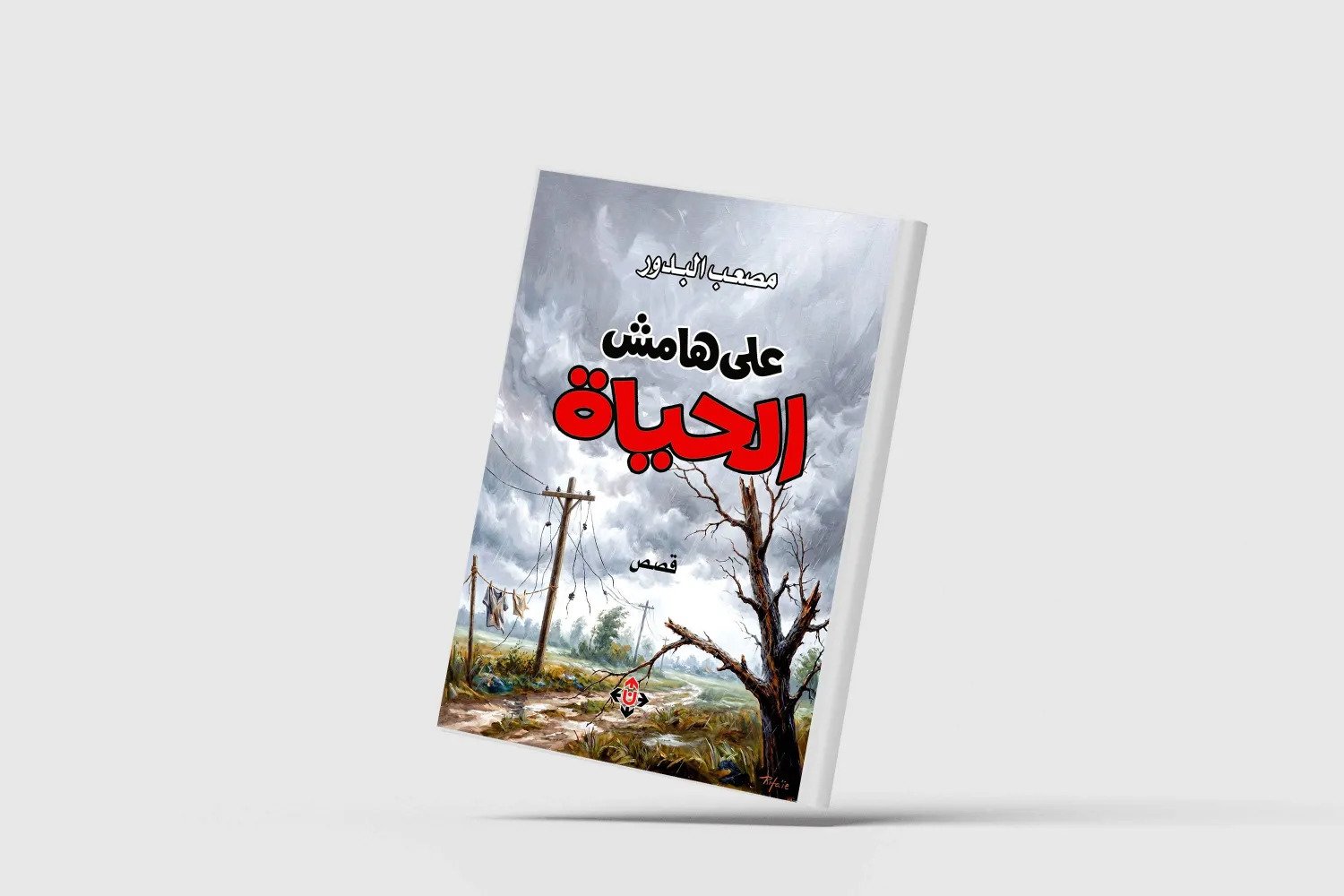
In his short-story collection On the Margins of Life (Ala Hamish al-Hayat), published by Alaan Publishers and Distributors in Jordan in 2026, Musab Al-Bdoor revisits a social world shaped not merely by nostalgia for the past, but by an attempt to examine the transformations that have affected individuals, society, and shared values. Through nine stories rooted in childhood memory, Al-Bdoor reconstructs the experience of a Jordanian generation that grew up with limited material resources but within a social environment rich in solidarity, cooperation, contentment, and adaptability.
Memory in the collection is not simply a repository of old stories. It becomes a means of understanding the present. By recalling details of childhood, family, neighbors, games, and ordinary daily experiences, the author implicitly invites the reader to compare two different periods: a past characterized by modest living conditions and strong social bonds, and a present marked by increasingly complex relationships, needs, and rhythms of everyday life.
It is through this perspective that the collection acquires its broader cultural significance, moving beyond the author’s individual experience to approach the collective memory of an entire generation.
When Individual Memory Becomes Collective Memory
The publisher notes that the stories in the collection “are not a record of events that happened to specific individuals,” but rather artistic images inspired by social reality and shared memory, in which fact and imagination merge.
This space between reality and fiction allows the stories to move beyond straightforward autobiography. The central question is therefore not whether these events actually happened, but rather: Why do they feel so familiar?
The answer lies in Al-Bdoor’s reliance on details that could belong to the experiences of many members of the same generation: the home, family, neighborhood, friends, cold weather, games, deprivation, and modest childhood desires. Individual experience thus becomes an entry point into a much broader social experience.
It is a form of memory that does not preserve major historical events, but rather those details that are often excluded from historical narratives: a child’s game, a family incident, the warmth of a home, a disagreement between siblings, or an act of solidarity among neighbors.
These details matter precisely because they exist “on the margins” of official history, while in reality constituting an essential part of a society’s history and everyday culture.
The “Margin” as the Center of the Story
The title of the collection itself offers an important key to its interpretation. For Al-Bdoor, life is the larger central text, while the stories function as marginal notes written around it.
The paradox, however, is that these margins often prove more revealing than the central text itself.
Major transformations in societies are not visible only through political decisions, economic developments, or historical events. They can also be traced through changes in family structures, methods of raising children, relations between neighbors, children’s games, and the images people retain of their parents and childhood homes.
In this sense, the “margin” ceases to be secondary. Instead, it becomes a space in which realities overlooked by grand narratives can be uncovered.
This helps explain the collection’s organization into nine “marginal notes,” all of which, despite their different stories, return to the childhood memories of an entire generation. It is as though the author is writing annotations in the margins of a vast book called life, attempting to rescue small details from oblivion.
The Child Who Never Fully Leaves the Adult
The child is perhaps the clearest connecting thread running through the collection. The body grows older, but the child never completely disappears. Childhood remains alive in memory, allowing the adult to revisit the first ways in which the world was seen and understood.
This childhood is not necessarily idealized. It is a space of wonder and play, but also one of fear, deprivation, and hardship.
In the face of limited resources, childhood imagination becomes a form of compensation. A child can construct an entire world out of simple objects, assign emotional value to a toy far beyond its material worth, and transform limited surroundings into a vast landscape of adventure.
Yet what appears during childhood to be merely a game or an ordinary incident returns in adult memory carrying different meanings. The past is now interpreted through the knowledge of the present, and memory becomes an attempt to understand how the individual personality was formed.
At this point, the collection moves from simply recovering childhood to reflecting on its lasting impact.
The child does not merely remember what happened; years later, the adult begins to understand what those experiences did to them.
The Family as the First Workshop of Identity
Family relationships occupy a central place in On the Margins of Life. Fathers, mothers, and siblings are not merely figures surrounding the child; they are fundamental forces in shaping the child’s understanding of both self and world.
Within the family, individuals first encounter the meanings of security and fear, acceptance and rejection, authority and affection, competition and solidarity.
The family therefore appears in the collection with two interconnected faces. It is a source of warmth and protection, but it can also be the source of wounds whose effects continue long after childhood has ended.
This duality gives the stories much of their human depth. The author does not present the family as an ideal institution, nor does he reduce it to a permanent source of hardship. Instead, he approaches it as the first environment within which the personality is formed, with all its contradictions.
The person who emerges in adulthood is, to a significant degree, the product of those early relationships: the words they heard, the situations they experienced, the way parents and siblings treated them, and the space they were given to dream, fear, make mistakes, and discover themselves.
Childhood Innocence Confronting a Harsh Reality
One of the collection’s most prominent tensions lies in the contrast between the innocence of childhood and the harshness of the surrounding world.
Children’s games can turn into small wars, innocent competition can become a desire for revenge, and cold weather can move beyond its physical meaning to become a symbol of deprivation and hardship.
Warmth, by contrast, acquires a significance beyond temperature. It becomes associated with home, family, protection, and belonging.
Through these contrasts, Al-Bdoor gives simple everyday details symbolic significance. A child searching for warmth may not simply be seeking protection from the cold, but security itself. A game that turns into a battle may become a miniature reflection of a world in which people learn competition, conflict, and self-defense at an early age.
Childhood memory thus becomes a magnifying mirror through which society itself can be observed.
Nostalgia Is Not a Romantic Return to the Past
At first glance, the collection might appear to belong to the literature of nostalgia. It recalls a generation that lived a simpler life and highlights values such as cooperation, contentment, and social solidarity.
Yet reading the collection solely through this lens risks reducing the complexity of its literary project.
Al-Bdoor does not portray the past as an ideal era free from suffering. Poverty, deprivation, hardship, and small conflicts are embedded within the memories themselves.
The comparison, therefore, is not simply between a beautiful past and a troubled present, but between two different ways of living.
Material resources may have been more limited in the past, but certain human relationships were more intense. Life may have been materially more difficult, yet those difficulties generated different mechanisms of adaptation, cooperation, and mutual dependence.
Nostalgia consequently becomes a cultural question: What has the individual lost during the transition from a simpler way of life to modern society?
The point is not to advocate a return to the past, but rather to identify the values that may have weakened or disappeared during this transformation.
Neighbors and Friendship: Community Beyond the Home
The collective memory of the collection extends beyond the boundaries of the family to include neighborhoods, neighbors, and friends.
Throughout the stories, moments emerge in which social solidarity becomes a means of confronting crises. The neighbor is not simply someone who lives next door, but part of a broader social network that provides individuals with a sense of protection and belonging.
Friendship across religious and social differences also appears as a model of human connection shaped more by everyday experience than by rigid classifications or closed identities.
These images become especially significant when compared with the transformations associated with modern life, in which relationships have expanded dramatically in terms of communication but have not necessarily become deeper in terms of human solidarity.
The recovery of the old neighborhood, neighbors, and friendships thus becomes a search for the meaning of “community” at a time when individualism is increasingly prominent.
Literature as an Archive of Everyday Life
On the Margins of Life highlights an important cultural function of literature: its ability to preserve what official documents often overlook.
History records wars, political transformations, economic crises, and major events. Literature, however, can record how ordinary people lived through such transformations: what they feared, how they played, how they related to their families, how they confronted poverty, and what home, neighbors, and friendship meant to them.
From this perspective, the collection can be read as a form of cultural archive of everyday life.
It is an archive that does not claim documentary precision, because reality and imagination inevitably intersect within it. Yet it preserves something that may be even more difficult to document: the emotional texture of an entire period.
What Musab Al-Bdoor seeks to rescue from oblivion is not simply a sequence of events, but a way of living, feeling, and seeing the world.
This is precisely why small details acquire such significance. What once appeared to be a marginal incident in a child’s life can, years later, become a key to understanding a generation, a society, and broader cultural transformations.
Ultimately, On the Margins of Life suggests that the margins may be far more important than they initially appear. Life is not made solely of major events whose dates we remember, but also of thousands of seemingly fleeting details that we later discover have shaped our memory and identity.
In this sense, the collection does more than recover individual childhoods. It retrieves a part of Jordanian social memory and places it in dialogue with the present—not to glorify the past, but to understand what has changed in both individuals and society, and what has remained alive despite the passage of time.
Most read