
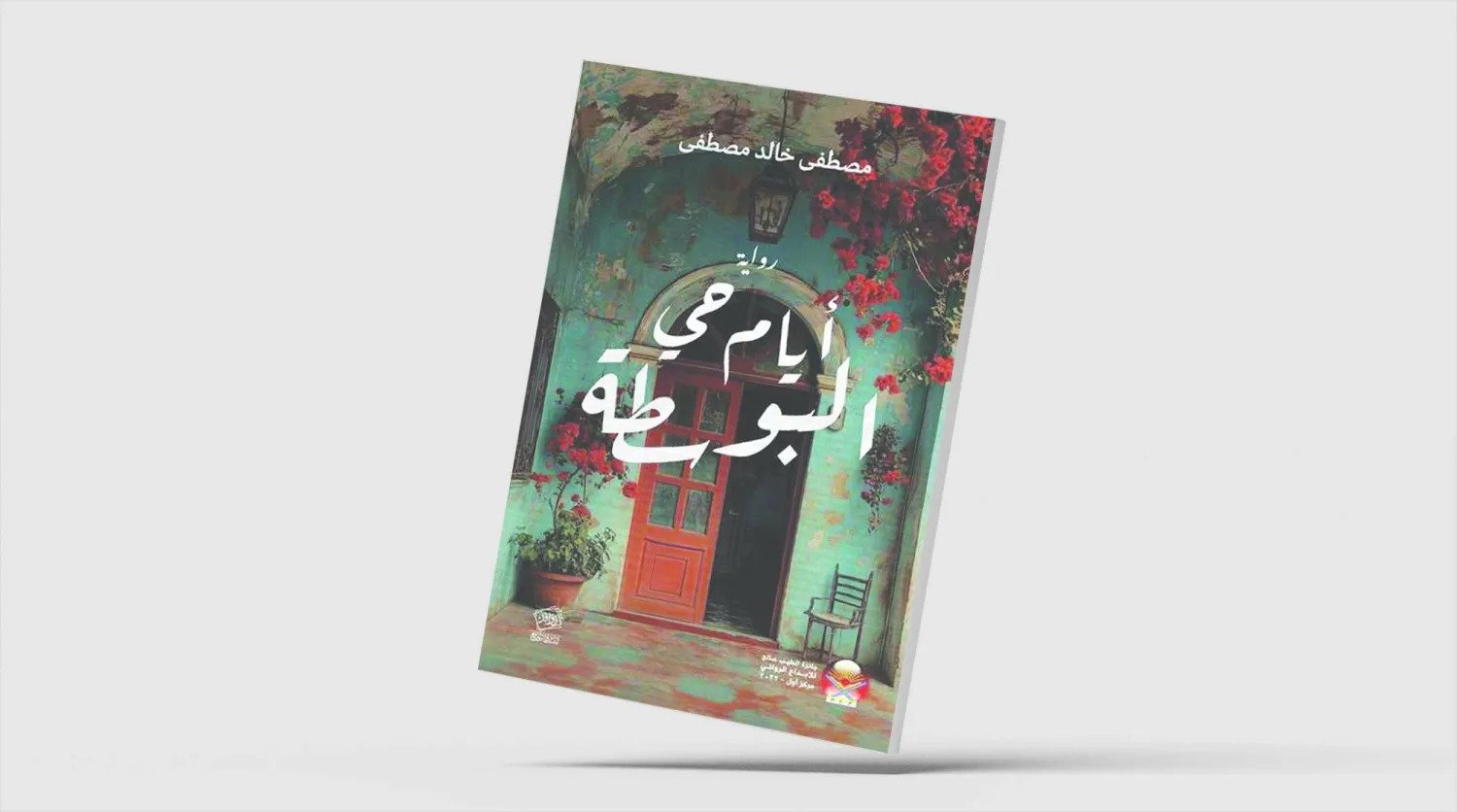
Mustafa Khaled Mustafa’s novel Days of Al-Bosta District is more than a literary evocation of an old neighborhood in Omdurman. It represents an attempt to examine society through the memory of place and the web of human relationships that developed within it. Recently published in Cairo by Rawafed Publishing and Distribution, the novel had previously won first prize, in manuscript form, in the Tayeb Salih Award for Literary Creativity, placing it among contemporary Sudanese literary works that seek to reconsider the relationship between the individual and the social environment, and between personal memory and collective memory.
The novel is set in Al-Bosta District in Omdurman, yet the author does not treat the neighborhood merely as a geographical backdrop for the events. Gradually, the district becomes a character in its own right, preserving the history of its inhabitants and the details of their everyday lives while bearing the traces of the transformations that have affected the society around them. Through this spatial setting, Mustafa weaves together a network of interrelated stories in which individual destinies intersect with broader social transformations. What takes place inside homes thus becomes an extension of what is happening in society, while the details of everyday life become a means of understanding the social and cultural structures that shape individual destinies.
One of the novel’s distinctive features is its interaction between personal experience and collective memory. The author draws some of his characters and stories from people and events he has encountered, but he does not reproduce these experiences in a documentary manner. Instead, he reshapes them within the fictional structure, giving them meanings that extend beyond the boundaries of individual experience. In this sense, one of the novel’s central functions is to transform private memory into material through which society itself can be examined, revealing dimensions of everyday life that may remain absent from official documents and grand historical narratives.
Women occupy a particularly significant position within the novel, with their experiences providing a window into a range of complex social and psychological issues. The narrative moves across different generations, allowing the reader to observe both the transmission of patterns of thought and behavior from one generation to another and the transformations affecting family and social relationships. Through its female characters, the novel addresses issues including patriarchal violence, marriage, mental illness, and the fragmentation of family relationships, while exploring the social and cultural pressures that shape individual identities, choices, and destinies.
The author does not present these issues as isolated phenomena. Instead, he places them within an interconnected network of relationships. Violence within the family, for instance, is not portrayed simply as an individual behavior but as a phenomenon that can be understood within a broader system of authority, social expectations, and cultural norms. Likewise, mental illness is not presented merely as a medical condition. It intersects with the family’s and society’s perceptions of the patient and with the roles that family members are compelled to assume in dealing with illness and its consequences.
One of the novel’s most significant narrative spaces is its treatment of mental illness. Rather than limiting itself to a description of a clinical condition, the novel explores the impact of illness on human relationships and everyday family life. One passage reveals this dimension through the relationship between a daughter and her mother and the psychological transformation the daughter experiences upon entering the hospital:
“The moment you enter the hospital gate with Shadia, your face changes and you feel an unbearable weight upon your chest. Many people have told your mother that the patient among the two of you is actually you [...]”
The passage illustrates the author’s approach to mental illness: it is not narrated from an external or purely clinical perspective, but explored through its impact on human relationships and family life. The hospital itself becomes a narrative space parallel to the neighborhood, where the stories of different patients intersect and new relationships emerge. Individual suffering consequently becomes part of a broader collective experience in which pain, isolation, and the need for understanding converge.
Significantly, the narrator does not remain solely focused on her mother’s condition. Over time, she grows closer to other patients, learning about their lives and personal histories and recognizing aspects of her own experience in theirs. The circle of empathy thus expands beyond the relationship between daughter and mother to encompass other individuals, each carrying a personal story marked by suffering. In this respect, the novel approaches mental illness as a human and social experience that cannot be reduced to medical diagnosis alone.
From this perspective, Days of Al-Bosta District can be read as a novel about relationships as much as it is a novel about place. The meaning of the neighborhood derives from the people who inhabit it, while the characters themselves are shaped by the social environment to which they belong. A reciprocal relationship therefore emerges between place and its inhabitants: the neighborhood preserves the memories of its residents, while the characters carry within their memories an image of the neighborhood, its history, and its transformations. The reconstruction of place consequently becomes, at the same time, a reconstruction of relationships, events, and conflicts preserved in collective memory.
This perspective also connects the novel to a broader question concerning the representation of the city in contemporary Sudanese literature. Omdurman is not simply a setting for the narrative; it is a social and cultural space carrying historical and human layers. By focusing on a relatively small neighborhood, the novel approaches Sudanese society through the details of everyday life rather than limiting its perspective to major political events or direct historical transformations. Social change can also be observed through family relationships, marriage patterns, relations between generations, and the ways in which society perceives illness, difference, and behavior that falls outside accepted norms.
This approach gives the novel a significance that extends beyond its narrative dimension. It enables readers to reflect on how individual destinies are shaped within social environments. A fictional character does not exist in isolation; rather, their choices and development are influenced by family history, patriarchal authority, social expectations, and the stereotypes imposed by the surrounding community. At the same time, the characters retain a capacity for resistance and for redefining themselves, creating a tension between individual aspirations and the expectations imposed by their social environment.
The interaction between generations is particularly important in this regard. The stories move across different generations, making it possible to compare changing patterns of thought and evolving values and relationships. This does not necessarily mean that the novel presents a linear transition from tradition to modernity. Rather, it reveals how older social structures may persist in new forms and how tensions emerge when circumstances change while certain assumptions and social norms remain deeply rooted.
Memory is therefore one of the central mechanisms through which the novel is constructed. It is not merely a repository of the past but a means of reinterpreting the present. The events and experiences recalled by the characters do not belong exclusively to a closed past; they continue to influence their relationships, choices, and perceptions of themselves and others. Days of Al-Bosta District therefore does not simply seek to recover a vanished period. It explores the ways in which the past continues to shape the present.
Mustafa Khaled Mustafa’s literary career provides a broader context for this work. A Sudanese physician and novelist born in Omdurman in 1998, he has published three literary works: Ghul Salima (a novel, 2020), The Begawi Tekiya (a novel, 2022), and The Noble Ceiling of Dreams (a short-story collection, 2023). He has also received several literary awards and grants, including the 2022 Tayeb Salih Award for Literary Creativity for Days of Al-Bosta District, the 2025 Bayt Al-Ghasham–Dar Arab International Translation Award for his novel Hah Hah... Cough Cough... I Escaped by a Miracle, the 2020 Nirvana Literary Award for his short story The War of Al-Bahlawan Street, and a 2023 Arab Fund for Arts and Culture (AFAC) grant for his short-story collection The Noble Ceiling of Dreams.
Taken together, this trajectory suggests a literary practice concerned with the individual in relation to his or her social environment and with capturing seemingly ordinary details that can reveal broader social transformations. In Days of Al-Bosta District, in particular, the central wager appears to be the transformation of everyday details into material for reflection, and the use of individual stories as an entry point into questions of family, society, memory, illness, authority, and human relationships.
Ultimately, the novel leaves the reader with a question that extends beyond the boundaries of the neighborhood in which its events unfold: To what extent can a place preserve the traces of its inhabitants, and to what extent can an individual free themselves from the social memory that has shaped their consciousness and destiny? Between old Omdurman and the memories of its characters, Days of Al-Bosta District constructs a fictional world in which private stories become part of a larger narrative about society, while place itself is transformed from a mere setting into a living archive of human experiences, aspirations, disappointments, and the transformations that have left their mark on collective memory.
Most read