
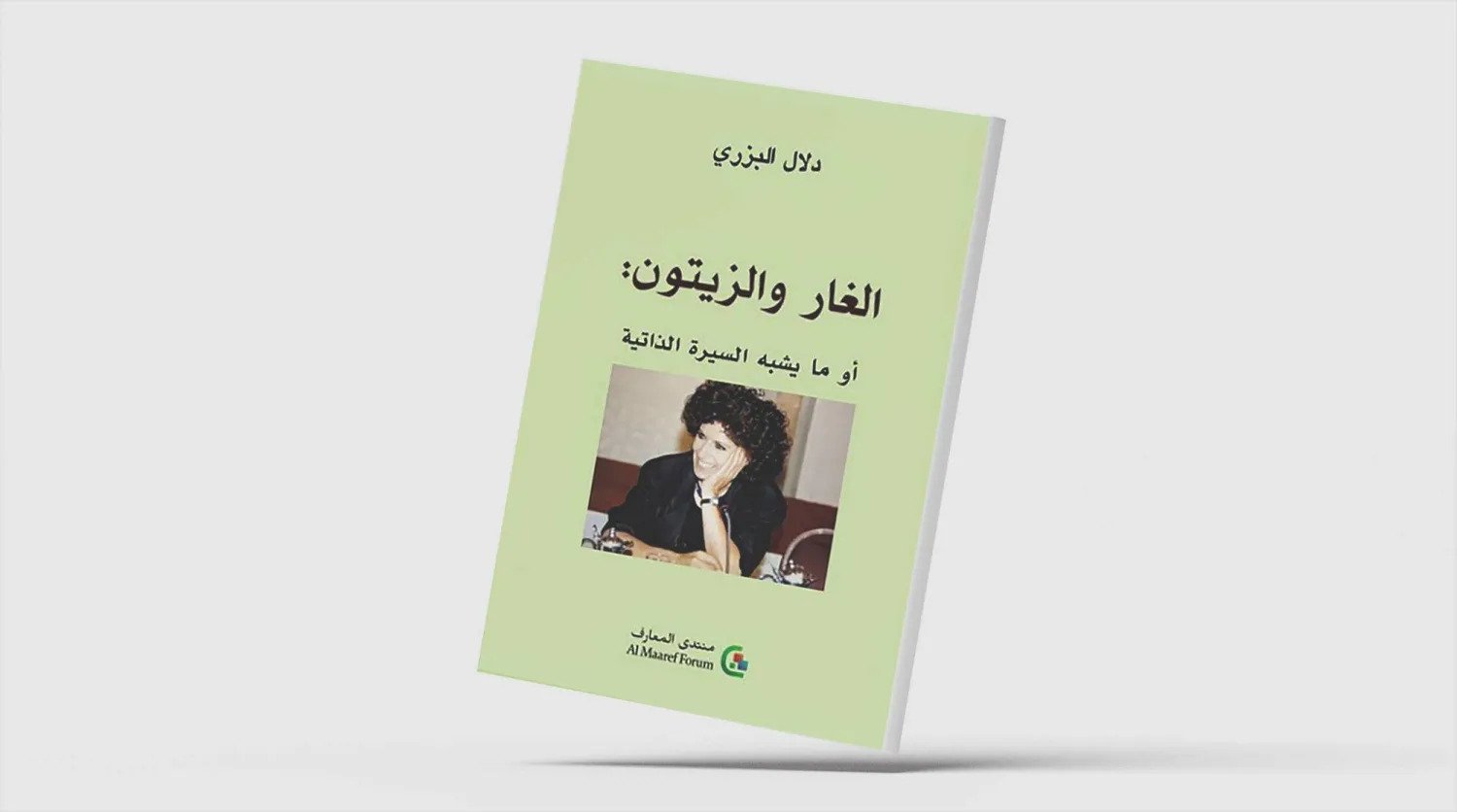
When Lebanese sociologist Dalal al-Bizri wrote her memoir, Laurel and Olive (Al-Maaref Forum, Beirut, 2026), she was not merely revisiting the events of a life that unfolded across decades, cities, and countries. She was also reexamining the very meaning of belonging—to one’s homeland, one’s memory, and the language through which one comes to understand the world. In this memoir, language is far more than a means of communication or a vessel for writing. It is a space where identity, memory, exile, and choice intersect, gradually transforming from an initial condition into a conscious decision.
Al-Bizri’s relationship with language appears inseparable from her life of movement. Human beings do not choose the language through which they first encounter the world; it precedes them, gives them their earliest vocabulary, and, to a considerable extent, determines the names they assign to things, the images they form of people, and the meanings they attach to places. Yet this initial condition does not necessarily remain fixed. Every geographical or cultural transition can open a breach in the first language, allowing other languages to enter and reshaping one’s relationship with both self and other. This is precisely what al-Bizri’s memoir reveals: a long journey from a language inherited by birth to a language chosen through consciousness.
Al-Bizri was born in Dakar, Senegal, to Lebanese parents, and French was her first language—the language that surrounded her at home, at school, and in the streets. Her mother spoke French, Arabic, English, and Wolof, the local language, while her father, despite his Nasserist Arabist sympathies, spoke to his children in French, motivated, as the author recalls, by laziness or “hurry.” French was therefore not a cultural choice in her childhood; it was simply the language of everyday life, the language through which things were understood and named and through which the first foundations of consciousness were formed.
Arabic was present in a different way. It came through recordings of Mohammed Abdel Wahab, through her parents’ conversations, and through occasional references to Lebanon and the Arab world. Yet it was not a lived language. It resembled an intimate family archive, blending tone, music, and nostalgia, without becoming a fully developed linguistic system in which the child could live. French thus appeared more immediate and more capable of producing meaning, while Arabic remained, in her early consciousness, a distant language charged with emotional resonances more than with everyday function.
The family’s move to Casablanca, however, altered this equation. There, Arabic and its various dialects began to draw closer to her everyday experience. Through the streets, school, and social environment, the child began to absorb Moroccan Arabic and develop a new linguistic memory. Yet French remained dominant, particularly at the school she describes as an almost entirely French space: French teachers, French curricula, and French as the prevailing language, while Moroccans constituted a minority, alongside a small number of Jews.
Her linguistic journey, therefore, was inseparable from her journey through places. Each city left a linguistic and cultural layer in her consciousness, and every move added new words to her internal map. From Dakar to Casablanca, then to Beirut, and later Cairo and Kuwait, al-Bizri was not simply moving across geographical spaces; she was moving between different linguistic, cultural, and social systems. The memoir thus emerges, in one of its essential dimensions, as a history of movement between languages as much as a history of movement between cities.
As she grew older, this linguistic transformation became increasingly intertwined with intellectual and political maturation. Al-Bizri did not turn toward Arabic as the result of a purely educational or nationalist choice, but as part of a broader process of reconstructing the self and engaging with public life. Upon entering university and becoming involved in leftist political activism, particularly within the Lebanese Communist Action Organization, language became part of an everyday social and political practice. Words were no longer merely vocabulary to be acquired; they became instruments of participation, argument, persuasion, and political expression.
At this point, the movement from French to Arabic acquires a meaning that extends beyond language itself. It becomes a transition from the language of educational elites to the language of the social and political sphere, and from the language in which her earliest consciousness was formed to the language she consciously chose to address her society and establish her intellectual presence within it. Arabic, in this sense, became part of the construction of the self rather than merely a means of expressing it.
This perhaps explains the distinctive character of al-Bizri’s experience. She did not abandon French, nor did she regard it as a language that had to be discarded for her Arab identity to be complete. On the contrary, French remained deeply embedded in her cultural, aesthetic, and intellectual formation. What changed was the hierarchy between the two languages. French was no longer the center and Arabic the margin; instead, the two became intertwined fields of thought and writing.
Al-Bizri writes: “I love French; I enjoy its literature and even the speeches of its leaders, the elegance and richness of their language. I benefit greatly from its translations... I move between Arabic and French. I search for the most accurate and precise word...” This movement between the two languages reveals one of the central features of her experience: the first language is no longer a prison, while the second does not become an exclusionary substitute. Both instead become tools for comparison, precision, and the production of meaning.
Significantly, al-Bizri describes a gradual reversal in the direction of her search for meaning. Whereas she once moved from French to Arabic in search of an equivalent or an explanation, she eventually found herself looking for the meaning of Arabic words in French. This is not merely a linguistic observation; it signals a deeper transformation in the center of gravity of her consciousness. Arabic, which had begun her life as a distant and ambiguous language, had become a language from which she could move outward toward another.
Language thus becomes, in Laurel and Olive, almost a memoir within the memoir. As the narrative advances, language repeatedly emerges as a mirror of personal transformation. The movement from one school to another, from one city to another, from education to politics, and from academic work to journalism and writing all contributed to reshaping her relationship with language. Acquiring Arabic was not separate from acquiring the Arab world itself: the language became more intimate as experience drew closer, and more spontaneous as her engagement with social, cultural, and political life deepened.
This is what gives the memoir a significance beyond the individual story. It illuminates the experience of an entire generation of Arab intellectuals who, during the second half of the twentieth century, found themselves confronted with a profound cultural paradox: French and English as languages of modernity, education, and the elite, and Arabic as the language of society, identity, and memory. Yet al-Bizri does not present the issue as a conflict between two languages. Rather, she portrays it as a prolonged negotiation between multiple selves within a single person.
Her return to Arabic, therefore, does not appear as an ideological return to an imagined “origin.” It is instead an attempt to find a language capable of remaining close to life. The Arabic she seeks is not rigid, purist, or closed; it is a living and shifting language, nourished by dialects, social interaction, political experience, and everyday detail. It is Arabic as a twin of life, rather than a monument to identity.
This perspective is also closely connected to the personality revealed by the memoir. Al-Bizri, as the book’s introduction by Taha Hussein Labib suggests, is a “rebellious” figure who does not hesitate to question herself or reveal her dissatisfaction with aspects of who she has become. Her writing is therefore not an act of celebration of a personal trajectory so much as an interrogation of it. She revisits her successes and failures, political commitments and disappointments, movements and ruptures, as well as her relationship with language as one of the most ambiguous territories of the self.
It is striking that this memoir was written after al-Bizri left Beirut following the port explosion and settled in Toronto beside her daughter. Her final departure seems to have reopened all her previous journeys. After decades of moving between cities and countries, she found herself looking back on her life from a new geographical position, far from the city that had remained, despite war, division, sectarianism, and successive crises, a central part of her memory.
In this context, Laurel and Olive appears as an attempt to put memory in order before it becomes increasingly difficult to retrieve. The homeland to which al-Bizri returns in the book is not an idealized homeland, but one burdened by war, sectarian divisions, and political and social fractures. Likewise, the Arab world through which she traveled does not appear as a homogeneous space, but as a vast field of contradictions, transformations, and disappointments in political and social projects.
Yet the writing is not driven by bitterness alone. There is a clear desire to recover experience as it was lived, with all its contradictions and ironies, and with as little embellishment as possible. This is why the language of the memoir often feels restrained and dense, sharp at times and direct in many passages, as though the author refuses to add ornament to a life that requires none.
One of the most striking paradoxes is that a woman who spent her life searching for the language through which she could articulate herself ultimately chose to write her memoir in Arabic—the language that was not her first, but which, after a long journey, became her symbolic home. Perhaps this is the most beautiful paradox of the book: one may be born into one language and live among several, yet may not discover one’s true language until after traveling a long distance between them.
Laurel and Olive can therefore be read as a book about language as much as it is a book about life. It is the memoir of a woman who moved across geographies, identities, and intellectual currents, continually reshaping her relationship with words at every stage. In the end, language was no longer merely a means of recounting the past; it became the way through which the author reclaimed her right to look at that past, question it, disagree with it, and reconcile herself with some of its dimensions.
A few months after the book was published, al-Bizri announced on her Facebook page that she had been diagnosed with cancer. In retrospect, the memoir acquired an additional resonance. It came to resemble a personal and intellectual reckoning, an attempt to lighten the burden of the years on both body and memory. Between laurel and olive, between what is rooted and what is transient, between homeland and departure, and between the French with which she began and the Arabic with which she ultimately arrived, Dalal al-Bizri’s memoir emerges, at its core, as an open-ended question about the human being’s search for a place in the world—not merely in geography, but also in words.
Most read