The process of building Syria’s new army is no longer merely a military matter involving the reorganization of units, the redistribution of forces, or the appointment of commanders. It has become one of the issues most closely connected to the future of the Syrian state itself.
Following the fall of Bashar al-Assad’s regime, the new authorities inherited an extraordinarily complex military and security landscape: dozens of factions that had fought for years, each with its own commanders, networks, areas of influence, combat experience, and economic and social relationships.
Against this background, integrating these factions into the Ministry of Defense was only the first step in a longer and more difficult process. The challenge was not simply to move fighters from outside the state into the state, but to transfer their primary allegiance from the group to the institution.
This is the essence of the transformation currently underway in the Syrian military: moving from a formula that brought factions under the umbrella of the state to one that seeks to dismantle their ability to operate as independent blocs within that state.
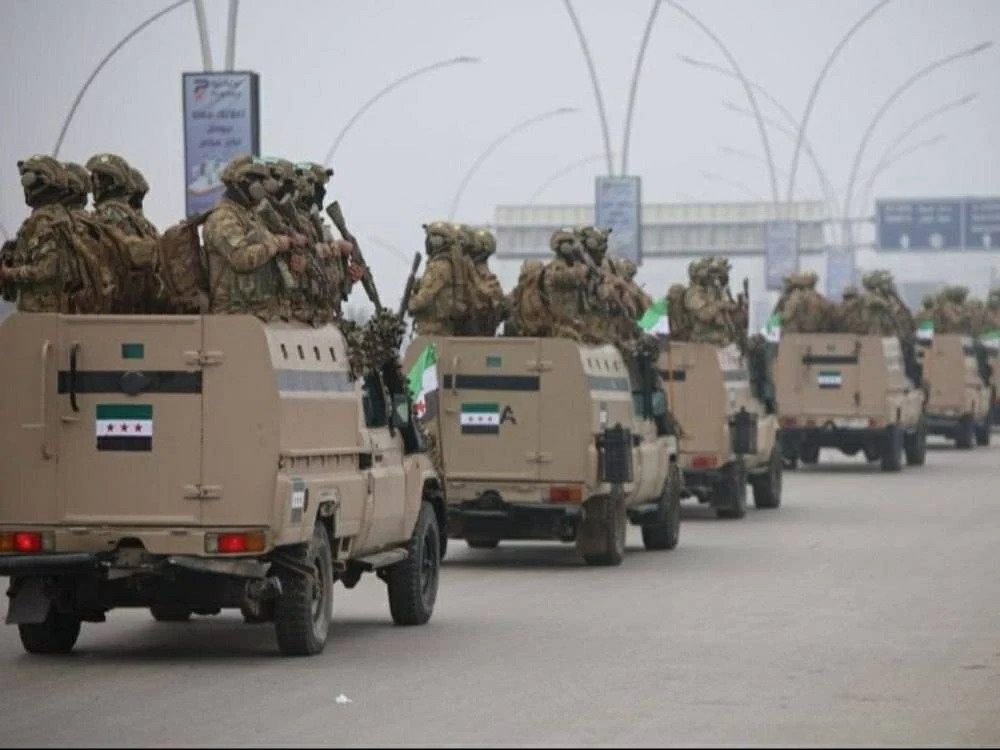
According to the material underlying this analysis, the new Syrian army initially consisted of around 22 divisions that were direct extensions of former factions. These formations retained, to varying degrees, their previous structures, leaderships, and internal networks. Yet this arrangement quickly demonstrated that merely placing factions under the authority of the Ministry of Defense did not necessarily create a national army. A faction could change its name to a division or brigade while retaining much of its organizational structure, loyalties, and networks of influence.
The process of building the army therefore entered a second and more sensitive phase: dismantling the factions from within.
This is where the real strategic challenge begins.
From Integrating Factions to Ending Factionalism
The reconstruction of the Syrian army can be understood through two distinct phases.
The first was the phase of absorption: bringing armed factions into a formal framework under the Ministry of Defense and assigning them positions within the emerging military structure.
The second is the phase of institutional redesign: redistributing personnel and commanders, changing areas of deployment and operational responsibilities, and reducing the ability of individual formations to preserve the organizational cohesion they possessed before entering the state structure.
This transition reflects an apparent recognition among Syria’s new leadership that the state cannot build a unified military institution if it contains several smaller armies operating under official names.
A national military is not defined merely by the existence of a Ministry of Defense, a general staff, or military ranks. It also requires a single chain of command, a unified decision-making authority, a common military doctrine, and unified systems of resources, information, and discipline.
For this reason, redistributing fighters may be more consequential than simply increasing the size of the armed forces, because it targets the organizational structure that allows a faction to preserve its identity and influence within the institution.
The source material describes this process as an effort to “clip the wings of the factions inside the army,” referring to attempts to reduce their ability to reproduce their previous influence.
From a strategic perspective, this represents a transition from the integration of armed power to the state’s monopoly over armed power.
That is a fundamental distinction.
The Problem Is Not Simply the Weapons
At first glance, rebuilding the army may appear to be primarily a question of weapons, ranks, and deployments. Yet the Syrian experience reflected in the report suggests that the deeper problem lies in networks of loyalty.
The factions that emerged during the war were not merely military formations. Some developed economic, administrative, and social relationships in the territories they controlled and established leadership structures, interests, and personal networks. Consequently, abolishing a faction’s formal organizational structure does not necessarily eliminate its influence.
This raises one of the most difficult questions in post-conflict state-building:
How can a state dismantle institutions of power that developed outside the state without turning the process of dismantling them into a source of renewed conflict?
Factional power is not simply military power. It is also political, social, and economic capital accumulated over years of conflict.
For this reason, restructuring the army is not simply a matter of moving a fighter from one division to another. It involves redefining that fighter’s position within the architecture of state authority.
If a soldier continues to see himself as primarily subordinate to a former faction commander rather than to the military chain of command, the state may have integrated the external appearance of the armed group without changing its underlying structure.
But if salary, rank, assignment, promotion, discipline, and military orders become linked exclusively to the institution, integration begins to evolve into state-building.
The Battle over Allegiance: To Whom Does the Army Belong?
This makes loyalty one of the most important indicators of success in rebuilding the military.
A national army is expected to be loyal to the state rather than to a region, group, commander, or political current.
This is precisely what makes the redistribution of personnel and commanders an institutional and political instrument at the same time. When former faction members are redistributed among different formations, their ability to reproduce their previous structures becomes weaker, making the continuation of factional networks more difficult.
The material indicates that some factions remained connected to their traditional strongholds, commanders, and economic, administrative, and social networks that had developed over more than a decade.
The dismantling of these relationships within the military therefore represents an attempt to redefine the relationship between the soldier and the state.
But this process also carries an important risk: if any component perceives restructuring as politically or regionally targeted, institutional reform itself could become a source of new tensions.
The success of the process therefore depends not only on its ability to dismantle factions, but also on its ability to create a broader sense of equality within the institution.
Why Is the Rise of Leadership from Hay’at Tahrir al-Sham a Central Issue?
One of the most sensitive questions surrounding the construction of the new army concerns the role that figures associated with Hay’at Tahrir al-Sham (HTS) and the former leadership of Jabhat al-Nusra will retain.
The report presents two distinct narratives on this issue.
The first, conveyed by an informed source, argues that the new military and security structure is intended to retain figures from HTS in key leadership and decision-making positions.
The opposing narrative, presented by Colonel Abd al-Muati al-Halabi, argues that HTS dissolved itself and moved toward integration into the state, and that the selection of some of its commanders is based on the organizational, security, and military experience they accumulated during the war and their administration of Idlib.
The issue, therefore, is not simply about the identities of particular individuals. It is about the criteria on which the new military leadership will be constructed.
Will the determining factor be military and organizational experience?
Previous affiliation?
Political trust?
Or a combination of these factors?
The question is critical because building a stable military institution requires a difficult balance between experience, legitimacy, representation, and institutional trust.
Relying on the most experienced figures may provide the state with greater organizational capacity in the short term, but it could generate concerns among other components if the new state institution appears to be an extension of a former organization.
Conversely, excluding experienced military personnel solely because of their previous affiliations could deprive the army of capabilities that may be necessary in a highly complex transitional period.
The real challenge, therefore, is to transform the experience accumulated by the factions into institutional expertise belonging to the state, rather than allowing that experience to become a vehicle for reproducing the faction within the state.
The New Army Between the Need for Cohesion and the Risk of Reproducing Centralization
This issue creates a fundamental dilemma.
A state emerging from a prolonged war needs a strong and cohesive army capable of maintaining security. Yet military strength does not automatically become state power simply because it has been placed under centralized command.
A military institution requires clear rules governing appointments, promotions, deployments, budgets, and oversight.
Otherwise, unifying armed power could simply replace multiple factions with an excessively centralized military structure closely associated with a single group.
This makes institutionalization more important than mere unification.
Unification answers the question: “Who commands?”
Institutionalization answers the deeper question: “How are decisions made, who oversees them, and what rules remain in place when individuals change?”
The success of the new Syrian army will therefore depend not simply on whether the factions have been dissolved, but on whether institutional rules become stronger than individual personalities.
Five Corps: Reengineering Military Power Rather Than Simply Redistributing It
The report indicates an inclination to retain a five-corps structure, while potentially changing the leadership, composition, areas of deployment, and operational missions of the corps.
This has strategic significance beyond administrative restructuring.
Military deployment determines the state’s ability to respond to threats, but it also shapes the relationship between the center and the regions.
During the factional phase, military deployments were often linked to the traditional areas of influence of individual groups. A state-based military, by contrast, requires forces to be deployable according to national requirements rather than the territorial boundaries of a faction.
From this perspective, changing deployment areas can become an important instrument for dismantling the geography of factionalism.
If a faction defines itself through a particular territory, transferring its forces elsewhere weakens its connection to the social and economic structures that previously sustained its independent power.
But such a process requires careful management. Changes in military deployment in a post-war state can carry political messages to local communities, particularly in areas where trust in the central government remains fragile.
Turkey: Partner in Building the Army or Stakeholder in Its Structure?
The reconstruction of the Syrian military cannot be separated from Turkey’s role.
According to the material, Syrian-Turkish military coordination has become publicly acknowledged in areas including organization and training, accompanied by repeated visits by senior military officials from both countries. The report also refers to American acceptance of this cooperation.
Turkey’s role, however, cannot be understood solely as technical assistance in military construction.
Turkey has direct security interests in Syria, and its view of Syria’s military arrangements is connected to border security, national security concerns, armed Kurdish organizations, and the future of northern and eastern Syria.
Syrian-Turkish military cooperation therefore has two parallel dimensions:
The first: building the institutional capabilities of the Syrian military.
The second: seeking to ensure that the emerging Syrian security structure is compatible with Turkish security interests.
The two objectives are not necessarily contradictory, but their coexistence makes the question of the independence of Syrian military decision-making particularly important.
The greater the external reliance for training, organization, and military capabilities, the more significant the question of the limits of foreign influence becomes.
The American Role: Supporting Reconstruction or Reshaping the Security Environment?
The report indicates that Turkish coordination in rebuilding the army is taking place with American approval and links this cooperation to counterterrorism.
This matters because the United States, like Turkey, has direct security interests in Syria, even though its priorities do not necessarily coincide with either Turkish or Syrian priorities.
The presence of multiple external actors around the process of military reconstruction therefore places the emerging Syrian military institution at the intersection of several competing interests.
This creates another strategic challenge:
Can the Syrian state use external support to build its institutions without allowing those institutions to become arenas for competition among outside powers?
The answer will depend to a considerable extent on Damascus’s ability to define its national priorities clearly and transform external cooperation into resources that strengthen state institutions rather than turning those institutions themselves into instruments for implementing competing agendas.
Extremist Factions: Between Containment and Dismantling
The more hardline factions and foreign fighters represent one of the most sensitive issues in the process.
The report indicates that some of these elements have been integrated into the army, including within the 84th Division, and that the stated principle is for them to be subject to the same military laws governing other units.
Yet integrating individuals does not necessarily resolve the problem if a group retains its organizational identity and capacity for collective action.
This makes the distinction between integrating individuals and integrating groups particularly important.
The state may absorb former fighters as individuals into the institution. But it faces a different problem if those individuals retain their former command structures, communication networks, and loyalties.
The policy of distributing personnel among different units may therefore be an attempt to prevent the re-formation of factional blocs within the army.
Such a policy, however, requires a careful balance between two seemingly competing objectives: making use of combat experience while preventing that experience from becoming an independent source of power.
The Factional Economy: The Missing Link in Military Reform
One of the most important—and perhaps least visible—aspects of rebuilding the army concerns the economic interests associated with the factions.
The material refers to financial, administrative, and social networks that emerged and became entrenched during the years of war.
This point is particularly important because the state can dissolve a military organization through an administrative decision, but it cannot dismantle the economic interests that developed around it with the same ease.
The loss of economic privileges may generate resistance to restructuring even if such resistance does not take the form of an overt military rebellion.
Military reconstruction is therefore inseparable from reorganizing the war economy.
A stable national military institution cannot be established if financial, commercial, and resource networks associated with the former factions continue to operate outside the state’s economic framework.
For this reason, the success of military restructuring will be linked, to some degree, to the reintegration of resources previously controlled by factions into state institutions.
The Army as a State-Building Project
Viewed as a whole, the reconstruction of the Syrian army is essentially a process of rebuilding the state itself.
The military is one of the most important institutions through which the state exercises sovereignty, monopolizes legitimate force, protects its borders, enforces law, and implements political decisions.
The existence of multiple centers of power within the military therefore implies the existence of multiple potential centers of decision-making.
This makes military reconstruction part of a broader process involving security institutions, local governance, the economy, the judiciary, and relations between the center and the regions.
From this perspective, the success of integration will affect issues extending far beyond the military institution itself.
If the state succeeds in transforming factions into genuine national units, this could provide an important foundation for building more stable civilian institutions.
If factions retain the ability to exercise influence within the military, however, the state could find itself facing a new system that is formally different but still carries elements of the old factional order.
The Hardest Test: What Happens When Loyalties Collide?
The real test for the new army may not emerge during the restructuring period itself, but when the state faces its first major crisis in which interests collide.
What happens if a central government decision conflicts with the interests of a particular region?
What happens if orders are issued to redeploy a unit and its local network objects?
What happens if a political dispute emerges between the state leadership and military commanders with factional backgrounds?
And what happens if an external actor attempts to influence a unit or commander because of previous relationships?
These scenarios will reveal whether integration has genuinely produced a unified military or merely created a temporary coalition of power centers operating within the Ministry of Defense.
For this reason, institutional behavior during crises will be more revealing than organizational structures during periods of stability.
From “Victorious Factions” to a “Victorious State”
The broader strategic significance of restructuring the army lies in its attempt to move from a historical phase in which armed power was distributed among multiple factions to one in which the state becomes the sole institutional framework governing the use of force.
This transition is difficult.
The factions that contributed to overthrowing the former regime possess a form of legitimacy derived from their military role, and some may believe they have a political and security entitlement to help shape the new order.
But the state cannot remain viable if the factions’ contribution to overthrowing the former regime becomes a permanent justification for retaining independent centers of power within the state.
The new phase therefore requires transforming the legitimacy of military victory into institutional legitimacy.
This is one of the most difficult forms of political transition following civil conflict.
Military victory can overthrow a regime, but it is not sufficient to build a state.
Three Battles Within One Battle
The process of building the new Syrian army can be summarized as three simultaneous struggles:
The first is the organizational battle.
It involves restructuring units and corps, redistributing forces and commanders, and redefining areas of deployment and operational responsibilities.
The second is the battle over loyalty.
It involves transferring allegiance from the faction, commander, and locality to the state and the military institution.
The third is the sovereignty battle.
It involves building a Syrian military decision-making process capable of benefiting from external support without becoming dependent on regional and international power balances.
If Damascus succeeds in all three, it will have taken a major step toward state-building.
If it succeeds only in the first, it may produce a more organized army that nevertheless contains multiple centers of power.
What Will Determine the Success of the Experiment?
Several indicators will help reveal the nature of the transformation taking place in the Syrian military.
First: Will promotion, appointment, and command become governed by clear institutional criteria?
Second: Will the factions’ independent economic structures disappear?
Third: Will military forces become deployable according to state decisions rather than factional geography?
Fourth: Will a common military doctrine emerge that transcends previous divisions?
Fifth: How will the relationship between commanders originating from HTS and other military components be managed?
Sixth: What will be the limits of the Turkish, American, and other external roles in training, organization, and capacity building?
And seventh, perhaps most importantly: Will the military institution succeed in building confidence among Syria’s various communities that it is an army of the state rather than an army of a particular group or region?
These indicators matter more than simply the number of corps or the names of their commanders.
Conclusion: The Battle to Build the Army Is a Battle over the Shape of the State
The restructuring of the Syrian army demonstrates that the current phase differs fundamentally from the period immediately following the fall of the former regime.
During the first phase, the objective was to prevent a security vacuum by incorporating armed factions into the Ministry of Defense.
The second phase is more difficult: removing the factional character from the institution that absorbed those factions.
This means that Damascus is not simply trying to build a new army. It is attempting to redefine the relationship between armed power and the state.
If it succeeds in dismantling factional structures, unifying the chain of command, bringing military resources and decision-making under institutional control, and developing a national military doctrine, the integration process could become one of the foundations of the new Syrian state.
If previous loyalties, economic networks, and organizational structures remain embedded within the army, however, integration could amount to little more than renaming the factions without producing a genuine transition from the logic of the group to the logic of the state.
Ultimately, the strategic question is not simply:
How many factions have been integrated?
Nor is it:
How many corps will the new army contain?
The more important question is:
Has the army become an institution of the state, or has the state become a new framework for managing the balance of power among factions?
The answer will shape, to a considerable extent, the nature of Syria’s emerging political order, its level of stability, its ability to monopolize the use of force, and the limits of regional and international influence over it.
For this reason, rebuilding the Syrian army is not merely a military struggle in the narrow sense. At its core, it is a struggle to move from the authority of arms to the authority of institutions, and from the legitimacy of victorious factions to the legitimacy of the state. It is a process that remains incomplete, and its outcome will be one of the most important indicators of the direction Syria takes in the years ahead.
Most read




Read also