
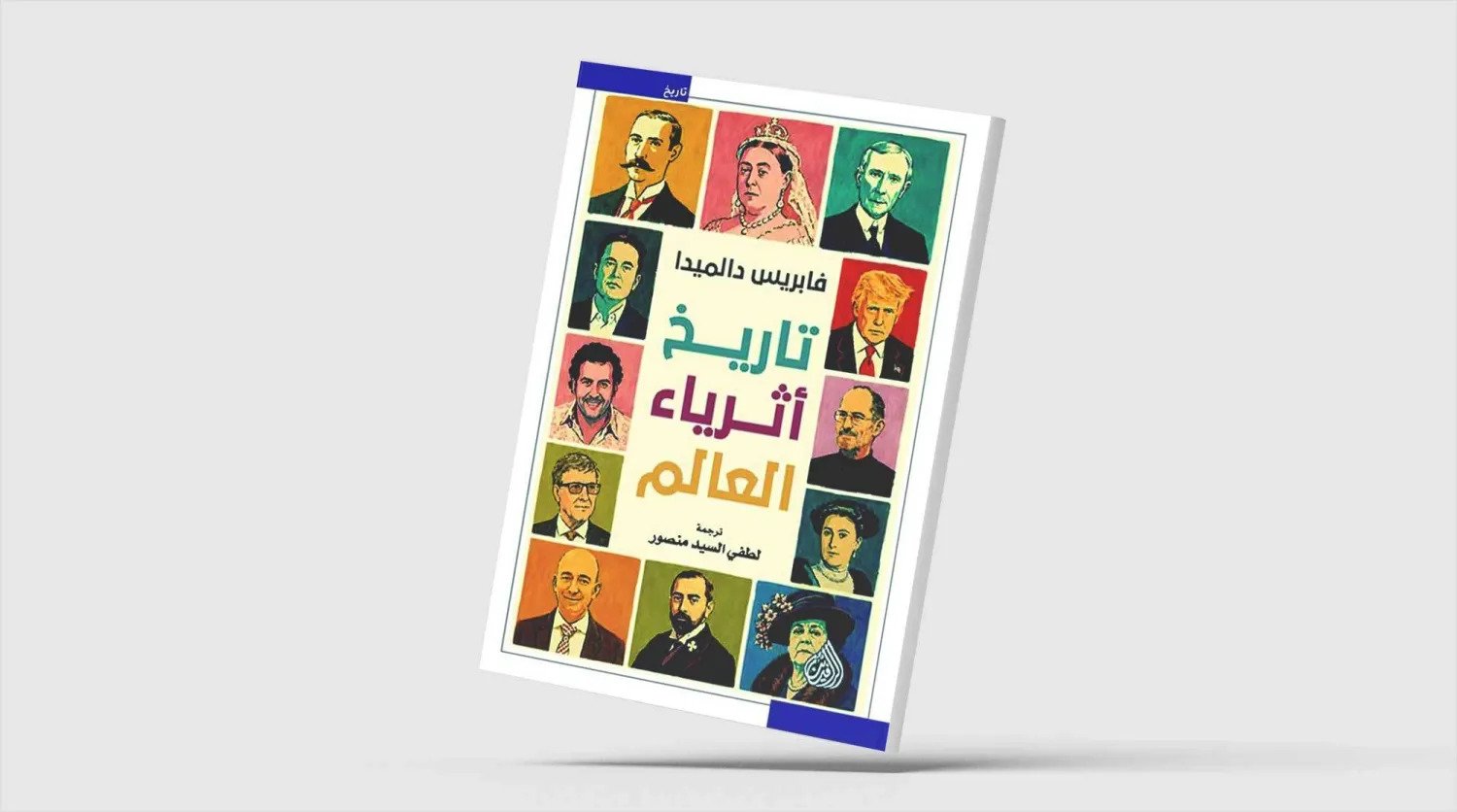
The significance of studying the wealthy lies not simply in measuring the fortunes they have accumulated, but in understanding how wealth has historically been transformed into a form of power capable of influencing politics, economics, the media, and society. From this perspective, the recent publication by the Iraqi publishing house Al-Rafidain of the Arabic translation of French historian and academic Fabrice d’Almeida’s A History of the Wealthy, translated by Lotfi El-Sayed Mansour, offers an opportunity to ask a question that goes beyond the biographies of the rich and addresses their place in history itself: How have wealthy individuals contributed to shaping the societies in which they lived, and how have social and political transformations, in turn, redefined their relationship with the wider public?
In his book, d’Almeida examines the history of wealth and influence, seeking to move beyond the stereotypical image that reduces wealthy people to their financial assets. Rather than treating the wealthy as a homogeneous group driven by the same motives, the book approaches them as individuals whose fortunes emerged from different historical contexts and whose lives were shaped by ambition, risk, success, failure, and, in many cases, broader economic, social, and political transformations.
This perspective highlights one of the book’s central ideas and gives it significance beyond its immediate subject. Wealth is not merely the possession of economic resources. Once it reaches a certain scale, it can become a capacity to influence the distribution of resources and opportunities and to shape decision-making. Capital can provide access to political circles, influence public debate, shape media narratives, or support political, cultural, and intellectual projects. Studying the history of the wealthy therefore becomes, in part, a study of the historical relationship between money and power.
Yet, according to the book’s argument, d’Almeida cautions against viewing the wealthy as a single social type. The problem becomes more complicated when popular imagination gives way to exaggeration, confusion, and conspiracy theories, leading people to assume that all individuals with immense fortunes are driven by selfishness and unchecked ambition. Behind every great fortune, however, lies a different story: a distinct personal trajectory and a particular set of economic, social, and political circumstances. Understanding the wealthy therefore requires moving beyond generalizations and examining the individual experiences and historical contexts that produced their fortunes.
This perspective is particularly relevant at a time when private wealth has become a major force in the global economy. The holder of a vast fortune is no longer simply an investor or businessperson. Such individuals may become economic actors capable of influencing markets, financing major projects, owning media organizations, or supporting political, cultural, and scientific initiatives. As a result, the boundaries between economic power and social and political influence become increasingly complex, turning the question of how wealth should be governed and managed into a matter that concerns society as a whole, rather than wealthy individuals alone.
This is where the book’s discussion of the lack of consensus over how to deal with vast fortunes becomes particularly important. Public debate has, over the course of decades, developed relatively clear approaches to poverty through concepts such as the poverty line, social assistance, and welfare policies. There is far less agreement, however, on how societies should address extreme concentrations of wealth. The issue is not simply how much the wealthy possess, but how those fortunes are managed and how they affect investment, economic activity, politics, and the public sphere.
The issue, in this context, cannot be reduced to a moral confrontation between “the rich” and “the poor.” Large fortunes can contribute to investment, job creation, innovation, and productive ventures. Under different circumstances, however, they can also contribute to the concentration of economic power and political or media influence. The more complex question, therefore, is not whether the existence of wealthy individuals is inherently good or bad, but how governments and societies can manage the power generated by wealth and ensure that economic disparities do not become unaccountable disparities in political and social influence.
From this perspective, the idea of addressing major fortunes on a case-by-case basis becomes particularly significant. The nature of the economic activities in which wealthy individuals are involved, the scale of their investments, the companies and institutions they control, and their broader social impact can vary enormously. It is therefore difficult to design a single policy capable of addressing every case. Tax and public-investment policies consequently become part of a broader effort to balance the encouragement of economic activity with the prevention of excessive concentrations of wealth and influence.
This leads to the book’s deeper political dimension. Tensions between elites and the wider population are hardly new, but the relationship has become more sensitive in an era marked by the rise of populism and growing debates over economic inequality. When large segments of society perceive wealth not merely as greater access to resources but also as greater influence over decisions affecting the lives of others, the gap between society and its elites can evolve from an economic divide into a crisis of political trust.
In this sense, A History of the Wealthy is not simply a book about money in the narrow sense. It is a study of one of the forces that has helped shape modern history. Examining the wealthy ultimately means examining the relationship between individuals, institutions, states, markets, and societies, as well as the ways in which wealth can move from being a form of private property to becoming a potential source of public power.
The significance of the book is further underscored by the background of its author, Fabrice d’Almeida, a contemporary historian whose work includes the history of the media, political propaganda, and the manipulation of images, alongside research into the history of Nazism and European political culture. He is a professor of contemporary history at Université Paris-Panthéon-Assas (Paris 2) and has received several French distinctions in recognition of his scholarly contributions, including the rank of Knight in the Order of Arts and Letters in 2022 and the National Order of Merit in 2023.
The Arabic translation by Lotfi El-Sayed Mansour is part of a broader body of work devoted to bringing French literature and thought to Arabic readers. Mansour has translated a range of literary and intellectual works, including The Brodeck Report and The Dusk by Philippe Claudel, Our Lady of the Nile by Scholastique Mukasonga, and The Material Ecstasy by J. M. G. Le Clézio. His work also includes intellectual and cultural titles such as The Psychology of Stupidity and A World History of Bullshit. He has also been active in publishing Arabic translations of French literature, philosophy, and intellectual thought in Egyptian and Arab periodicals and magazines.
Ultimately, the value of the book lies in its ability to revisit an old question in a contemporary form: When does wealth cease to be merely private property and begin to become public power? There is no single answer, just as the wealthy do not constitute a homogeneous group that can be reduced to one image. What is increasingly clear, however, is that the extraordinary expansion of private fortunes in modern societies has made their relationship with the state, the market, politics, and the public sphere an issue that extends far beyond the wealthy themselves.
Understanding the history of the wealthy therefore means more than understanding how certain individuals became rich. It means understanding how money, when accumulated on a vast scale and converted into influence, can reshape the societies that produced it.
In this sense, the Arabic publication of A History of the Wealthy arrives at a moment when the book offers a useful entry point for reconsidering wealth not simply as a figure on a balance sheet or in a bank account, but as a historical, social, and political phenomenon with consequences for the structure of power and the relationship between elites and society.
Most read