
Xi-Trump Meeting: How China Seized Control Of The Narrative And Agenda

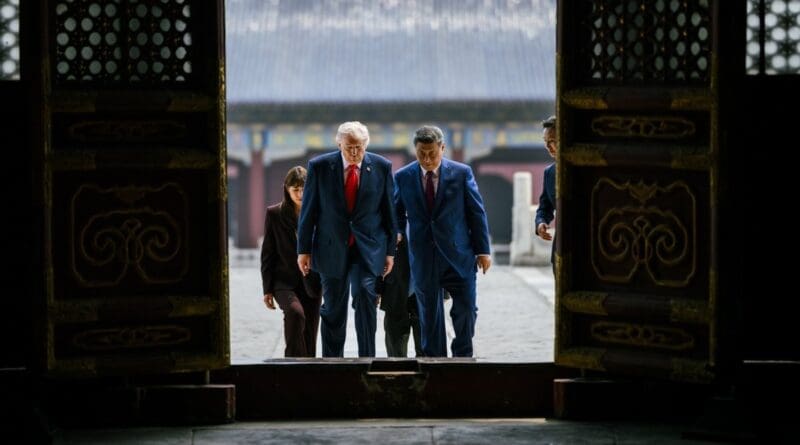
US President Trump’s state visit to China from 13-15 May, widely viewed as high on symbolism and low on substance, nonetheless had important signals for the world. The visit indicated the beginning of a reset in US–China bilateral ties, though not without challenges. It also marked a milestone in President Xi Jinping’s “home-court” diplomacy, with the visit’s optics, agenda-setting, and public communications largely shaped by Beijing rather than Washington.
The optics were carefully crafted as a meeting between two equals. The US emphasised parity through its idea of a G-2 (a US-China duopoly). While China was publicly silent on the G-2 framing, it ensured a grand reception for the visiting delegation. Upon closer look, however, the meeting took place within an unspoken hierarchy, in which a rising China had the upper hand over an established but declining US. Overall, the signals that emerged from the visit were a net positive from a global perspective, particularly given signs of a possible thaw in the US-China trade war.
An understanding of the dynamics of the visit is better illustrated through the domestic political positions from which both leaders approached it. At the time of meeting, Trump’s overall approval ratings had fallen to around 34 per cent, and to around 27 per cent on economic issues, mainly due to poor macroeconomic conditions linked to the war in Iran. He has also drawn criticism from American business groups on the impact of tariffs. Xi, by contrast, appeared to enter the meeting from a position of relative strength, though with pressures of his own. China’s growth has slowed to one of its weakest rates in decades. The trade war has clearly imposed real costs on both the US and China.
US President Trump’s state visit to China from 13-15 May, widely viewed as high on symbolism and low on substance, nonetheless had important signals for the world. The visit indicated the beginning of a reset in US–China bilateral ties, though not without challenges. It also marked a milestone in President Xi Jinping’s “home-court” diplomacy, with the visit’s optics, agenda-setting, and public communications largely shaped by Beijing rather than Washington.
The optics were carefully crafted as a meeting between two equals. The US emphasised parity through its idea of a G-2 (a US-China duopoly). While China was publicly silent on the G-2 framing, it ensured a grand reception for the visiting delegation. Upon closer look, however, the meeting took place within an unspoken hierarchy, in which a rising China had the upper hand over an established but declining US. Overall, the signals that emerged from the visit were a net positive from a global perspective, particularly given signs of a possible thaw in the US-China trade war.
An understanding of the dynamics of the visit is better illustrated through the domestic political positions from which both leaders approached it. At the time of meeting, Trump’s overall approval ratings had fallen to around 34 per cent, and to around 27 per cent on economic issues, mainly due to poor macroeconomic conditions linked to the war in Iran. He has also drawn criticism from American business groups on the impact of tariffs. Xi, by contrast, appeared to enter the meeting from a position of relative strength, though with pressures of his own. China’s growth has slowed to one of its weakest rates in decades. The trade war has clearly imposed real costs on both the US and China.
For the first time, China was able to demonstrate a position of advantage over the US to the world. China confirmed almost nothing of what Washington announced. It also hardened its position on Taiwan, whereas the US couldn’t take a similar hard stand on Russia. Trump’s state visit exposed the limits of US foreign policy towards China and highlighted China’s growing ability to pressure other countries, including the US, on issues it values most, such as economic deals and Taiwan.
Most read



Read also