Military Escalation in Yemen: The Implications of Government Operations and the Limits of Their Impact on the Balance of Conflict

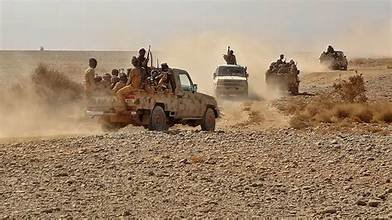
Recent military developments in Yemen reflect the Yemeni government’s continued reliance on intensive offensive operations against the Houthi movement, in an effort to weaken its combat capabilities and limit its ability to reinforce positions along the front lines. In this context, a spokesperson for the Yemeni Armed Forces announced that 2,309 strikes, described as precision strikes, had been carried out against Houthi positions across multiple fronts. He also reported that approximately 1,250 Houthi fighters had been killed and more than 460 military vehicles and pieces of equipment had been destroyed.
These figures, announced by military spokesperson Majed Al-Nuzaili, form part of the official account of intensified operations under what has been referred to as “Operation Dawn of Yemen.” According to the statements, the campaign involved fighter aircraft, drones, artillery, rocket-launching systems, and sniper units. However, assessing the strategic impact of these operations requires distinguishing between reported battlefield losses, military outcomes that can be independently verified, and the extent to which these developments affect the broader trajectory of the Yemeni conflict.
First: Offensive Operations and the Reshaping of Front Lines
According to official statements, the government’s operations aim to weaken Houthi defensive lines, disrupt command-and-control systems, and create conditions that would enable government forces to advance toward fortified positions. The diversity of the means employed, ranging from airpower and artillery to drones and sniper operations, suggests a multi-domain military approach designed to maintain pressure on Houthi positions while reducing the movement’s operational flexibility and logistical capacity.
The effectiveness of this approach depends on several factors, including the accuracy of intelligence, the sustainability of military pressure, and the ability of government forces to translate the results of strikes into lasting territorial gains. Inflicting personnel and equipment losses may weaken an adversary’s combat capabilities, but it does not necessarily produce a decisive shift in the balance of territorial control unless accompanied by gains that can be consolidated and by the capacity to secure areas into which forces advance.
Accordingly, the announced figures provide an indication of the scale of the operations that government forces say they have conducted. However, they are insufficient on their own to determine the extent to which the Houthis’ actual military capabilities have deteriorated, particularly in the absence of independent information confirming the scale of the losses and their impact on the movement’s deployment and ability to sustain combat operations.
Second: The Taiz Front and the Importance of Targeting Supply Lines
Taiz Governorate has received particular attention in recent military statements. The Yemeni Armed Forces spokesperson reported that government forces had intensified airstrikes and ambushes targeting Houthi convoys and reinforcements heading toward the front lines, with the stated objective of preventing the movement from regrouping and replenishing its losses.
The focus on supply lines reflects an understanding of the importance of logistical mobility to the continuation of military operations. The ability to sustain positions along the front lines depends on the regular delivery of fighters, ammunition, equipment, and other supplies. Disrupting these movements can increase the military costs facing the Houthis and undermine their ability to reinforce positions or launch counterattacks.
Nevertheless, the actual impact of these operations depends on their continuity and their capacity to cause prolonged disruption, rather than simply targeting convoys or reinforcements at particular moments. An assessment of the situation in Taiz must also take into account changes in territorial control, the nature of the lines of contact, and the ability of the parties to adapt to sustained military pressure.
Third: Conditional Amnesty as a Complementary Instrument to Military Confrontation
The government’s messaging has not been limited to military operations. It has also included the renewal of an amnesty offer announced by Presidential Leadership Council Chairman Rashad al-Alimi for Houthi fighters who surrender their weapons and cease fighting. According to official statements, the offer includes assurances of “safe return and amnesty” for those who lay down their arms and return to their families.
The combination of military pressure and conditional amnesty reflects an attempt to employ multiple instruments to influence the cohesion of the Houthi movement. The approach seeks to raise the costs of continued fighting while offering an alternative pathway for individuals willing to withdraw from the conflict. Such a policy could become significant if it helps curb recruitment or encourages individual defections. Its effectiveness, however, depends on the clarity of the amnesty conditions, the credibility of the guarantees provided, and the ability to implement them reliably.
Meanwhile, the military spokesperson’s appeal to families in Houthi-controlled areas to prevent their children from being recruited highlights the issue of recruitment and the role of local communities in sustaining military mobilization. Assessing the impact of these appeals, however, requires additional information about recruitment patterns, families’ responses, and the security and social conditions prevailing in the areas concerned.
Fourth: Civilian Protection and the Contest for Legitimacy
The military spokesperson accused the Houthis of continuing to target residential neighborhoods and civilian infrastructure in Taiz despite the losses he said they had suffered on the battlefield. In contrast, he stated that government forces were committed to international humanitarian law and that their attacks were confined to legitimate military targets.
These statements highlight the civilian and humanitarian dimensions of the conflict alongside its military competition. Protecting civilians and infrastructure is a fundamental criterion for assessing the conduct of armed actors. It also affects the level of local trust and the legitimacy of parties claiming to represent state institutions or govern territories under their control.
However, statements issued by parties to an armed conflict are not, in themselves, sufficient to establish or disprove allegations of violations. An objective assessment of claims concerning attacks on civilians or compliance with international humanitarian law requires independently verified evidence, including information about the nature of the targets, the circumstances surrounding the attacks, and the extent of damage inflicted on civilians and civilian infrastructure.
This dimension is particularly important in Taiz, where continued fighting near populated areas may increase risks to civilians regardless of the military gains claimed by either side.
Fifth: The Limits of Battlefield Gains and Their Political Implications
From a political perspective, the impact of military operations cannot be measured solely by the number of strikes conducted or the reported casualties inflicted. Their strategic significance depends on whether they can alter the calculations of the parties, strengthen the government’s position in negotiations, and reduce the Houthis’ ability to impose their terms militarily or politically.
If the operations succeed in weakening defensive lines, disrupting supply networks, and achieving sustainable territorial advances, they could provide the government with additional leverage. Conversely, if the results remain confined to mutual attrition without any substantial change in the lines of control, the fighting may continue without producing a decisive shift in the trajectory of the conflict.
The continuation of hostilities also raises questions about the relationship between military escalation and the prospects for a political settlement. Developments on the battlefield may influence the parties’ willingness to negotiate, but they do not, by themselves, guarantee a settlement, particularly given the multiple military and political factors shaping the Yemeni conflict.
Conclusion
Recent military statements from Yemen point to an intensification of government operations against Houthi positions, with a stated focus on weakening defensive lines and disrupting supply networks across several fronts, particularly in Taiz Governorate. They also indicate an effort to combine military pressure with other instruments, including a conditional amnesty offer, in an attempt to affect the movement’s ability to sustain its military campaign.
Nevertheless, determining the actual outcomes of these operations depends on the availability of independent information regarding the reported losses, changes in territorial control, and the extent to which the Houthis’ recruitment, logistical, and command capabilities have been affected. Ultimately, the impact of escalation depends not simply on the scale of the strikes but on whether they can produce a sustained shift in the balance of power while limiting risks to civilians and preserving space for potential political solutions.
Most read




Read also