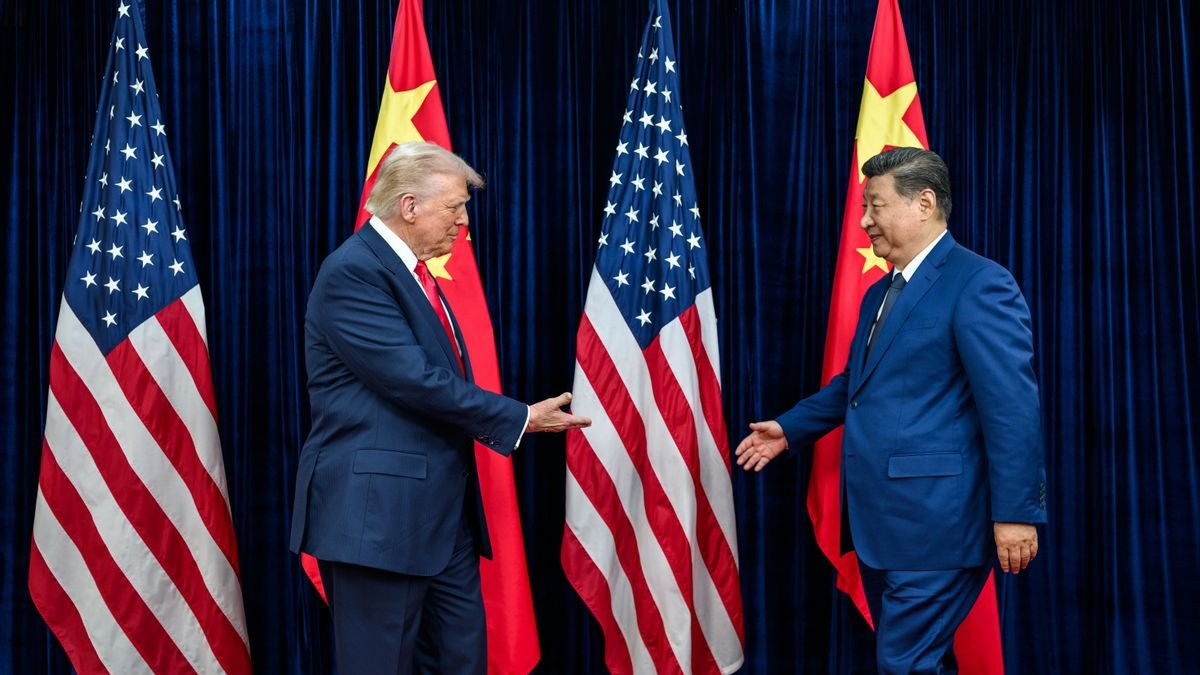
U.S.-China relations can no longer be understood independently of the major regional and international crises shaping the global order. Trade, technology, artificial intelligence, Taiwan, energy, and regional security have increasingly become interconnected components of a broader contest over the future of the international system and the distribution of power within it. From this perspective, U.S. President Donald Trump’s visit to Beijing in May 2026 acquired significance extending well beyond the bilateral relationship. Taking place at a particularly sensitive moment amid the war between the United States and Iran and the crisis surrounding navigation through the Strait of Hormuz, the visit placed the Gulf region directly within the strategic calculations of the world’s two largest economic and military powers.
The visit marked the first trip by a sitting U.S. president to China since Trump’s previous visit in 2017. On the surface, it was framed around restoring diplomatic channels and managing disagreements, while the underlying relationship remained defined by profound strategic competition over trade, technology, supply chains, military capabilities, and international influence. The summit demonstrated that Washington and Beijing are not moving, at least in the foreseeable future, toward ending their rivalry. Rather, they appear to be seeking mechanisms to establish limits that prevent competition from escalating into open confrontation.
This represents the central paradox of the summit: both the United States and China have strong incentives to avoid escalation, yet neither is willing to abandon the instruments that provide it with strategic leverage. The United States uses trade policy, tariffs, restrictions on advanced technology and semiconductor exports, and other economic measures as tools to protect its economic and technological advantages. China, meanwhile, seeks to preserve its industrial and commercial capabilities, expand its presence in global markets, and reduce its exposure to U.S. pressure.
In the field of artificial intelligence in particular, the competition is increasingly evolving from an economic race into an issue connected to national security, digital infrastructure, and the future distribution of global power. Accordingly, the positive language surrounding the summit can be understood primarily as part of an effort to manage competition rather than as evidence of a settlement of the structural disputes separating the two countries.
Even when Washington and Beijing reach trade or economic understandings, fundamental issues—including Taiwan, technology restrictions, critical minerals, sanctions, Iran, and each country’s position within the international system—remain potential sources of renewed tension. The realistic objective, therefore, is not to eliminate strategic competition but to make the relationship more stable and predictable.
The Gulf Enters the U.S.-China Strategic Equation
If trade and technology represent the economic and strategic frontiers of U.S.-China competition, the Gulf and the Strait of Hormuz constitute one of its most consequential geopolitical arenas. The region’s growing importance is no longer determined solely by the scale of its oil reserves. It also stems from its central position within international trade, maritime transportation, energy markets, financial systems, and digital infrastructure.
The war involving the United States and Iran has placed the Strait of Hormuz at the center of both American and Chinese strategic calculations. The strait is not simply a regional maritime passage; it is a strategic chokepoint whose prolonged disruption could affect oil and gas prices, inflation, global growth, and international supply chains. Any sustained disruption to navigation through Hormuz would therefore have consequences extending far beyond the Middle East.
This helps explain China’s concerns about the conflict involving Iran. China remains heavily dependent on energy imports from the Gulf, meaning that prolonged disruption to navigation through Hormuz would raise energy costs for the Chinese economy and disrupt global trade in which China is one of the principal hubs.
Beijing therefore views Gulf security from both economic and strategic perspectives. It has a clear interest in regional stability, but it also seeks to avoid direct military alignment with any side in a conflict that could turn China into a participant in an open-ended regional confrontation.
This position is reflected in China’s approach to the Strait of Hormuz. Beijing emphasizes freedom of navigation while also linking that principle to respect for the rights of coastal states and opposition to the militarization of maritime routes. This approach is not limited to the Gulf; it is also connected to China’s calculations regarding the Taiwan Strait and the South China Sea, where Beijing simultaneously emphasizes its sovereignty and security interests while affirming the importance of freedom of navigation in international waterways.
China and Iran: A Partnership, Not an Alliance
The Iranian crisis raises a more complicated question concerning the limits of the China-Iran relationship. It would be misleading to characterize the relationship as a full-fledged alliance, just as describing China’s position as absolute neutrality would fail to capture all of its dimensions.
China does not maintain formal military alliances in the Middle East and has generally sought to preserve relations with competing regional actors. This enables Beijing to retain a broad margin for maneuver and to maintain relationships with states whose interests frequently conflict.
This strategy is particularly evident in China’s simultaneous engagement with the Gulf states and Iran. Beijing has developed extensive economic, energy, and investment relations with the Gulf Cooperation Council states while maintaining commercial, oil, and diplomatic relations with Iran. China’s interest, therefore, is less about choosing one side of the regional equation than about preserving an environment that allows it to secure access to energy and markets while avoiding the costs of direct military involvement.
The situation is further complicated by the fact that Chinese private companies benefit from Iranian oil imports, making the relationship with Tehran more complex than a purely political calculation. At the same time, Chinese companies face security challenges when seeking to expand their presence in the Gulf, as regional instability and security vulnerabilities can increase the costs and risks associated with long-term investment and infrastructure projects.
Consequently, expectations that China might become a direct military participant in the conflict do not appear consistent with the traditional pattern of Chinese foreign policy. This does not, however, mean that Beijing lacks influence. China possesses economic, diplomatic, energy, and commercial instruments that could potentially be used to encourage de-escalation and protect its interests.
Gulf States Between Washington and Beijing
Against this backdrop, the Gulf Cooperation Council states face an increasingly complex strategic equation. On the one hand, the United States remains the region’s principal external security partner, providing military and technological capabilities that China cannot currently replace in full. On the other hand, China has become an increasingly important economic partner for the Gulf, not only in energy but also in trade, investment, infrastructure, and technology.
This reality is encouraging Gulf states to pursue a strategy of partnership diversification rather than a complete shift from one camp to another. Their economic transformation projects require technology, investment, and access to global markets. China can provide extensive opportunities in infrastructure, trade, and industry, while the United States remains a major actor in advanced technology, defense, artificial intelligence, and security.
Artificial intelligence has emerged as a particularly important arena in which Gulf relations with both powers are being reshaped. The United States retains significant advantages in advanced AI models, computing infrastructure, and foundational technologies, while China continues to expand its capabilities in applications and related technologies.
For Gulf states, engagement with both sides creates room for strategic hedging. It allows them to avoid making their economic and technological transformation plans dependent on a single source of investment or technology.
Yet this strategy has clear limits. As U.S.-China competition over advanced technology intensifies, the room available to middle powers to maintain the same degree of strategic flexibility may narrow. Digital infrastructure, data centers, semiconductors, and artificial intelligence are increasingly becoming matters of national security. This could force Gulf states to strike a more delicate balance between their economic interests and their security relationships.
Taiwan and the Middle East: Two Fronts of the Same Competition
The Gulf cannot be fully understood separately from the Taiwan issue. Although the two regions are geographically distant, they are connected by a common logic involving the future of U.S.-China power competition and the rules governing maritime access and strategic mobility.
The United States views Taiwan’s security partly through the broader question of the credibility of its commitments in Asia, while China regards Taiwan as a core issue of sovereignty and national interest. Gulf states, meanwhile, have a direct interest in the evolution of this rivalry because a major escalation in East Asia could alter the distribution of U.S. military resources and strategic attention at a time when the Gulf continues to rely heavily on the American security presence.
The management of U.S.-China competition is therefore not simply a matter of preventing a direct conflict between the two powers. It also involves preventing their rivalry from generating destabilizing consequences in other regions.
From this perspective, the Gulf represents a test of Washington and Beijing’s ability to separate areas of shared interest from areas of strategic disagreement, just as East Asia represents another test of their ability to manage competition without allowing it to develop into direct confrontation.
Russia, China, and the Emerging International Order
Russia adds another dimension to the equation. Although China-Russia relations have expanded significantly, the economic dependence between the two countries is not symmetrical. Russia relies much more heavily on the Chinese market than China relies on Russia.
This imbalance gives Beijing considerable flexibility in managing relations with Moscow and Washington simultaneously. China can maintain a strategic partnership with Russia without treating its relationship with Moscow as a substitute for its economic ties with the United States and Europe.
This reflects a broader Chinese approach based on expanding networks of relationships rather than constructing a closed alliance system resembling the Cold War. The result is an international environment that may not necessarily develop into two fully consolidated blocs, but rather into a complex network of overlapping rivalries and selective areas of cooperation.
Major powers increasingly appear to be operating according to intersecting interests that vary from one issue to another.
The Gulf and a More Multipolar—and Less Stable—International System
The Trump-Xi summit demonstrates that U.S.-China relations are becoming increasingly intertwined with the future of the Middle East. Washington must manage its rivalry with Beijing while confronting security crises elsewhere; China must protect the energy flows and markets on which its economic strategy depends; and Gulf states must preserve their security relationships with the United States while expanding their economic and technological partnerships with China.
The Gulf is therefore no longer simply a region affected by competition among major powers. It has become part of the strategic calculations underlying that competition itself.
Energy security affects the Chinese economy. Maritime security is directly connected to global trade. Artificial intelligence is redefining the relationship between economic power and national security. Meanwhile, the conflict involving Iran is forcing Washington and Beijing to operate in a region where their interests and disagreements increasingly intersect.
The significance of the Trump-Xi summit therefore lies not only in the agreements announced during the meeting, but also in what it reveals about the next phase of international relations: intense competition that does not eliminate limited cooperation, economic interdependence that does not erase security disputes, and regional powers seeking to diversify their options without abandoning their traditional relationships.
For the Gulf states, this environment is likely to reinforce the importance of partnership diversification while maintaining strategic balance. For China, the central challenge is to protect its economic interests in the Middle East without becoming directly involved militarily. For the United States, the challenge is to manage its rivalry with China without allowing the accumulation of geopolitical crises to diminish its capacity to shape regional and global affairs.
The future of U.S.-China relations, therefore, will not be determined solely in Washington or Beijing. Part of that future will be shaped in the straits, maritime routes, energy markets, and strategic corridors stretching from the Gulf to East Asia. The Strait of Hormuz offers a particularly clear illustration of how the geopolitics of energy, trade, technology, and security have become interconnected components of a broader struggle over the future of the international order.
The Trump-Xi summit did not resolve the fundamental disputes between Washington and Beijing, nor did it produce a decisive breakthrough in the Iranian crisis. What it demonstrated instead was the growing necessity of managing strategic competition before it develops into direct confrontation. In this emerging environment, the Gulf is no longer merely an arena in which great-power competition is played out; it is increasingly becoming one of the arenas through which the future structure of that competition itself will be determined.
Most read




Read also