The Strait of Hormuz After Six Months: From Maritime Closure to a Reshaping of the Balance of Power

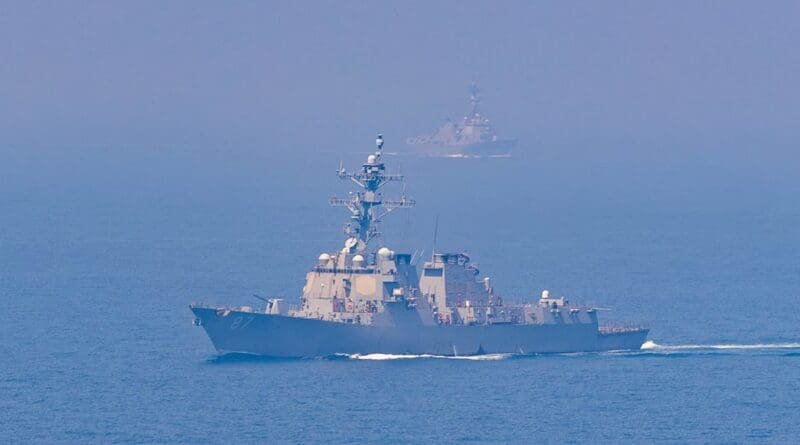
Six months after Iran closed the Strait of Hormuz, the crisis is no longer merely a military confrontation centered on a strategic waterway. It has evolved into a test of the global trading system’s ability to adapt when maritime routes become instruments of geopolitical pressure. The strait, which under normal circumstances carries roughly one-fifth of the world’s oil and liquefied natural gas exports, is experiencing unprecedentedly low levels of maritime traffic. The number of bulk commodity vessel voyages has fallen from an average of about 95 per day in February to roughly 10 per day following the closure on March 1—a decline of approximately 85%.
These figures demonstrate that the “closure” of Hormuz does not necessarily mean a complete physical halt to maritime traffic. Rather, it has effectively transformed the strait from a normal commercial waterway into a high-risk transit zone that shipping companies can no longer navigate according to conventional operating rules. Vessels that continue to transit face the risks of mines, interference with navigation systems, and possible attacks, while others are forced to reroute or remain inside the Gulf, increasing transportation and insurance costs and placing additional pressure on energy and commodity supply chains.
Hormuz as a Geopolitical Weapon
The significance of the current development lies in the fact that Iran is using the strait not merely as a military instrument, but also as a political and economic pressure tool in its confrontation with the United States and Israel. Tehran has linked the reopening of the maritime passage to acceptance of its conditions, including a halt to military operations, the lifting of sanctions, and the withdrawal of U.S. forces from the vicinity of Iran.
The Strait of Hormuz has therefore shifted from being an international trade and energy corridor into a direct bargaining instrument in the conflict. This changes the nature of the crisis. Every additional day of reduced maritime traffic increases the economic and political costs for the opposing parties and gives Iran additional leverage over its adversaries, even though Tehran is aware that a complete closure of the strait could also harm its own interests and those of the Gulf states that depend on the regional economy.
This helps explain why Tehran insists on treating Hormuz not simply as a maritime passage that can be opened or closed, but as part of a broader negotiating equation. Iran is attempting to convert the geographic leverage provided by its position along the strait into political influence, making the resumption of maritime traffic part of the price of a settlement rather than a technical measure detached from the broader course of the war.
From Closure to “Selective Navigation”
Perhaps the most significant development is not simply the decline in the number of vessels, but the transformation in the nature of traffic through the strait. Maritime traffic has not stopped entirely; rather, it has become selective and limited, explaining why some vessels continue to transit despite the risks.
Kpler data indicate that average traffic temporarily increased to 36 voyages per day following the U.S.-Iranian memorandum of understanding in June, before falling to approximately 15 voyages per day as fighting resumed intermittently between July 8 and August 22.
This fluctuation demonstrates that maritime traffic has become directly tied to the level of military and political escalation. When the likelihood of confrontation declines, shipping companies become more willing to assume the risks. When fighting resumes, traffic quickly contracts. Maritime security is therefore no longer based on stable and predictable rules; instead, it has become dependent on real-time risk assessments.
This is forcing shipping companies to redefine what constitutes a “safe route.” A route that was previously established and clearly defined under International Maritime Organization rules is no longer necessarily the route selected by vessels, as security calculations increasingly interact with traditional navigational considerations.
The Battle Over Routes Inside the Strait
The conflict has also produced a new maritime geography within Hormuz. Before the war, vessels primarily followed the route designated by the International Maritime Organization, which runs through the center of the waterway. After the conflict began, two main routes emerged: a northern route along the Iranian coast and a southern route between the Omani coast and areas where mines may potentially have been laid.
These routes reveal an important strategic paradox: even when maritime traffic continues, the way the strait is being used has fundamentally changed. Vessels are no longer operating according to navigational efficiency alone. Instead, they are balancing proximity to potential threats, the availability of protection, the likelihood of mines, and the reliability of navigational data.
The situation became even more complicated as the proportion of vessels whose routes could not be clearly identified increased. According to Kpler, around two-thirds of transit operations have been classified as having an “unknown route” since the collapse of the ceasefire on July 8, compared with less than 1% before the war.
This does not necessarily mean that two-thirds of the vessels have actually lost track of their routes. Rather, it reflects the growing difficulty of monitoring maritime movements because tracking devices may be switched off, signals may be jammed, or sufficient satellite imagery may not be available. This is strategically significant because the absence of information has itself become part of the security crisis.
As international actors become less capable of determining the locations and routes of vessels, it becomes harder to assess risks, plan rescue and protection operations, and distinguish ordinary commercial traffic from movements associated with military operations or attempts to avoid designated danger zones.
The U.S.-Iranian Memorandum and the Fragility of Stability
The temporary improvement in maritime traffic following the U.S.-Iranian memorandum of understanding in June provides an important indication that the Hormuz crisis is neither technical nor primarily related to the physical infrastructure of the strait. At its core, it is political.
Once the political environment improved, average traffic increased to 36 voyages per day. But that improvement did not last, and traffic declined again as fighting resumed.
This means that any sustainable solution to the Hormuz crisis cannot rely solely on maritime arrangements or the deployment of additional surveillance and protection capabilities. It requires a political settlement capable of reducing the likelihood that the strait will be used as a weapon in the conflict.
The ability to physically reopen the strait does not necessarily mean that normal maritime traffic will be restored. A vessel may technically be able to transit, but its owner may consider the security, insurance, and commercial risks sufficiently high to make the journey economically unviable.
The distinction between “opening the strait” and “restoring maritime security” is therefore crucial. The former can be achieved through a political or military decision at a particular moment; the latter is a process requiring the restoration of confidence, clarity regarding rules of engagement, and a reduction in the risks posed by mines, attacks, and interference with navigation.
A Crisis That Goes Beyond Oil
The Strait of Hormuz is usually viewed primarily through the lens of oil markets. Yet the current crisis demonstrates that its consequences extend much further.
The strait is a major artery for energy shipments, but disruptions to maritime traffic also affect shipping, insurance, corporate supplies, and port operations, as well as the movement of maritime workers. If the crisis persists, it could therefore evolve from an energy crisis into a regional logistics crisis with global consequences.
The figures provided by the International Maritime Organization highlight the human dimension of the crisis. Approximately 6,000 seafarers and around 500 vessels remain stranded in the Gulf, while at least 20 seafarers and port workers have been killed over the past six months as a result of incidents or attacks in the region.
The crisis has thus moved beyond the realm of geopolitics into the sphere of human security. The longer the disruption continues, the more the risks faced by seafarers become an intrinsic cost of the war rather than merely a secondary consequence.
In June, the International Maritime Organization launched an initiative to evacuate more than 11,000 seafarers stranded in the Gulf, but the effort was quickly disrupted following an attack on a vessel. In addition, 57 vessels departed the Strait of Hormuz as part of a plan to evacuate stranded seafarers, carrying approximately 1,100 people.
Yet the continued presence of around 500 vessels and 6,000 seafarers in the Gulf demonstrates that partial evacuation operations have not addressed the core of the problem; they have merely mitigated some of its humanitarian consequences.
Can Markets Bypass Hormuz?
The most important lesson from the crisis is that markets can adapt to the disruption of a strategic maritime corridor, but they cannot eliminate its importance.
Shipping companies can reroute vessels, states can search for alternative routes, and energy markets can redistribute some supplies. Yet these alternatives come with higher costs and have limited capacity to compensate for the volume and strategic significance of the Strait of Hormuz.
Thus, an approximately 85% decline in traffic does not mean that the global economy has come to a halt. Rather, it means that the cost of maintaining economic activity has increased. The longer the crisis continues, the greater the likelihood that these costs will be passed on to energy, transportation, insurance, and commodity prices, although the scale of the impact will vary across markets.
A prolonged crisis could also encourage governments and corporations to reconsider investments in energy and transportation infrastructure, accelerating the development of alternative pipelines, ports, and strategic energy reserves in an effort to reduce dependence on maritime routes that can suddenly become conflict zones.
Iran Between Leverage and Blowback
Although closing Hormuz gives Iran an important source of leverage, using this instrument also carries strategic risks for Tehran.
The strait is not merely an outlet for Gulf states’ exports; Iran itself operates within an economic environment that depends on trade and energy flows. The longer maritime traffic remains disrupted, the greater the possibility that Iran’s pressure tactic could turn into a source of pressure on the regional economy in which Iran itself operates.
Moreover, continued threats to maritime traffic could provide justification for expanding the international military presence in the Gulf, which could partially undermine one of Tehran’s stated objectives: pushing U.S. forces farther away from its territory.
This creates a strategic paradox: the more successful Iran is in making Hormuz dangerous, the greater the international need to secure it; and the greater the international military presence required to secure it, the more complicated the security environment in which Iran operates.
For this reason, the strategy of closing the strait appears more effective as a temporary bargaining instrument than as a long-term policy.
The Real Battle: Who Controls the Return to Normality?
Ultimately, the central strategic question is not simply whether the Strait of Hormuz is “open” or “closed.” The reality is more complicated: the strait remains partially open, but it no longer functions as a normal commercial waterway.
The real issue is who has the ability to determine the conditions for a return to normal operations.
Iran wants the restoration of maritime traffic to become part of the price of a political settlement, while the United States and its allies seek to prevent Tehran from turning an international maritime artery into a tool of strategic coercion. Shipping companies, meanwhile, operate according to an entirely different calculation: profitability versus risk.
This creates three overlapping dimensions to the crisis: a military dimension involving control and deterrence; a political dimension involving the terms of a settlement; and an economic-commercial dimension involving whether shipping companies consider transit worth the risk.
Hormuz Will Not Be the Same After the War
Even if an agreement is reached that reopens the strait, maritime traffic is unlikely to return immediately to prewar levels.
The confidence that existed before the crisis has been severely damaged. Shipping companies that have reassessed their security and insurance exposure will need time before returning to previous operating patterns. Continued concerns over mines, interference with navigation, and attacks will make a full return to conventional routes a gradual process rather than an immediate decision.
The longer-term impact of the crisis, therefore, may not be measured by the number of vessels that were halted over the past six months, but by the redefinition of the risks associated with the Strait of Hormuz in global strategic and commercial calculations.
The crisis has demonstrated that control over a narrow maritime passage can generate influence far beyond its geographic size, and that the security of global trade depends not merely on the ability of vessels to sail, but on the international system’s ability to ensure that maritime routes remain open and usable during periods of war and crisis.
The Strait of Hormuz has consequently become more than an energy corridor. It has emerged as a barometer of the Gulf’s security architecture, a measure of the major powers’ ability to safeguard freedom of navigation, and a direct test of the limits of Iranian power to weaponize geography for political purposes.
The question that will ultimately determine the future of the crisis is therefore not simply: When will Hormuz reopen? It is: Under what conditions, and under what security arrangements, will it reopen—and who will guarantee that its closure cannot once again become a tool for reshaping the rules of the regional conflict?
Most read



Read also