The Houthi Escalation and the Makkah Alliance: A Test of Collective Security

The renewed escalation between Saudi Arabia and the Houthi movement in Yemen is no longer simply another chapter in the protracted Yemeni conflict. It is increasingly emerging as a broader test of the evolving regional security arrangements in the Middle East. As the confrontation expands from battlefields inside Yemen to attacks on Saudi territory, critical infrastructure, and maritime routes in the Red Sea, the scope of the risks is widening to encompass energy security and international trade. At the same time, these developments are placing newly established regional defence arrangements before their first practical test.
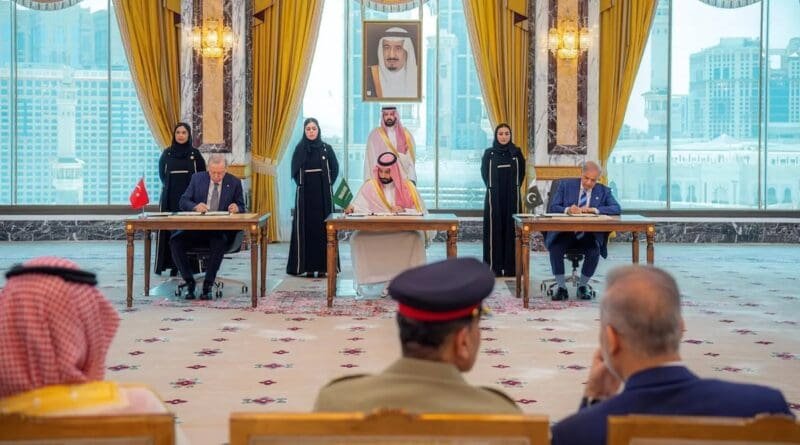
These developments are particularly significant in light of the mutual defence agreement signed by Saudi Arabia, Türkiye, and Pakistan in Makkah in August. The agreement stipulates that an armed attack against any one of the three countries would be considered an attack against all of them. However, the wording of the agreement leaves considerable room for determining the nature of the response according to the circumstances of each crisis and the requirements of the state under attack.
The current escalation therefore tests not only Saudi Arabia's ability to confront the Houthis, but also the capacity of the new security arrangements to move beyond political declarations towards practical coordination.
From Border Attacks to Pressure on Critical Infrastructure
One of the most important developments in the confrontation is the expansion of the range of targets threatened or attacked inside Saudi Arabia. Houthi attacks are no longer confined to military targets or border areas; they increasingly involve vital facilities and economic interests at a time when the Kingdom is already operating in an exceptionally complex regional security environment.
The sensitivity of Saudi Arabia's critical infrastructure is heightened by the Kingdom's reliance on an extensive network of oil facilities, transportation systems, and ports linking production areas to export markets. Any attack on this network therefore carries not only military significance but also potentially wider economic and strategic implications.
The East-West Pipeline, known as Petroline, is particularly important in this context. It provides Saudi Arabia with an alternative route for transporting and exporting oil through the Red Sea, thereby reducing the Kingdom's reliance on routes passing through the Gulf and the Strait of Hormuz. Consequently, threats to this infrastructure amid broader regional instability increase pressure on Saudi Arabia's ability to maintain flexibility in its oil exports.
This highlights one of the most important implications of the escalation: the conflict is no longer simply about inflicting military costs on the adversary; it is increasingly about affecting its economic capacity and strategic mobility.
The Red Sea: A Front Linking Yemen to Global Energy Security
While attacks on Saudi territory represent the immediate dimension of the crisis, developments along Yemen's western coastline give the confrontation a broader regional and international dimension.
The Red Sea and the Bab el-Mandeb Strait are not merely geographical extensions of the Yemeni conflict. They constitute one of the world's major maritime corridors linking Asian and European markets. Consequently, any expansion of Houthi influence along Yemen's western coast, including developments involving the port of Mokha, adds a new dimension to the conflict and increases concerns over maritime security.
The significance of these developments is further amplified by the instability surrounding the Strait of Hormuz. If one of the world's most important energy transit routes becomes vulnerable to disruption while similar risks emerge around Bab el-Mandeb, the strategic room for manoeuvre available to energy exporters and importers becomes considerably narrower.
Saudi Arabia's security equation is therefore no longer confined to protecting its southern border. It increasingly encompasses the protection of oil infrastructure, the security of export routes, the preservation of freedom of navigation in the Red Sea, and the prevention of Yemen's western coastline from becoming a persistent platform for strategic pressure against the Kingdom.
The Houthis and the Changing Balance of Deterrence
The latest developments also expose a deeper problem concerning the balance of deterrence in Yemen. Despite years of military operations and pressure against the Houthi movement, the group has retained the ability to conduct long-range attacks and employ missiles and drones while threatening maritime navigation.
The continuation of such attacks does not necessarily mean that the Houthis possess the capability to achieve a comprehensive military victory. It does, however, demonstrate their ability to raise the cost of Saudi security and create a persistent environment of uncertainty.
This type of asymmetric deterrence presents a particular challenge for states with superior military and technological capabilities. The weaker actor does not necessarily need to defeat its adversary to generate strategic effects. In some circumstances, maintaining the threat against critical infrastructure and commercial routes may itself impose significant political and economic costs.
The Makkah Agreement Faces Its First Practical Test
Against this backdrop, the mutual defence agreement between Saudi Arabia, Türkiye, and Pakistan assumes particular importance. When the agreement was announced, the three countries stated that an armed attack against any one of them would be regarded as an attack against all three, alongside a commitment to strengthening defence cooperation and collective deterrence.
The central issue, however, is not the wording of the agreement alone, but how it is interpreted when a genuine security crisis occurs.
A commitment to collective defence does not necessarily mean that every attack will trigger the deployment of troops or direct military involvement. Turkish Foreign Minister Hakan Fidan, for example, indicated that the nature of any assistance would be determined through consultations and according to the nature of the attack and the requirements of the country concerned.
The real test of the agreement, therefore, lies in whether the three countries can develop a joint response mechanism without making collective defence synonymous with automatic participation in an open-ended war.
Pakistan's Strategic Dilemma
Pakistan faces a particularly delicate equation. On the one hand, it has longstanding defence and strategic ties with Saudi Arabia. On the other, Islamabad seeks to preserve sufficient diplomatic space to engage with different actors across the region.
Direct military involvement against the Houthis could transform the defence commitment into participation in a broader regional conflict, with potentially significant strategic and political consequences.
Pakistan's defence minister stated in September that the Makkah agreement could become operational if attacks against Saudi Arabia continued. This reflects a clear political commitment, but it does not by itself determine the precise form or scale of any military involvement.
This illustrates one of the central characteristics of the alliance: political solidarity is considerably easier to demonstrate than military commitment.
Governments can issue statements of condemnation and support relatively quickly. Translating those positions into joint military operations, however, entails strategic and political costs that cannot easily be separated from each country's broader interests.
Türkiye Between Its Partnership with Saudi Arabia and Regional Calculations
Türkiye faces a similarly complex dilemma. Ankara has developed increasingly close economic and defence relations with Riyadh, but it also seeks to manage its relationship with Iran and avoid turning the Makkah agreement into a framework for direct confrontation with Tehran.
Since the agreement was signed, Turkish officials have stressed that it is defensive in nature and is not directed against any particular country. Fidan also stated that Iran was not identified as a common threat in the agreement.
This clarification is important for understanding the agreement's limits. A collective defence commitment does not necessarily require the three countries to share an identical perception of the threat. This may be one of the agreement's political strengths, as it allows cooperation without explicitly defining a common adversary. At the same time, however, it may become a source of ambiguity when one member is attacked by an actor whose regional relationships and affiliations intersect with the interests of another member.
Washington and the Limits of External Security Guarantees
The current developments also raise a broader question concerning Saudi Arabia's reliance on the traditional US security umbrella. Reports indicate that Washington has approached requests for direct military involvement in the confrontation with caution, amid its engagement in multiple regional crises.
This does not necessarily indicate a rupture in the US-Saudi security relationship. It does, however, highlight an important shift in Saudi strategic thinking: can traditional external security partnerships alone provide sufficient protection in an environment characterised by multiple and increasingly interconnected threats?
Regional arrangements such as the Makkah agreement may form part of an effort to construct an additional layer of collective security, reducing reliance on major external powers as the sole providers of regional security.
Building such a layer, however, requires more than signing an agreement. It requires clear consultation mechanisms, intelligence-sharing arrangements, greater integration of air and missile defence systems, and prior understandings regarding the forms of assistance that could be provided under different scenarios.
The Test of the Alliance Goes Beyond Troop Deployments
For this reason, assessing the Makkah agreement solely by asking whether Türkiye and Pakistan will deploy troops to Saudi Arabia would oversimplify the issue.
Collective deterrence can take multiple forms, including intelligence sharing, logistical assistance, air and missile defence, protection of critical infrastructure, maritime security, and defence-industrial cooperation.
The agreement itself points towards broader areas of defence cooperation rather than merely joint combat operations.
From this perspective, the current escalation may provide an opportunity to test the agreement's institutional architecture rather than simply its capacity to generate direct military intervention.
A Conflict That Extends Beyond Yemen
At its core, the Saudi-Houthi confrontation demonstrates how the Yemeni conflict has evolved into part of a broader regional security equation. Yemen is no longer merely a theatre of internal conflict or a bilateral Saudi-Houthi confrontation. It has become a strategic space where Gulf security, energy security, international maritime trade, regional competition, and the restructuring of alliances intersect.
The situation becomes even more consequential when pressure on Bab el-Mandeb coincides with instability around Hormuz. Under such circumstances, energy security becomes dependent on the stability of two strategic maritime chokepoints at the same time, while Saudi Arabia faces security challenges from multiple directions.
The central question is therefore no longer simply: How should Saudi Arabia respond to the Houthis?
The broader question is: How can a regional security framework be constructed that is capable of addressing cross-border threats without allowing responses to those threats to expand into wider regional wars?
Conclusion
The current escalation between Saudi Arabia and the Houthis represents an early test of the emerging regional security architecture in the Middle East. The confrontation demonstrates the increasingly blurred boundary between domestic security and regional security, while highlighting how an attack on an oil facility or maritime route can quickly become an issue with broader economic and international implications.
The future significance of the Makkah agreement will therefore depend not only on its formal provisions, but also on its ability to produce practical mechanisms for deterrence, coordination, and crisis management. The central challenge is not simply to declare solidarity, but to define the limits of collective commitment when implementing that commitment becomes politically and militarily costly.
The national interests of Saudi Arabia, Türkiye, and Pakistan will remain decisive in determining the nature of their responses. Each country has its own calculations concerning Iran, Yemen, the United States, energy security, and the wider regional balance of power.
Accordingly, the Houthi escalation is testing not only Saudi Arabia's ability to protect its territory and critical infrastructure, but also whether emerging regional security arrangements can move from political solidarity to structured deterrence, and from formal agreements to effective mechanisms for crisis management.
This may ultimately prove to be the most important test facing the Makkah agreement: not whether it will become an alliance that fights another war, but whether it can help prevent regional crises from escalating into broader conflicts in the first place.
Most read



Read also