The First Presence of Women in Art

Cave art constitutes the earliest visual record known to and documented by humankind. Although such art may have been produced within utilitarian or ritual contexts, it nevertheless remains the first written language of prehistoric humans, through which they documented the details of their lives and hunting activities. Herein lies the true significance of the emergence of art: an instinctive impulse toward expression and the documentation of human existence. Art was thus humanity’s first—and for a long time, only—available visual record, predating the invention and development of writing.
Cave paintings were the language through which early humans documented their lives and hunting journeys, while also transmitting their experiences to subsequent generations. During this period, art also functioned as an assertion of human existence, affirming the individual’s presence, distinctiveness, and consciousness.
Archaeological studies by American archaeologist Dean Snow have offered a new reading of this visual legacy. Snow subjected hand stencils found on the walls of caves in France and Spain, dating back more than 25,000 years, to statistical analysis and concluded that a substantial proportion of these ancient images—particularly the hand stencils—were created by women. His research drew on an anatomical and scientific fact: the proportions of finger lengths differ noticeably between males and females. His measurements indicated that approximately 75 percent of these hand stencils belonged to women, suggesting that a significant portion of this early visual documentation of human existence was produced by women.
The significance of this scientific finding lies in its challenge to the traditional narrative of art history, which assumed that men—particularly hunters—were the first artists to paint inside caves. This discovery instead suggests that women played a leading role in humanity’s early practices of visual expression and documentation. It therefore opens the way to a new understanding of the development of art: women’s presence in artistic expression was not a belated response to modernity, but rather an original and foundational act that began at the dawn of humanity, during the Paleolithic era.
As human societies transitioned from hunter-gatherer communities, characterized by mobility, relative equality, and collective participation, to settled agricultural societies, which necessitated a division of roles between the sexes, the structure of society underwent a profound transformation that affected women’s creative status. With the emergence of private land ownership and patriarchal systems for managing it—where physical labor in open fields was given priority—women’s roles became increasingly confined to the domestic sphere, reproduction, and the care of the family and the next generation that would inherit the land. This contributed to the decline of women’s foundational role in art.
During the great transitional phase that marked the dawn of human civilizations, art underwent a major transformation. The first features of urban civilization began to emerge, while artistic practices, channels of expression, and their social contexts evolved. Major art forms such as architecture and sculpture became instruments of political and religious representation, and were predominantly produced by men because of the physical demands associated with them.
Women’s creative activity, meanwhile, increasingly shifted toward applied and craft-based arts connected to domestic and everyday life, such as textiles, weaving, and embroidery. Over time, women’s role in art declined from one of production and active participation to one of appearance and representation. Women increasingly became subjects to be observed by others, with their meanings and representations shaped according to external perspectives.
As social organization became more complex and cities emerged, patriarchal institutions came to monopolize the authority to determine how society was seen and how its history was recorded. This was reflected in explicit institutional practices: women were excluded from public spaces and decision-making arenas, while academies and artistic workshops remained largely reserved for men. Men represented women according to their own perspectives, reducing women’s visual presence to predetermined symbolic forms, often associated with fertility, motherhood, and beauty.
Even in exceptional cases where women themselves produced art and expressed their own perspectives, the writing of art history remained deeply influenced by prevailing social and institutional structures.
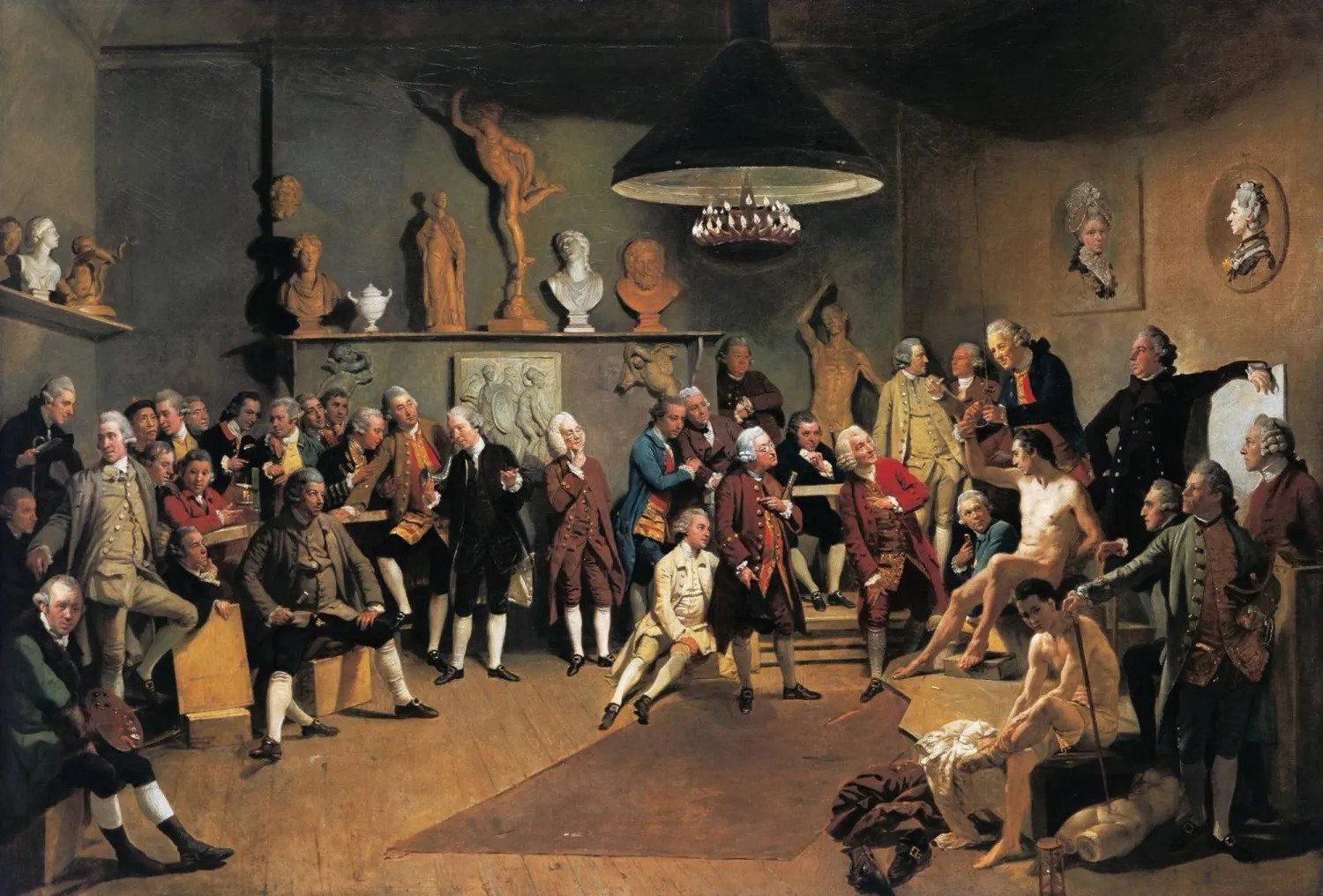
At the beginning of her book Women, Art, and Society, art historian and critic Whitney Chadwick cites the example of the Royal Academy of Arts in London. Although artists Angelica Kauffman and Mary Moser were among its founding members in 1768, the two women were, according to Chadwick’s reading, marginalized in the academy’s official visual record.
In Johann Zoffany’s painting commemorating the founding of the academy, the two female artists were excluded from the central gathering of members. Instead, the painter depicted them as two portraits hanging in the background. In the context of Chadwick’s book, this example illustrates the disparity that historically shaped the status of women and men in the art world, reducing women to objects of representation rather than recognizing them as active participants.
However, a closer analysis of this example suggests that the visual exclusion of the two artists in Zoffany’s painting was not necessarily a deliberate act of exclusion, as Chadwick argues, but rather a reflection of the restrictions, traditions, and social and institutional conventions prevailing in the eighteenth century.
At the time, women were prohibited from attending life-drawing classes involving the study of the nude human body. This was precisely the subject of Zoffany’s painting: male members of the academy gathered around a nude model during a life-anatomy session. Women were not socially or morally permitted to attend such classes. The artist therefore represented Kauffman and Moser through two individual portraits hanging on the wall in the background, providing a protocol-compliant solution consistent with the ethical and social standards of the period.
Zoffany’s documentary approach demonstrates how social conventions and institutional restrictions intersected with artistic practices to determine women’s position within such institutions.
The example of the Royal Academy of Arts in Britain reflected a broader institutional pattern that prevailed across Europe. In France, the Académie des Beaux-Arts in Paris, then the world’s artistic capital, remained closed to women, who were not permitted to enroll in formal studies there until the late nineteenth century. Even after this belated admission, women’s presence remained constrained by social standards that shaped both artistic production and its reception.
The history of women in art was therefore not a linear progression that began from nothing and gradually evolved into its present form. Rather, it was a complex trajectory that began with women’s early acts of expression in caves and subsequently declined as economic and social structures changed.
This demonstrates that women’s absence from the artistic scene for centuries was not the result of any deficiency in their creative abilities. Instead, it was largely a consequence of the social, institutional, and organizational systems that defined the spaces in which women could move, participate, and be visible.
For this reason, contemporary women’s artistic movement acquires a deeper historical significance. It is not merely a modern attempt to create a new visual language, but rather an act of historical reclamation: a conscious effort to restore and reaffirm women’s original presence as an expressive and documentary force that helped shape human consciousness from the very dawn of civilization.
Most read