
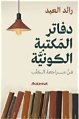
Caught somewhere between academic rigor, impressionism, and personal temperament, book reviews of all kinds have remained a cultural practice largely free of any constraints that might confine them to a particular framework or restrain their writers. Everyone approaches a review in whatever way they deem appropriate. This is one of the most important insights offered by Raed Al-Eid’s book, published by Kalimat Publishing and Distribution under the title Cosmic Library Notebooks: The Art of Book Reviewing.
Through this work, which is documentary as much as it is literary, Al-Eid undertakes something resembling a historical account and analytical study of a form of writing that few Arab writers have attempted to examine systematically, or regarded as a genre worthy of attention in its own right. The book’s principal strength lies in Al-Eid’s effort to trace the different forms and varieties of this art, bring them together, understand them, and clarify the distinctions between them.
For this reason, “the art of reviewing” is subjected this time to scrutiny, tracing, examination, analysis, and the drawing of conclusions. Contrary to what one might expect, Al-Eid argues that the decline of the printed book, or the waning of its prominence, does not mean the decline of this art. On the contrary, it has strengthened its role and allowed it to emerge in forms that were previously unfamiliar, making it less immediately recognizable as book reviewing.
Every day, after all, we encounter an assessment of a book, a program, or a contribution on one of the social media platforms. We leave a star rating, a like, or a long or short comment. Evaluation lies at the heart of the social media economy and constitutes a fundamental part of its vitality and circulation. This is not necessarily comparable to serious book reviews, but the connection between the two exists, and the relationship deserves to be recognized.
Al-Eid attempts to offer a “review of reviews,” in the manner of a “science of science” or an “interpretation of interpretation.” He investigates the practice in an effort to define its nature, trace its origins, clarify the terminology associated with it and the motivations behind writing reviews, identify their components, methods, requirements, and the choices available to their authors. He also examines the scale of the review economy and the consequences of publishing reviews, the pitfalls involved in reading them, and ultimately the claim that the art itself has died.
According to Al-Eid, writing about books emerged with the spread of books themselves. Those unable to obtain a particular work could console themselves by reading part of it, or something about it, in a comprehensive volume created for that purpose. Reviews and summaries therefore provided a valuable service. This was the first reason for the emergence of reviews: “to introduce readers to the rare book that is difficult to obtain, to bring the distant closer, and to disseminate the unique. In the early days of writing and publishing, books were difficult to produce and laborious to copy, and not everyone could obtain them; people therefore had to make do with little of them.”
There are books that have not survived to the present day at all, yet we know they existed and know something about their contents because of reviews and accounts of them. The book points out that examples of such writing can be found in the dialogues of Plato, the letters of Seneca, the writings of Plutarch, the arguments of Cicero, the meditations of Marcus Aurelius, and the works of Aristotle. Among Arab writers, Al-Jahiz was no less prolific in writing about books, criticizing them, encouraging readers to read some of them, and transmitting the contents of others.
Al-Eid regards Ibn al-Nadim’s Al-Fihrist as a model representing a long era in the history of book reviewing. Ibn al-Nadim’s primary concern was to preserve within his book the substance of the books of his time, gathering together what he had read, learned, and heard about. Its importance lies in the fact that many of the books he discussed subsequently disappeared and are no longer available to us. Ibn al-Nadim’s accounts therefore carried them into history and prevented them from disappearing completely.
The book traces the evolution of reviews throughout history, in both East and West, up to the modern era. Reviews began to appear in something resembling their contemporary form in French newspapers during the seventeenth century. From that point onward, their forms and methodologies developed, moving from merely introducing books to evaluating and judging them.
This evolution generated considerable debate—not only over the role of reviews, but also over the boundaries they were expected to observe. Writers moved beyond description toward criticism and praise. Clément Moisan, in his book What Is Literary History?, recounts that literary journalists of the period “did not limit themselves to summarizing and quoting from the works they reviewed, but began issuing judgments and criticizing those works, believing that they were fulfilling their duty to readers by guiding them.”
During the nineteenth century, magazines began dedicating sections and columns to keeping pace with new books, following publications, presenting them, and reviewing them. In the Arab world, Al-Muqtataf magazine appeared in 1883, and seven years after its founding it introduced a section titled “Gifts and Commendations,” on the premise that introducing readers to books and reviewing them constituted gifts to the reader.
The section was later renamed “Commendation and Criticism,” reflecting a significant transformation in its functions and its adoption of new analytical and critical approaches. Al-Zuhur magazine subsequently called its book-review section “The Fruits of the Press,” adopting a concise presentation and rapid introduction to newly published works. Apollo magazine continued this tradition under the title “Press Fruits.”
When Ibrahim al-Yaziji joined Al-Bayan magazine and later Al-Diya, he chose to publish his book reviews under the heading “Literary Works,” treating the review as an independent literary text in its own right. Many writers produced literary texts in the form of reviews, including Taha Hussein, Abbas Mahmoud Al-Aqqad, Al-Mazini, and many others.
In 1896, The New York Times announced a dedicated supplement for book reviews. It initially appeared every Saturday morning, before being moved to Sunday mornings in order to increase readership and provide readers with entertainment and intellectual benefit during their weekend.
The supplement survived far longer than anyone might have expected. In 2021, the newspaper celebrated the 125th anniversary of its founding, accompanied by a documentary volume chronicling this literary and intellectual endeavor.
When reviews were written by editorial departments and limited to introducing and describing books without requiring substantial effort, they did not necessarily carry the names of individual writers. This changed once reviews became associated with opinion and analysis, and were written by authors whose names newspapers had an interest in highlighting.
Today, with approaches and methodologies multiplying, styles and schools diversifying, specialized terminology emerging, and publishing platforms proliferating, reviews are no longer merely marginal forms of writing. They have become too important to ignore or exclude from literary and linguistic dictionaries and reference works.
Indeed, the author argues that reviews have evolved into “an independent literary genre in their own right, with its own concepts and dimensions, as well as its wide-ranging and diverse practices.”
He calls for recognition of what might be termed “the literature of reviews.” For not everyone who has written in this field has sought merely to introduce books within a particular discipline. Some have actually produced literary reviews that can stand alongside works of high literature, elevating writing about writing into an original creative act rather than a rapid reaction or hastily composed commentary.
It is also important not to overlook the commercial and economic dimension of book reviews.
A single article that captures readers’ attention and draws them in can elevate a book’s standing in the public imagination and cause people to rush to acquire it. Al-Eid therefore notes the emergence of companies specializing in book marketing and the commissioning of prominent newspaper columnists. Some publishing houses have contracts with leading book reviewers, while authors have developed relationships with YouTubers and social media influencers to promote their books. It is hardly surprising, therefore, to find that once a promotional campaign begins, books may quickly disappear from bookstore shelves.
Raed Al-Eid thus attempts to trace the trajectory of book reviewing from its earliest origins to the present, with a broad perspective open to different forms and fields of knowledge. The result is a study with a distinctly literary sensibility, resembling what might be called an “anthropology of reviews.”
It surveys the history of this art in print magazines and cultural periodicals before following it into the open digital age, where social media platforms and blogs have become among the most popular means of evaluating books, sharing news about them, and exchanging opinions concerning them.
The book fills a gap in the Arab library and addresses a theoretical void concerning an art form that has consistently been regarded as too minor to deserve serious attention. More than that, it restores recognition of its literary value and its role as a vital engine of book sales and a major catalyst for literary and intellectual debates.
For this reason, the author describes the book reviewers to whom he dedicates his work as “builders of cultural bridges and custodians of the cosmic library.”
Al-Eid is, in effect, drawing the initial map of a field that has not received the seriousness it deserves, hoping that others will come after him to develop it and explore its finer details—particularly as the field itself is undergoing simultaneous transformations in form, substance, and medium.
That is a major revolution, and one that deserves close attention.
Here the book invokes the words with which Ibn Khaldun concluded his famous Muqaddimah:
“Perhaps those who come after us, whom God may support with sound thought and solid knowledge, will delve into its questions more deeply than we have written. The discoverer of an art is not required to enumerate all its questions; rather, his task is to establish the field of knowledge, diversify its chapters, and define what it discusses. Those who come later will add questions little by little until the work is complete.”
Reproduced from Asharq Al-Awsat.
Most read