
The Amazigh Woman As Living Archive: Soundousse Belayachi And The Aesthetics Of Cultural Memory

Introduction
Contemporary Moroccan painting has become one of the principal arenas in which questions of identity, gender, memory, and cultural belonging are negotiated, and few living artists occupy this arena as deliberately as the Amazigh painter and designer Soundousse Belayachi. Born in Casablanca in 1971 and long resident in Rabat, Belayachi has built a body of work in which the Amazigh woman is never a decorative surface but a bearer of history. Her canvases sit at an intersection rarely held with such discipline: the intersection of aesthetic celebration and cultural testimony, of individual portraiture and collective symbol, of intimate domestic memory and civilizational argument.
It would be a mistake to approach this body of work as a simple gallery of admirable faces. Behind each face, each fibula, each length of woven cloth, lies an entire epistemology — a way of knowing and transmitting that the written archive of North Africa has persistently underserved. Belayachi’s paintings restore to visibility a form of historical agency that survived not in chronicles or treaties but in gesture, ornament, and craft, carried almost exclusively on the bodies and in the hands of women.
As I have argued elsewhere, the artist herself treats the arts as expressions of ethnic identity, from which it follows that the guardians of that identity are literally those who ensure its transmission from one generation to the next (Chtatou, 2024). Belayachi’s canvases therefore do not merely depict beauty; they stage an argument about who has actually carried Amazigh civilization through history, and the argument is unambiguous: it is women. What follows is an attempt to trace that argument across the principal registers of her practice — the face, the ornament, the exhibition, the biography, the material, and the metaphor of weaving that binds them together, in order to show that a portrait, in her hands, is never only a portrait.
The Face as a Site of Meaning
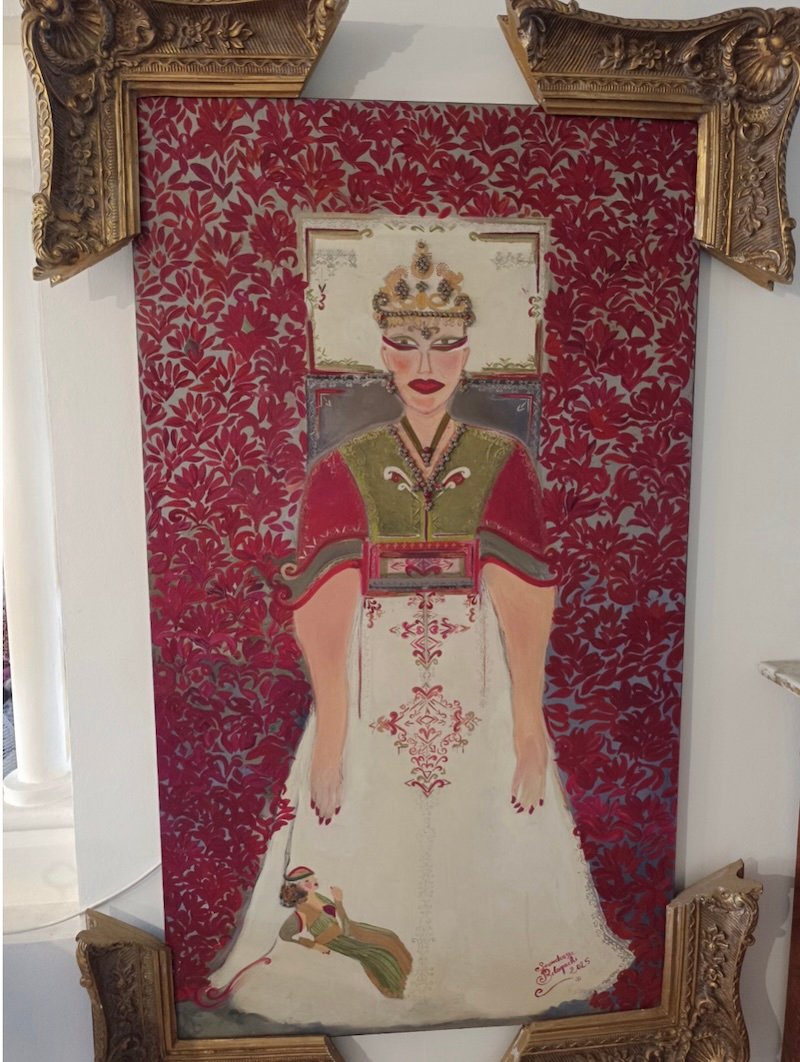
Before any single symbol is identified — before the viewer registers a particular fibula, a particular textile pattern, a particular tattoo — Belayachi’s paintings first ask to be read through the face. Her women hold expressions that resist a single emotional register: dignity shades into meditation, pride into a quiet melancholy, serenity into something closer to vigilance. This ambiguity is deliberate. A face rendered as pure serenity would risk collapsing into the picturesque, an image consumed for its prettiness and then set aside; a face rendered with this degree of interior complexity insists instead on being considered, on being read as a subject with a history rather than admired as an object of decoration.
This treatment of the face has particular weight given the historical role of facial ornamentation — tattooing, jewelry, ceremonial adornment — in Amazigh communities, where such practices once communicated belonging, fertility, protection, and social status.
Facial tattooing among Amazigh women marked distinct phases of a woman’s life and was applied from a young age, with placement carrying specific meaning: a line on the chin could signal an engagement, while a mark near the nose might indicate marriage or, in some cases, the loss of a child (Osman, 2022). Beyond marking biography, the practice was tied to protection against harm and to an ideal of feminine beauty, and because tattooing was reserved for women, it functioned simultaneously as an assertion of gender and of communal belonging (Osman, 2022). Belayachi detaches these elements from a purely ethnographic frame and reintegrates them into a contemporary visual language without erasing their legibility as traditional signs. Heritage, in this rendering, does not belong exclusively to the museum vitrine or the archaeological catalogue; it can live directly in a face, a hairstyle, a fibula, or a tattooed line, continuously and in the present tense.
Painting by Soundousse Belayachi
The Woman as Guardian and Archive
Belayachi’s portraits invert the customary hierarchy of North African historiography, in which dynasties, wars, and male scholars occupy the foreground while the domestic and artisanal labor of women recedes into anonymity. Her women are instead cast as active custodians of a non-written archive — an archive woven into carpets, painted onto skin, hammered into silver, and sung into lullabies. This is not a nostalgic gesture toward a vanished past; it is a claim about historical method. If a civilization transmitted itself chiefly through practice rather than script, then the historian — and, in this case, the painter — must look where the transmission actually occurred: in the hands of mothers, weavers, and artisans, not only in the courts of sultans and the archives of colonial administrators.
The historical record largely omitted this contribution, yet the rituality, orality, and craft of Amazigh women constitute a genuine repository of knowledge, one that unsettles conventional narratives of women as mere consumers, rather than producers and adapters, of culture (Chtatou, 2024). Control over the visual vocabulary of Amazigh identity — its motifs, colors, and silhouettes — conferred upon these women both social prestige and a form of cultural authority that Belayachi’s brush now makes visible to a contemporary audience (Chtatou, 2024). This authority was never merely symbolic. A woman who understood which fertility symbol belonged on which textile, which color sequence marked a bride rather than a widow, or which tattoo pattern signaled a particular lineage possessed a technical and social competence indistinguishable from what, in other traditions, would be called scholarship. Belayachi paints that competence as visible knowledge rather than folkloric backdrop.
This reframing carries an implicit argument about power. To control the visual grammar of a community — to decide what counts as beautiful, appropriate, or meaningful — is to hold a form of cultural sovereignty. Belayachi’s women hold their gaze toward the viewer with a steadiness that refuses supplication; they are not being looked at so much as they are looking back, asserting the authority of those who know what the symbols around them mean. In this sense her portraiture performs a quiet correction of the ethnographic gaze that historically reduced Amazigh women to specimens of costume and custom rather than agents of meaning.
Adornment as Public Testimony
Jewelry, tattoos, and dress occupy a privileged place in Belayachi’s iconography, and for good reason: among Amazigh women these were never incidental ornaments but declarations of self, transmitted publicly and read collectively. A fibula pinned at the shoulder announced region, marital status, and lineage as unambiguously as a written seal; a tattoo traced along the chin or forehead carried protective and social meaning legible to anyone versed in the code. Belayachi’s insistence on rendering these objects with jeweler’s precision — the exact curve of a silver clasp, the granulation on a bead, the geometric logic of a tattooed line — signals that she reads them the same way: not as costume but as script.
The fibula, historically the pin used to fasten a woman’s draped garment at the shoulder, varied in style from one region of North Africa to another, so distinctly that a brooch’s form, materials, and ornamentation could identify a woman’s regional and tribal origin at a glance (Becker, 2024a). Young women traditionally received such brooches at marriage, and their heavier, more elaborately worked pairs were then reserved for ceremonial and religious occasions rather than daily wear (Becker, 2024a). The triangular form at the center of many fibulae, meanwhile, recurs across Amazigh visual culture more broadly — painted on domestic walls, woven into textiles, worked into pottery — and has long been read as a gendered symbol tied to female fertility (Becker, 2024a). Belayachi’s paintings, in reproducing this triangular vocabulary with such fidelity, place her portraits in direct continuity with a much older visual grammar rather than merely quoting it as costume.
Clothing, tattooing, and jewelry function as public statements of identity, and this openly performative dimension of Amazigh womanhood stands in sharp, almost polemical contrast with reductive stereotypes that cast women of the Islamic world as sequestered and veiled (Chtatou, 2024). Belayachi seizes on precisely this contrast. Her fibulae, silver necklaces, and amber beads are rendered with an insistence that refuses to let ornament dissolve into mere prettiness; each object is instead treated as a fragment of testimony, a visual footnote to a civilization that recorded itself on the body rather than on the page.
This politics of visibility matters beyond the frame of the painting. Amazigh adornment has too often circulated in Western and even domestic Moroccan contexts as raw material for tourist souvenirs or fashion pastiche, stripped of the social grammar that gave it meaning. By restoring these objects to the center of serious portraiture — by insisting that a fibula deserves the same compositional weight as a face — Belayachi performs an act of reclamation. The ornament is returned to its makers and wearers as an object of historical testimony rather than decorative curiosity, and the viewer is invited to read it rather than merely admire it.
Painting by Soundousse Belayachi
Color, Material, and the Senses
Belayachi’s technique — a layered practice of oil, wax, and pastel — produces surfaces that are less painted than accumulated, in a manner that echoes the material logic of the textiles and jewelry she depicts. Color in her work is rarely applied as a single flat field; it builds through translucent passages that let underlying tones glow through, an effect that mimics the way light moves across woven wool, hammered silver, or henna-stained skin. The result is an atmosphere in which the viewer encounters Amazigh culture as much through sensation as through iconography — through the felt richness of ochre, indigo, carnelian, and amber rather than through a checklist of symbols.
This sensorial emphasis is not incidental to her subject matter. Amazigh culture has historically been transmitted through material and embodied practice — textile, architecture, ornament, dance, and gesture — far more than through text. A painter who wanted merely to illustrate this culture could have settled for documentary flatness; Belayachi instead translates its material intensity into paint, moving, in effect, from textile to canvas and from lived adornment to image without losing the tactile charge of the original.
Tradition and Modernity Held Together
One of the more intellectually serious aspects of Belayachi’s project is her refusal to treat tradition and modernity as opposed terms. Her subjects wear ancestral jewelry and traditional dress, yet nothing in the composition, palette, or presentation belongs to a museal or antiquarian register. The paintings are unmistakably contemporary in their formal vocabulary even as their content is unmistakably rooted in inherited Amazigh visual codes.
This hybridity mirrors a broader condition of contemporary Moroccan society, in which Amazigh identity is not a relic preserved against modernization but a living framework continuously reconstructed within it. A woman today can wear a grandmother’s fibula, hold a university degree, use a smartphone, and remain deeply attached to ancestral practice — these are not contradictions to be resolved but a single, coherent contemporary identity. Belayachi’s canvases refuse the temptation to freeze Amazigh womanhood in an imagined, unchanging past; they insist instead that heritage is something modernity can carry rather than something modernity necessarily erases.
A Plural Amazigh World
Belayachi’s work also resists the flattening of Amazigh identity into a single visual template. The Amazigh world spans the Rif, the Middle and High Atlas, the Souss, and the pre-Saharan south, and each of these regions carries its own vocabulary of jewelry, textile pattern, and dress. By varying the ornamental detail across her portraits — a fibula characteristic of one region, a textile motif associated with another — Belayachi implicitly maps this internal diversity rather than collapsing it into a generic “berber” aesthetic of the kind long marketed to tourists.
This regional attentiveness matters because Amazigh identity, precisely because it is so often invoked as a single constitutional and political category in contemporary Morocco, risks being flattened in public discourse into an abstraction. Belayachi’s paintings work against that flattening from within the register of art: they insist that Amazigh civilization is not monolithic but a family of related, historically specific traditions, each carried by particular women in particular places.
A Feminine Counter-Narrative
There is, finally, a gendered historiographical claim embedded in Belayachi’s choice of subject. Much writing about North African societies has privileged rulers, dynasties, tribal confederations, and male intellectuals, leaving the everyday cultural labor of women underexamined. Belayachi’s protagonists are, without exception, women, and her implicit history is consequently a history from below — told through faces, gestures, textiles, and ornament rather than through chronicles of conquest and governance.
This is not a marginal aesthetic choice but a historiographical intervention. It suggests that civilizations are sustained as much by mothers, weavers, healers, and storytellers as by kings and scholars, and that a complete account of Amazigh history is impossible without attending to the material and symbolic labor of women. In placing her female subjects at the compositional and thematic center of her practice, Belayachi performs, canvas by canvas, an act of historical correction that written historiography has been slow to undertake.
Painting by Soundousse Belayachi
“Amazigh’s Beauty” and the Politics of the Exhibition
This argument crystallized in Belayachi’s 2025 exhibition Amazigh’s Beauty, presented in Casablanca as an explicit homage to the strength, dignity, and social centrality of Amazigh women.
Critics who reviewed the exhibition described her work as showing the Amazigh woman in all her facets — proud, dignified, maternal, independent — an oeuvre of rare intensity in which aesthetics fuses with consciousness and painting becomes a language of transmission and memory (Le Monde Amazigh, 2025). Belayachi’s practice sits, in this sense, at the crossing of several idioms: an oriental elegance of line and finish merges with unmistakably Amazigh iconography — geometric motifs, traditional tattoos, ancestral jewelry, colored textiles (Le Monde Amazigh, 2025). The title of the show is itself a thesis. Beauty here is not cosmetic; it is civilizational, and to perceive it is to perceive the resilience of a people who preserved their identity against successive erasures.
Staged at Casablanca’s Cathédrale du Sacré-Cœur during the city’s Marché des Créateurs, the exhibition placed Belayachi’s work in explicit dialogue with a broader gathering of emerging Moroccan talent, situating Amazigh womanhood not as a niche ethnographic subject but as a full participant in the contemporary national art scene. The choice of venue and context is itself worth noting: rather than confining Amazigh iconography to folkloric or heritage settings, Belayachi placed it inside the circuits of contemporary gallery culture, asking it to be judged by the same criteria as any other serious contemporary practice — and to hold its own.
A Biography Written into the Work
Belayachi’s own itinerary illuminates the hybridity of her painting. Trained from childhood in drawing and painting in Casablanca, she later pursued professional formation in makeup and body art in Paris — cinema, theater, fashion, bridal, and television work that sharpened her command of the human face and body as expressive surfaces before she turned that command toward the canvas.
Her professional training in film, theatrical, and body painting in Paris during the 2000s (ArtMajeur, n.d.) is not incidental biographical detail; it explains the tactile precision with which she renders skin, tattoo, and ornament, and it accounts for a technique that moves fluidly between oil, wax, and pastel to build the luminous, richly textured surfaces for which her portraits are known.
There is a further biographical resonance worth drawing out. A career built on cinema, theater, bridal, and television makeup is, at its core, a career built on preparing faces to carry meaning for an audience — on understanding how ornament, color, and gesture communicate identity, mood, and status before a single word is spoken. Belayachi transposes this professional literacy directly onto canvas: her portraits are composed with the same deliberateness a makeup artist brings to a face destined for the camera, where every line and every accent of color is chosen because it will read clearly at a distance and carry emotional weight instantly. Her turn from applied craft to painting is consequently less a rupture than a continuation, a shift of medium that preserves an underlying, lifelong preoccupation with the expressive power of the adorned face.
The Carpet as Metaphor and Practice
Weaving, both as material practice and as governing metaphor, runs through Belayachi’s broader engagement with Amazigh visual culture. Among Amazigh communities, weaving was never a neutral craft skill; it was, and largely remains, a practice saturated with meaning about fertility, prosperity, and female creative power.
The wool that Amazigh women work is traditionally associated with prosperity, the fertility of the land, and divine blessing, and women who weave are correspondingly held in high social esteem, to the point that a popular saying promises a woman who completes forty carpets in her lifetime a guaranteed place in heaven (Becker, 2024b). The loom itself is treated in some regions as the site of a symbolic birth: as the warp threads are mounted, the textile is said to acquire a soul, and weavers may straddle the loom’s beams in a gesture likened to childbirth before the piece is finally washed and blessed upon completion (Becker, 2024b). Weaving, in other words, has long functioned in Amazigh thought as a second register of female creative and reproductive power, running parallel to motherhood rather than merely illustrating it.
Her painting Motifs de convivialité amazighe (“Motifs of Amazigh conviviality”) takes the Berber carpet — long dismissed and imitated without acknowledgment by the European decorative industry before artists such as Paul Klee and architects such as Le Corbusier rehabilitated its geometric vocabulary (Le Monde Amazigh, 2020) — and restores it to its rightful authorship. The carpet’s repeating geometries become, in her hands, a figure for cultural transmission itself: pattern accumulated, repeated, and passed hand to hand across generations of women.
The choice of title, conviviality, is itself significant. It suggests that the carpet’s geometric vocabulary was never merely decorative but relational — a visual language through which households, lineages, and communities affirmed connection and continuity. Read this way, the loom becomes an ancestor of the canvas: both are surfaces on which pattern is built stitch by stitch, or brushstroke by brushstroke, into something that outlasts the maker’s own lifetime. Belayachi’s decision to paint the carpet rather than merely reproduce it extends this logic one step further, translating a craft historically undervalued by the very European markets that copied it into a register — fine-art painting — in which authorship and authorial intent are unambiguous and cannot be so easily detached from their maker.
Conclusion: Painting as an Act of Memory
Soundousse Belayachi’s project can be read, finally, through three interlocking terms: woman, memory, and identity. Beauty in her canvases is never an end in itself; it is the surface through which dignity, craftsmanship, and historical agency become visible. Her Amazigh woman is mother, artisan, guardian, and custodian at once, and through her the largely oral, largely non-written civilization of the Imazighen acquires a durable, contemporary face.
What ultimately distinguishes Belayachi’s practice from a merely celebratory ethnographic portraiture is its refusal to separate aesthetics from historical argument. The beauty of the woman leads the eye to her jewelry; the jewelry leads to the craftsmanship that produced it; the craftsmanship leads to the historical agency of the women who practiced it; and that agency leads, finally, to the larger question of civilizational survival. Each formal choice in her painting therefore doubles as a claim about who preserved Amazigh culture and how. In restoring women to the center of that civilizational story, Belayachi performs an act of historical correction as much as an act of art — she reminds us that the loom, the needle, and the tattoo needle have preserved as much history as the sword or the treaty, and that it is time painting said so plainly. Her women look out from the canvas not as passive witnesses to a history made elsewhere, but as its makers, its archivists, and its custodians.
Most read




Read also