
From Reopening Hormuz to the Struggle for Influence and Negotiating Leverage

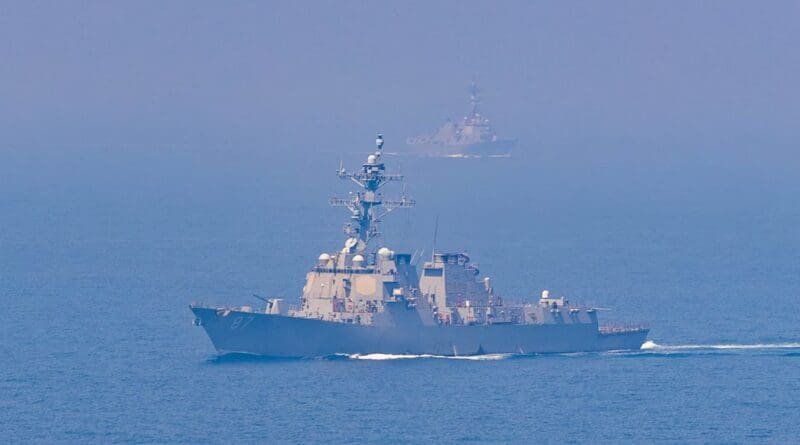
The US announcement that international shipping lanes through the Strait of Hormuz have been reopened does not appear to have brought the maritime crisis to an end so much as moved it into a new phase. A significant gap remains between the military ability to secure shipping lanes and the restoration of the commercial and security confidence needed for shipping companies to resume normal operations.
This paradox demonstrates that the battle over Hormuz is no longer solely about naval mines or attacks on vessels. It has become part of a broader struggle over influence, rules of engagement, and the balance of power between the United States and Iran. While Washington seeks to consolidate its ability to guarantee freedom of navigation, Tehran is attempting to preserve whatever remains of its ability to use the strait as a strategic bargaining tool in any future negotiations.
The central question, therefore, is no longer whether the Strait of Hormuz is “open” in military terms, but whether it has become sufficiently secure politically, militarily, and economically for shipping activity to return to normal levels.
From Freedom of Navigation to a New Balance of Power
The US discourse surrounding the Strait of Hormuz reflects an important shift in the way Washington is managing its confrontation with Tehran. US President Donald Trump has declared that the strait is open to shipping, arguing that Iran’s ability to threaten vessels has been reduced to a very limited level.
The significance of these statements goes beyond their military dimension. They suggest an American effort to establish a new strategic reality: that Iran is no longer able to use the strait as effectively as it did before the war.
According to the US account, the balance of power in the strait has changed substantially since the outbreak of the war, after Iran’s ability to threaten or disrupt maritime traffic had been one of its principal instruments of pressure. For Washington, therefore, reopening the passage is not simply a military operation designed to clear mines and protect ships. It is also part of an effort to reshape the negotiating environment with Tehran.
The significance of this development lies in the fact that control over international shipping routes provides the actor capable of securing or disrupting them with influence that extends beyond the maritime sphere. The Strait of Hormuz is one of the most important gateways to global energy markets, and any actor capable of affecting traffic through it possesses a form of leverage that can be used in political, security, and economic negotiations.
Hormuz as an Iranian Instrument of Leverage
The Strait of Hormuz has long been a central element of Iran’s strategic calculations. The waterway constitutes a major chokepoint in the global energy system, carrying roughly one-fifth of the world’s seaborne oil and liquefied natural gas supplies.
For this reason, Iran’s ability to threaten maritime traffic in the strait has not been merely a military instrument. It has also represented an important source of political leverage. Even the possibility of disrupting shipping can raise insurance and transportation costs, increase energy prices, and deepen uncertainty in global markets.
This dynamic became particularly evident as the war developed. At the beginning of the conflict, oil continued to move through the strait with relatively little interruption, while Brent crude traded at around $72 per barrel. As attacks and concerns over naval mines subsequently intensified, however, maritime traffic became increasingly disrupted, and oil prices rose, according to the figures cited in the report, to as high as $126 per barrel.
The strength of the Hormuz card therefore lies not only in Iran’s actual ability to close the strait, but also in its ability to convince markets that disruption or closure is a credible possibility.
The United States Seeks to Reverse the Equation
Washington, by contrast, has sought to transform Hormuz from an Iranian source of leverage into a source of American strategic advantage. According to the account presented in the report, this required moving from limited protection of shipping to a broader military operation aimed at securing the passage.
US efforts included escorting commercial vessels, providing air cover, intercepting drone and cruise-missile attacks, and subsequently undertaking extensive operations to clear maritime lanes of mines.
These operations involved US naval units, divers, special operations forces, surface and underwater drones, and civilian contractors. Large numbers of US troops, ships, and aircraft were also involved in securing shipping operations.
According to the US assessment, these efforts helped approximately 1,500 commercial vessels transit the strait, carrying a combined total of around 750 million barrels of oil destined for global markets.
If these figures are accurate, Washington has achieved a dual objective: reducing the immediate risks to maritime traffic while demonstrating its capacity to provide a practical alternative to Iranian influence over the waterway.
Yet military success does not necessarily translate into the political outcome Washington seeks.
Mines: A Military Problem That Does Not Explain the Entire Crisis
The issue of naval mines illustrates the gap between the US narrative and alternative assessments. US Central Command Commander Brad Cooper announced that international shipping lanes had been cleared of mines that Washington says were laid by Iran’s Islamic Revolutionary Guard Corps.
According to the US account, more than 200 objects suspected of being mines were identified within the main shipping lane, but inspections determined that only 11 were actual mines, while some of those had not been deployed correctly.
Bloomberg, however, cited estimates from US allies questioning whether the clearance operation was complete, suggesting that between 80 and 150 mines may still remain in the strait.
Regardless of which estimate proves more accurate, the issue highlights a fundamental element of the Hormuz crisis: the problem is not simply whether a threat exists, but how certain commercial actors can be that the threat has been eliminated.
Shipping companies do not merely require military confirmation that the passage is open. They need a high degree of confidence that the remaining risks will not turn a commercial voyage into an unacceptable operational and financial liability.
Why Are Ships Not Returning Immediately?
This is where one of the most important paradoxes of the current situation emerges. Even if the United States succeeds in securing the shipping lanes militarily, shipping companies do not necessarily interpret this as a full return to normal conditions.
The data cited in the report indicate that seven vessels carrying commodities transited the strait on one day, compared with 17 the previous day and below the preceding 10-day moving average of 15 vessels.
Estimates from vessel-tracking services also suggest that traffic through the strait remains at roughly 5–15 percent of its normal pre-war levels.
The accuracy of such data can be affected by the ability of some vessels to switch off their tracking transponders during voyages. Nevertheless, the broader trend carries significant political and economic implications: reopening the strait militarily has not yet translated into reopening it commercially.
The reason is that transit decisions are not made by governments alone. They also reflect the calculations of shipping companies, insurers, and cargo owners. For these actors, any possibility of an attack, mine, or military escalation translates directly into higher costs and greater operational risk.
Maritime Security as Part of the Negotiating Equation
This reality is particularly important given attempts by regional mediators to revive the diplomatic track between Washington and Tehran.
If the United States has indeed succeeded in reducing Iran’s ability to threaten maritime traffic, one of Tehran’s most important traditional instruments of leverage may have lost part of its effectiveness.
This could give Washington a stronger negotiating position in any future talks, as one element of Iranian strategic power—the ability to affect global energy flows—would become less effective in the presence of a substantial US military capability to protect shipping.
At the same time, however, this dynamic carries another risk. The more freedom of navigation becomes dependent on a heavy US military presence, the more the shipping corridor itself becomes integrated into the military confrontation rather than remaining a relatively neutral domain for international commerce.
Washington’s success in securing Hormuz could therefore become an additional source of pressure on Iran, but it could also contribute to the increasing militarization of one of the world’s most important commercial waterways.
A New Deterrence Equation
The current situation increasingly resembles an effort to establish a new deterrence equation in the Gulf.
Iran had used its ability to threaten maritime traffic as a means of increasing the costs of any confrontation with it. The United States is now seeking to demonstrate that this capability is no longer sufficient to sustain the previous deterrence equation.
Yet deterrence depends not only on military power. It also requires the ability to manage risks and escalation on a sustainable basis. If the United States must maintain large numbers of warships, aircraft, and troops in the region indefinitely to guarantee freedom of navigation, this would suggest that the Hormuz problem has not been fully resolved, but is instead being managed through a heavy military deployment.
Iran, meanwhile, may seek alternative means of compensating for the decline in its ability to use the strait directly, whether through indirect instruments or by incorporating maritime threats into a broader political bargaining strategy.
Bab el-Mandeb and the Divergence in Risk Calculations
The comparison between traffic through the Strait of Hormuz and the Bab el-Mandeb Strait provides an additional indication of how shipping companies respond to changing security conditions. According to the data cited in the report, 17 commodity-carrying vessels transited Bab el-Mandeb on the same day that only seven crossed Hormuz.
This comparison does not necessarily mean that one waterway is categorically safe while the other is dangerous. Rather, it illustrates how shipping companies dynamically reassess risk and redistribute operations in response to changing security conditions.
Consequently, restoring maritime traffic through Hormuz will depend not only on mine clearance, but also on companies’ assessment of the overall risk compared with alternative routes.
Seventy Incidents and 19 Sailors: The Confidence Deficit
The reported number of maritime incidents helps explain why shipping companies remain reluctant to return to pre-war levels of activity. According to the report, the International Maritime Organization has recorded 70 incidents in the Strait of Hormuz since the beginning of the war, resulting in the deaths of 19 sailors.
For the commercial sector, these figures are not simply military or security statistics. They represent indicators of potential risks that must be incorporated into insurance and operational calculations.
The return of shipping therefore requires more than a political declaration or a successful military operation. It requires rebuilding confidence among shipping companies in the safety and predictability of the waterway, a process that may take considerably longer than the physical clearance of mines.
Could Hormuz Become a New Negotiating Arena?
The most significant aspect of the current developments is that the Strait of Hormuz is no longer merely a security issue separate from the broader political confrontation between the United States and Iran.
The strait has become part of a wider negotiating equation. Washington wants to demonstrate that Iran’s ability to threaten maritime traffic is no longer sufficient to disrupt the global economy, while Tehran has an interest in preserving as much as possible of the leverage provided by its geographical position and its ability to affect one of the world’s most important energy corridors.
The future of maritime traffic could therefore become one of the central issues in any future US-Iranian understanding. Iran may seek arrangements or guarantees limiting the scope of the US military presence or the nature of its maritime operations, while Washington may demand reciprocal guarantees concerning freedom of navigation and the protection of commercial vessels.
In this context, Hormuz could evolve from an instrument of confrontation into part of the settlement of that confrontation.
A Potential Iranian-Omani Agreement: The Regional Dimension
Against this backdrop, reports of a potential Iranian-Omani agreement acquire particular significance, given Oman’s geographical position and political role, as well as its traditional ability to communicate with different parties to regional conflicts.
An Omani track, if successfully developed, could provide an additional channel for reducing misunderstandings and managing maritime risks, particularly if security arrangements concerning the waterway can be separated from direct military escalation between Washington and Tehran.
The success of any such arrangements, however, will ultimately depend on the willingness of the two principal parties to provide reciprocal guarantees and on the ability of regional mediators to transform security understandings into a more sustainable framework.
Conclusion: Reopening the Strait Is Not the Same as Ending the Crisis
The developments surrounding the Strait of Hormuz reveal a fundamental shift in the nature of the US-Iranian confrontation. The struggle has moved beyond competition over the ability to close or reopen the waterway toward a contest over who has the capacity to define the security rules governing it.
The United States is seeking to establish a new equation based on the principle that freedom of navigation cannot remain hostage to Iran’s ability to threaten maritime traffic. Iran, meanwhile, is attempting to preserve as much as possible of the influence derived from its geographical position and its ability to affect one of the world’s most important energy corridors.
Yet the gap between the political declaration that the strait is open and the actual return of shipping activity to normal levels demonstrates the limitations of military power alone. A waterway may be operationally open to vessels without being economically normal until shipping companies, insurers, and markets consider the associated risks sufficiently manageable.
The real test of the next phase will therefore not be the number of mines cleared or the number of vessels escorted by US forces, but the ability of the parties to move from risk management toward the establishment of stable security arrangements.
If Washington and Tehran succeed in incorporating maritime security into a broader political understanding, the Strait of Hormuz could become an entry point for de-escalation. If, however, it continues to be used as an instrument of mutual pressure, it may remain one of the most sensitive chokepoints in the global economic and security system, with the mere prospect of disrupted shipping sufficient to reprice energy risks and reshape the calculations of regional and international powers.
Most read



Read also