Southern Syria’s Sovereignty Under Pressure: Israeli Escalation and the Limits of the New State

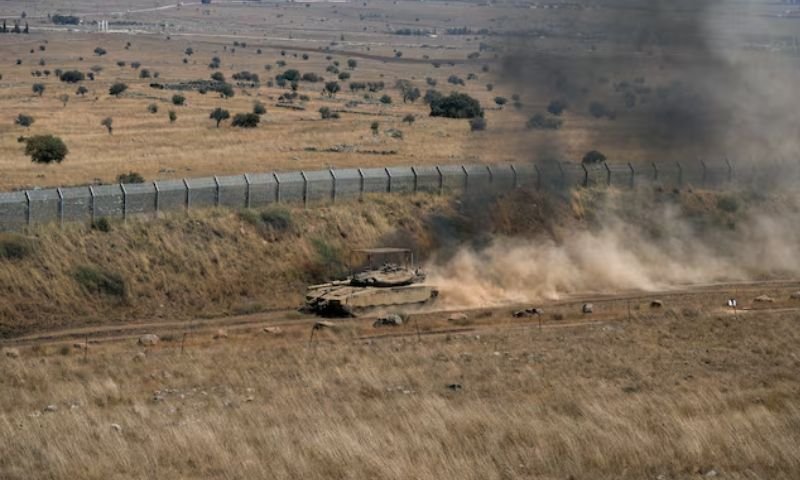
Israeli escalation in southern Syria is no longer merely a series of isolated military incidents. It increasingly appears to be developing into a sustained pattern of pressure combining artillery shelling, gunfire, ground incursions, temporary checkpoints, and the destruction of former military positions. This trajectory places southern Syria in a highly complex security and political environment at a time when the new Syrian state is seeking to consolidate its presence and rebuild its institutions after years of war and fragmentation.
On September 20 and 21, 2026, several areas of the Daraa and Quneitra countryside witnessed simultaneous Israeli shelling and incursions. In western Daraa, Israeli fire and artillery strikes affected agricultural areas and inhabited villages. Local sources reported that more than ten goats were killed in the village of Abdeen as a result of one of the attacks. The village of Maariya also came under bursts of fire, while agricultural land in the Wadi al-Raqad area was targeted. Illumination flares were also fired over Abdeen and Maariya.
In Quneitra, the Israeli movements assumed a more direct form, with an Israeli military force consisting of several vehicles reportedly entering the Rasem al-Halabi area and establishing a temporary checkpoint to inspect passersby. These movements coincided with shelling targeting agricultural areas around al-Rafid, Ruwaihinah, and Bir Ajam, as well as the demolition of a former military site near Jandal Castle in the Mount Hermon area. Local reports also indicated incursions into other areas, including Ain Zivan and Tal Ahmar.
The significance of these developments lies not only in the individual incidents themselves, but also in their cumulative effect. They raise a broader question: Is southern Syria moving toward a new security reality in which Israeli military activity inside Syrian territory becomes a regular feature of the landscape?
From Limited Operations to a Recurring Security Pattern
The significance of the current escalation lies in the fact that it is not confined to long-range artillery fire. Rather, it combines the use of force with a direct ground presence. Artillery strikes have targeted agricultural areas, while military patrols and vehicles have moved into or near populated areas, temporary checkpoints have been established to inspect civilians, and former military positions have been destroyed.
This combination of tools suggests that the issue is no longer solely about preventing a specific military threat. It is also about shaping a new security environment on the ground.
Here, a distinction must be made between the stated purpose of a military operation and its cumulative political and strategic consequences. Israel may present its operations as defensive or security-related measures intended to address potential threats. Yet the repeated incursions, shelling, and expansion of military activity can, regardless of their stated justifications, alter the security environment in southern Syria and constrain the Syrian state’s ability to exercise its sovereignty normally.
This does not necessarily imply a particular Israeli intention beyond what has been publicly stated. Rather, it means that the developments should be assessed in terms of their cumulative impact rather than treating each incident as an isolated event.
The 1974 Agreement and the Return of the Sovereignty Question
The developments acquire additional sensitivity because of the security and legal framework established by the 1974 Syrian-Israeli Disengagement Agreement.
The agreement established a ceasefire and separation of forces, defined military deployment lines and separation zones, and provided for the presence of the United Nations Disengagement Observer Force (UNDOF) to monitor the arrangements.
Consequently, any sustained change in military deployment patterns in southern Syria cannot be viewed solely as a local security issue. It affects an international security framework that has governed the area for more than half a century.
The problem is not simply whether there is an imminent prospect of a large-scale military confrontation. It is whether the existing situation on the ground is gradually being replaced by an undeclared alternative to the arrangements that have governed the area since 1974.
This may be one of the most serious aspects of the current developments: the possibility that an exceptional security measure could become the norm, temporary military activity could evolve into a permanent reality, and a precautionary measure could develop into a lasting arrangement.
Southern Syria and the Vulnerability of the Transitional Phase
These developments are unfolding at an exceptionally sensitive moment for Syria. The new state remains in the process of rebuilding its security and military institutions while attempting to restore the presence of state institutions in areas that have experienced years of war, fragmentation, and external intervention.
This transitional phase makes southern Syria particularly vulnerable.
A state that has not yet completed the reconstruction of its military and security institutions is simultaneously facing an actor with substantial military superiority and the capacity to conduct air, artillery, and ground operations near and beyond the border area, while Damascus’s ability to respond or impose stable security arrangements remains constrained.
Yet the challenge is not solely military.
Sovereignty is not measured only by the number of troops or weapons a state possesses. It is also reflected in its ability to protect its population, manage its borders, enforce the law across its territory, negotiate from a coherent institutional position, and secure international support when its security arrangements are challenged.
For this reason, southern Syria is testing the very concept of the new Syrian state: Can the state gradually restore its legitimate monopoly over the use of force and evolve from a transitional political authority into an institution capable of protecting its borders and citizens?
Civilians and Agriculture at the Center of the Conflict
It would be a mistake to reduce the escalation to military maps and strategic positions alone.
Southern Syria is home to communities that depend heavily on agriculture and livestock. Artillery fire targeting farmland or gunfire near villages therefore represents more than a military incident; it directly affects people’s lives and livelihoods.
The loss of livestock, restricted access to farmland, fear of approaching border areas, and the repeated presence of shelling and military activity can impose unofficial restrictions on movement and economic activity.
This reveals one of the most serious consequences of prolonged escalation: the transformation of security from a military issue into a factor affecting the social and economic structure of local communities.
The more difficult it becomes for residents to access agricultural or grazing areas, the greater the economic cost and the greater the possibility of displacement or loss of livelihoods—even in the absence of a large-scale military campaign.
1,752 Violations Since the Beginning of the Year?
According to data cited by the Sijill Center, which documents Israeli violations in Syria, 267 violations were recorded during August 2026, compared with 187 in July and 239 in June. The center’s figures put the total number of documented violations inside Syria at 1,752 from the beginning of the year through the end of August.
According to the same data, August represented the second-highest monthly number of violations recorded in 2026, after March, when 321 violations were documented.
These figures are important in illustrating the broader trend, but they should be treated as data produced by a specific monitoring organization, rather than as a comprehensive and definitive international tally of all Israeli military activity inside Syria.
Nevertheless, the trend reflected by these figures, combined with recurring reports of shelling and incursions, suggests that southern Syria has not returned to the relatively stable security arrangements that existed before December 2024. Instead, the region has entered a new security environment characterized by repeated Israeli military activity.
What Does Israel Want in Southern Syria?
This is perhaps the most difficult and sensitive question.
It would be difficult to reduce Israeli policy in southern Syria to a single objective. Likewise, interpreting every operation as part of one comprehensive long-term plan would require evidence extending beyond the military incidents themselves.
Nevertheless, three dimensions can be identified in the Israeli approach.
The first is the immediate security dimension, involving efforts to prevent the emergence of military threats near the border or to address movements that Israel considers capable of becoming future threats.
The second is the operational dimension, involving the creation of a deeper security environment than the one that existed before the changes of 2024, through patrols, incursions, surveillance, and targeted strikes.
The third is the political dimension. Continued military presence can, over time, create a new reality on the ground that may affect any future negotiations over border and security arrangements.
This is why it is important to prevent the military reality on the ground from becoming a substitute for political negotiations.
The longer incursions continue, the greater the possibility that temporary arrangements will become more entrenched and that de facto lines of control will become new elements in any future settlement.
The Syrian State Faces a Dual Test
The dilemma confronting Damascus is far from simple.
A direct military confrontation with Israel at this stage could carry significant risks for a state still rebuilding its institutions. At the same time, merely observing developments and relying on political protests without developing effective institutional and diplomatic capabilities could allow new realities on the ground to become entrenched.
Syria therefore needs a multidimensional strategy.
First, it needs to consolidate national military and security institutions, not to enter an arms race, but to restore the state’s institutional capacity to manage its territory and borders.
Second, it needs to activate the international diplomatic track, particularly through institutions associated with the 1974 disengagement framework, placing the issue of incursions and violations within a clear legal and political framework.
Third, it needs to expand the civilian presence of the state in the south, through public services, infrastructure, agricultural support, and the protection of livelihoods, because protecting communities is no less important than protecting borders.
Fourth, it must prevent southern Syria from becoming an arena for competition among local and regional actors. The stronger and more legitimate state institutions become, the less room there is for different actors to exploit security vacuums.
Sovereignty Cannot Be Restored Through Rhetoric Alone
At this stage, Syria needs to move from merely protesting violations toward developing a comprehensive policy for restoring sovereignty.
Sovereignty is not simply a political statement, nor is it synonymous with direct military confrontation. It is a system that begins with legitimate and effective state institutions and extends to their ability to protect citizens, manage borders, enforce the law, employ diplomatic and legal channels, and build international relationships capable of preventing the country from being left at the mercy of faits accomplis.
The escalation in southern Syria should therefore not be viewed as an isolated border issue disconnected from the process of state-building. Developments along the border highlight the urgent need to build a more cohesive Syrian state, more professional institutions, and a national compact that makes the protection of Syrian territory the responsibility of state institutions rather than competing local groups or political forces.
Between Deterrence and Diplomacy
Southern Syria now stands between two approaches that should not necessarily be regarded as mutually exclusive: building national capacity to protect sovereignty and pursuing political and diplomatic efforts to prevent that capacity from turning into an open confrontation.
Effective deterrence does not necessarily mean going to war, just as successful negotiations do not mean abandoning instruments of power.
What Syria needs is to develop institutions that enable it to negotiate from the position of a state, rather than from the position of a weak party seeking merely to contain its losses.
In this context, the continued Israeli incursions and shelling in southern Syria convey a message that goes beyond the immediate objectives of individual operations: the region has not yet settled into a stable new security framework, and Syrian sovereignty continues to face a tangible test on the ground.
Yet the success of the Syrian state in overcoming this challenge will not be determined solely by its ability to prevent incursions. It will also depend on its ability to build a state in which the people of the south, like Syrians elsewhere, feel that they are protected by a state that represents them and possesses the legitimacy, institutions, and diplomatic capacity necessary to make sovereignty a practical reality rather than merely a political slogan.
This is the central paradox: the greater the external pressure on southern Syria, the more urgent the task of rebuilding the Syrian state from within becomes.
The road to restoring sovereignty does not begin at the border alone. It also begins with building an inclusive state, national institutions, and a society that feels represented and protected by those institutions. Only then can Syria confront external pressures through a coherent national strategy that combines the protection of sovereignty with the avoidance of another devastating war.
Most read




Read also