Shared Strategic Horizons In The India-Japan Partnership And Future Of The Indo-Pacific
The Confluence of Two Seas
The contemporary architecture of the Indo-Pacific was birthed not in Washington, but in the Central Hall of the Indian Parliament on 22nd August 2007. Standing at the parliamentary podium, quoting Swami Vivekananda, Abe said, “The different streams, having their sources in different places, all mingle their water in the sea”. In that landmark speech, titled “Confluence of the Two Seas,” Abe articulated a vision where the Indian and Pacific Oceans would bring about a “dynamic coupling” as seas of freedom and prosperity. Drawing inspiration from the Mughal prince Dara Shikoh’s 1655 book, Abe signaled that Japan and India had “rediscovered” each other as partners sharing identical values and interests.
This address is now recognized as the genesis of the Indo-Pacific concept, a visionary call for a “broader Asia” that broke away from traditional geographical boundaries to incorporate a rising India as an indispensable pillar of a new maritime order. The speech laid the intellectual foundation for what would later become the Free and Open Indo-Pacific (FOIP) vision, shifting the regional focus from a narrow “Asia-Pacific” to a vast maritime continuum stretching from the shores of Africa to the Western Pacific. Abe recognized that the maritime space between the two oceans was becoming the center of gravity for the world’s political, economic, and cultural interests, and he tasked the two major democracies with the responsibility to ensure this region remained open and transparent.
Redefining the Narrative beyond US-Centricity
For many years, the Indo-Pacific construct was perceived largely as an American project, yet recent geopolitical shifts have forced a re-evaluation of this US-centric narrative. Under the second Trump administration, Washington’s decision to revert the designation of its “Indo-Pacific Command” back to its historic name, “Pacific Command” (USPACOM), has triggered significant surprise in regional capitals. To some observers, this reversion suggests strategic messaging of flagging US commitment and a potential desire to stabilize its own relations with China through a “G2” arrangement. The perceived reluctance of the US to prioritize the Quad and its absence from key regional summits have left regional middle powers concerned about “American abandonment”. However, this “strategic demotion” has also created a unique opportunity for India and Japan to step forward as the region’s primary anchors.
It could be argued that the Indo-Pacific should not be dependent solely on the “mood swings” of a distant superpower. As resident Asian powers, India and Japan possess stakes in this region that are as permanent as their geography. They are increasingly viewed as “emerging powers” that must manage great power rivalry through autonomous ideational and institutional means, rather than relying on material accommodation alone. While the US provides essential military capacity, the intellectual foundations of the Indo-Pacific were laid by Japan and India, who now shoulder the responsibility of sustaining a rules-based economic and maritime order. This shift emphasizes that regional stability will no longer be dictated by a single external power, but by the major democratic inhabitants of the region itself. This transition from strategic passivity to proactive stakeholdership allows India and Japan to build the material basis of resilience together, resisting external economic coercion and maintaining the regional balance of power.
The Summit cements a Natural Partnership
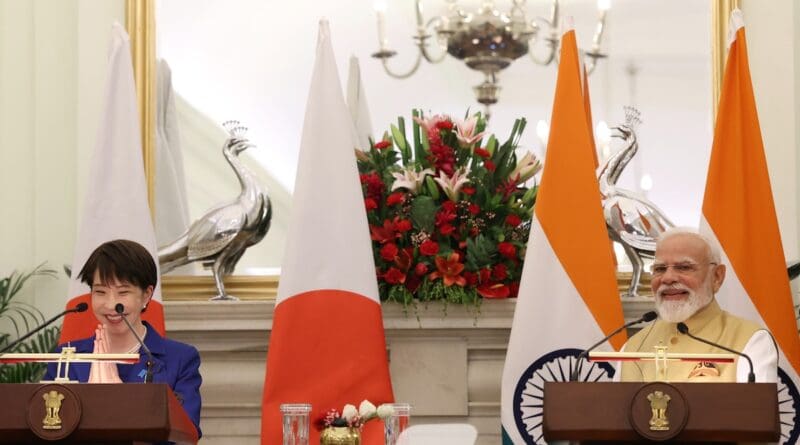
The 16th India-Japan Annual Summit, held in New Delhi from 1st-3rd July 2026, marked a transformative milestone in this bilateral journey. Sanae Takaichi, Japan’s first female Prime Minister, was received with high ceremonial honors, reinforcing the fact that Japan is India’s “truest natural partner”. Prime Minister Modi welcomed Takaichi as a “visionary leader” from Nara, a center of shared Buddhist heritage, signaling that their partnership is built on an “invaluable reservoir of friendship and trust”. The summit produced substantial outcomes, including approximately $12.5 billion (¥2 trillion) in fresh investment commitments and the signing of 129 Memorandums of Understanding (MoUs) covering diverse sectors. Central to these discussions was the Joint Roadmap on Economic Security, which focuses on building resilient supply chains for semiconductors, critical minerals, and advanced materials, areas specifically designed to shield both nations from external economic coercion.
A groundbreaking highlight was the agreement on the first-ever military hardware co-development project, involving a Naval Radio Antenna (UNICORN) for Indian naval platforms. This marks a “new chapter” as Japan definitively moves away from its post-war pacifist constraints to engage in genuine defense co-production with India. Furthermore, the leaders launched the India-Japan Cooperative Biogas for Growth Initiative, aiming to scale up biogas production in light of India’s target to establish 1,000 biogas plants. They also formalized an AI Strategic Dialogue and issued a joint statement to combine Japanese precision hardware with India’s software capabilities to provide new momentum to the advancement of AI globally. These initiatives demonstrate that the partnership is no longer just a “diplomatic courtship” but a deeply integrated industrial and security ecosystem.
From Ancient Monks to Modern Pioneers
The strategic convergence between India and Japan is deeply rooted in over 1,500 years of historical and cultural linkages. Exchange between the two nations began in the 6th century with the introduction of Buddhism to Japan, which remains the source of the Japanese people’s sense of closeness to India. Historical figures like the Indian monk Bodhisena, who arrived in 736 CE, serve as early “cultural emissaries”. Invited by Emperor Shomu, Bodhisena performed the eye-opening ceremony for the Great Buddha in Nara, a moment that had an immense cultural impact that resonates to this day. By the 16th and 17th centuries, the expansion of Indian Ocean routes diversified these links. The Japanese merchant-adventurer Tokubei Tenjiku, often called the “Marco Polo of Japan”, sailed to India in 1626 and wrote Tenjiku Tokai Monogatari, which captivated the Japanese imagination with tales of the Indian subcontinent.
2027 to be India-Japan Year of Shared Horizons
Looking ahead, the year 2027 will mark the 75th anniversary of diplomatic relations between New Delhi and Tokyo. The two governments have announced an extensive calendar of activities under the theme ‘India-Japan Year of Shared Horizons’ to strengthen ties through various activities. From youth and students to industry leaders, this milestone aims to engage a diverse audience in envisioning the future of their Special Strategic and Global Partnership. A key highlight will be Cricket Kizuna-75, which includes a friendly cricket match and training camps led by Indian coaches in Japan to promote the sport as a bridge between the two nations.
Cultural exchanges will be central to the year-long celebration, beginning with IMAGE-75, an initiative to support exchanges in animation, gaming, and comic arts, reflecting the popularity of Japanese pop culture among Indian youth. The governments will also launch RASA-75, a year-long celebration of the arts and traditions of both countries. For the business community, Business Connect-75 will establish direct linkages between Indian business clusters and Japanese regional banks through roadshows and forums. Spiritual and religious ties will be further strengthened as a delegation of Japanese Buddhist leaders visits Indian sites, promoting spiritual tourism. These events are designed not only to celebrate the past but to outline a shared vision for a resilient and prosperous future.
The Security Calculus of India and Japan without the US?
A critical question facing policymakers is whether the India-Japan security partnership can truly function independently of the United States. While a “Quad minus the US” remains a far-fetched military reality, Delhi and Tokyo are increasingly hypothetical about an Indo-Pacific future not dependent on Washington’s attention. Japan is undergoing a profound transformation, moving away from its post-war pacifism to become a “normal military power”. Under Prime Minister Takaichi, defense spending has reached 2% of GDP, and Japan has significantly revised its guidelines to allow the export of lethal combat systems like the Mogami-class stealth frigate. Takaichi is also actively pushing for the revision of Article 9 of the Japanese Constitution.
India, meanwhile, maintains its core principle of strategic autonomy, resisting efforts to transform the Quad into a formal military alliance or “Asian NATO”. However, New Delhi has transitioned from “strategic passivity” to a more proactive regional role, welcoming Japan’s remilitarization as a factor that relieves pressure on Indian borders and complicates China’s strategic calculus. The Acquisition and Cross-Servicing Agreement (ACSA) and frequent joint exercises like JAIMEX show that both navies are building networks of interoperability that reduce reliance on any single external power. While the US remains the “most consequential power geostrategically”, India and Japan recognize that they have the most at stake; they must therefore “hold the fort” by sustaining regional institutions and habits of cooperation. By building indigenous defense manufacturing capabilities under the Atmanirbhar Bharat initiative, India seeks to deepen its defense technology partnership with Japan to ensure a stable balance of power.
A New Anchor for a Multi-Polar Asia
The India-Japan partnership has evolved from a narrow economic exchange into a multifaceted strategic anchor for the entire Indo-Pacific. By emphasizing principles of diversity and inclusivity, India and Japan offer a “softer procedural approach” that appeals to the Global South, distinguishing their vision from the more “selective” approach of the US.
As they move toward their 75th anniversary, the message from the Modi-Takaichi summit is clear: the strategic future of the Indo-Pacific is now the business of those who inhabit it. Through a combination of ancient cultural heritage, modern technological convergence, and a shared resolve to maintain a rules-based order, India and Japan are constructing a viable power balance that will define the Asian century. Their partnership is no longer just a bilateral convenience; it is an indispensable necessity for regional peace, stability, and prosperity.
References:
- India News Network: “India, Japan Celebrate 75 Years of Diplomatic Ties in 2027,” India News Network, July 4, 2026. https://www.indianewsnetwork.com/en/india-japan-celebrate-75-years-diplomatic-ties-2027-20260704
- Press Information Bureau: “Press Release PRID 2280260,” Press Information Bureau, Government of India. https://www.pib.gov.in/PressReleasePage.aspx?PRID=2280260®=3&lang=1
- Ministry of Foreign Affairs of Japan: “Japan-India Relations (Basic Data),” Ministry of Foreign Affairs of Japan. https://www.mofa.go.jp/region/asia-paci/india/data.html
- Japan Forward: “Finding the Indo-Pacific Through the Tales of Tokubei Tenjiku,” Japan Forward. https://japan-forward.com/finding-the-indo-pacific-through-the-tales-of-tokubei-tenjiku/
- The Japan Institute of International Affairs: Monika Chansoria, “Japan Review Vol. 8, No. 2,” The Japan Institute of International Affairs. https://www.jiia.or.jp/eng/upload/eng/05JapanReview_Vol8_No2_Monika%20Chansoria.pdf
- Press Information Bureau: “Press Release PRID 2280587,” Press Information Bureau, Government of India. https://www.pib.gov.in/PressReleasePage.aspx?PRID=2280587®=3&lang=1
- The Hindu: “India-Japan Ties: Sanae Takaichi, PM Modi Meeting July 2, 2026 Updates,” The Hindu, July 2, 2026. https://www.thehindu.com/news/national/india-japan-ties-sanae-takaichi-pm-modi-meeting-july-2-2026-updates/article71173665.ece
- Carnegie Endowment for International Peace: “India, Japan, and ASEAN Cooperation in the Indo-Pacific,” Carnegie Endowment for International Peace, Feb. 2018. https://carnegieendowment.org/russia-eurasia/events/2018/02/india-japan-and-asean-cooperation-in-the-indo-pacific
Most read



Read also