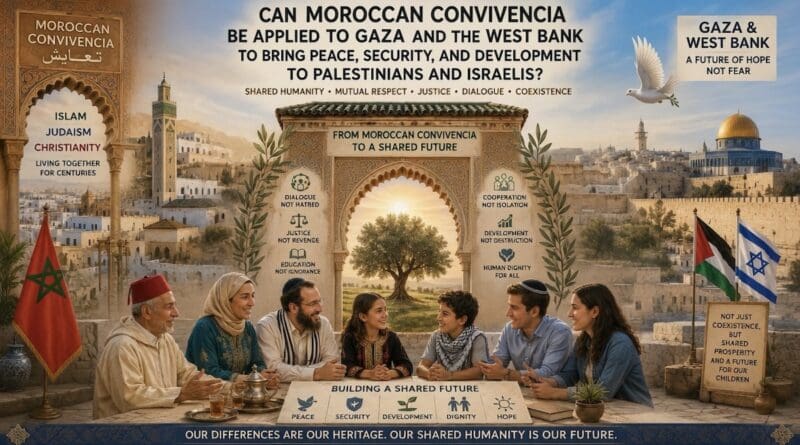
Can Moroccan Convivencia Be Applied To Gaza And The West Bank To Bring Peace, Security, And Development To Palestinians And Israelis?
1. Introduction
The question of whether a historically rooted culture of coexistence can be transplanted into an active geopolitical conflict is, on its face, a category error: cultures of coexistence are the sedimented product of centuries of shared life, common language, overlapping ritual calendars, and interlocking economic dependencies, whereas the Israeli-Palestinian conflict is a dispute over sovereignty, land, security, and national self-determination between two peoples who, in the main, do not share a state, a language of daily life, or an agreed historical narrative. And yet the impulse to ask the question is not naive. Morocco stands almost alone among Arab and Muslim-majority states in having preserved, across nearly a millennium, a continuous Jewish presence that shaped its urban geography, its commercial networks, its royal court, and its collective memory (Chtatou, 2022; Schroeter, 2002). That history is neither a myth of untroubled harmony nor a simple precedent for resolving a modern territorial conflict; it is a body of practices, institutions, and symbols that a serious observer of the Israeli-Palestinian impasse might reasonably ask whether, and how, it could inform a search for peace that has defeated generations of professional diplomats.
This essay takes that question seriously without answering it credulously. It proceeds in six movements. First, it traces the conceptual genealogy of convivencia from its coinage in Iberian historiography to its adoption as a description of Moroccan Muslim-Jewish relations. Second, it surveys the historical record of that Moroccan coexistence, and, third, the revisionist scholarship that has complicated any romantic reading of it. Fourth, it examines the institutional forms through which Morocco has combined its Jewish heritage with an enduring commitment to the Palestinian cause, most visibly through the monarchy’s chairmanship of the Al-Quds Committee. Fifth, it maps the structural differences between the Moroccan historical experience and the Israeli-Palestinian conflict as it stands in 2026, following the fragile ceasefire and stalled reconstruction process in Gaza and the deteriorating situation in the West Bank. Sixth, and finally, it asks what, if anything, can be responsibly carried over from the Moroccan case into policy and practice for Palestinians and Israelis, and what the limits of that transfer are. The argument throughout is that convivencia is not a peace plan; it is a moral vocabulary, and vocabularies can inform politics without replacing it.
2. Convivencia: Genealogy and Contested Meaning of a Concept
The term convivencia was not indigenous to Morocco. It was coined in 1948 by the Spanish historian and philologist Américo Castro, writing in American exile after the Spanish Civil War, in his study España en su historia: cristianos, moros y judíos (Castro, 1948). Castro used the term to argue, against the Francoist historiography of an essentially and eternally Catholic Spain, that Spanish identity itself was the product of centuries of intermingling among Christians, Muslims, and Jews in medieval Iberia (Wolf, 2009). The concept quickly became attached to the more specific historical image of al-Andalus, and above all of Umayyad Córdoba, as a golden age of interfaith tolerance, philosophy, and translation, running from the Muslim conquest of 711 to the expulsion of Spain’s Jews in 1492.
From its inception, however, convivencia was a contested and even paradoxical category. Kenneth Baxter Wolf’s history of the idea shows that the concept’s very success has been inseparable from a tendency to romanticize what were, in fact, hierarchical and frequently violent relations governed by the dhimma system, in which Christians and Jews held a legally subordinate but protected status under Muslim rule (Wolf, 2009). Maya Soifer’s critical intervention, tellingly titled “Beyond Convivencia,” argued that the term’s explanatory power had been diluted by its uncritical adoption as a synonym for tolerance rather than as an analytic description of asymmetric but functioning coexistence (Soifer, 2009). The concept, in other words, was born already carrying the seeds of its own critique: it named something real — sustained, structured proximity among religious communities — while inviting an idealization that the historical record could not fully support.
It is this doubled character of convivencia — real coexistence, contested tolerance — that makes it a useful, if double-edged, analytic tool for the Moroccan case, and it is precisely this doubled character that must be preserved, rather than flattened, when the concept is extended to a modern political conflict. To speak of a Moroccan convivencia is not to claim that Muslims and Jews in Morocco lived as equals; it is to claim that they lived in structured, durable, and mutually consequential proximity for the better part of a millennium, under terms that were unequal but that nonetheless produced habits of coexistence with genuine social content.
3. The Moroccan Trajectory of Jewish-Muslim Coexistence
Morocco’s Jewish community is among the oldest in the Muslim world, with roots that predate the Arab conquest and that were subsequently reinforced by waves of Iberian Jewish migration, above all following the 1492 expulsion from Spain (Chtatou, 2022). At its twentieth-century height, Morocco was home to the largest Jewish community in the Arab and Muslim world; today, following mass emigration to Israel, France, and elsewhere from the 1950s through the 1970s, the community numbers only a few thousand, yet it remains the largest Jewish community in the Arab world, sustained by an extensive network of synagogues, Jewish schools, and heritage institutions, most notably the Foundation of Moroccan Jewish Heritage and Casablanca’s Jewish museum, the only one of its kind in the Arab world (Chtatou, 2022).
The institutional anchor of Muslim-Jewish coexistence in urban Morocco was the mellah, the Jewish quarter that became a defining feature of Moroccan cities from the fourteenth century onward. Revisionist historiography associated with Emily Gottreich’s study of the Marrakesh mellah and Daniel Schroeter’s work on Essaouira and on the Jewish courtier and merchant Meir Macnin has shown that the mellah should not be read as a European-style ghetto of enforced segregation (Gottreich, 2007; Schroeter, 2002). It was, rather, a site of communal self-organization: a locus of rabbinic authority, craft specialization, and commercial networking that allowed Jewish communities to sustain an autonomous religious and social life while remaining deeply embedded in the surrounding Muslim urban economy. Daily contact between Muslims and Jews was dense and functional rather than merely symbolic: Muslim customers frequented Jewish quarters to trade, borrow money, and commission craftwork, while some Muslim tradesmen maintained businesses inside the mellah itself, including bakeries that allowed Jewish households to keep Sabbath prohibitions on kindling fire (Chtatou, 2022, citing Lévy).
This proximity was reinforced by cultural affinities that Moroccan social scientist Simon Lévy identified as facilitating conditions for coexistence: a shared monotheism, parallel purity codes, and the common practice of circumcision, among other overlapping ritual and legal sensibilities (as cited in Chtatou, 2022). Politically, Jewish elites at times occupied consequential positions close to the throne. Schroeter’s biography of Meir Macnin documents how a Jewish merchant from Marrakesh rose to become the principal royal intermediary between the Alawi sultans and the European powers in the early nineteenth century, moving fluidly between Morocco, Gibraltar, and London even as he remained legally a protégé, or dhimmi, of the sultan (Schroeter, 2002). The historical memory of royal protection has itself become part of the convivencia narrative, crystallized above all around King Mohammed V’s celebrated refusal, during the Vichy period, to permit the implementation of anti-Jewish racial decrees against Morocco’s Jewish subjects, an episode that remains central to Moroccan Jewish memory and to the kingdom’s contemporary self-presentation (Chtatou, 2022).
Institutions built on this memory have proliferated in the twenty-first century. The Mimouna Association, founded as a Muslim student initiative dedicated to preserving Moroccan Jewish heritage, co-organized in 2011 the first Holocaust remembrance conference held in the Arab world, at Al Akhawayn University in Ifrane (Distinctions Journal, 2023). Bayt Dakira, the House of Memory in Essaouira, and the restoration of dozens of synagogues across the kingdom under royal patronage, testify to an official as well as popular investment in sustaining the memory and material fabric of Jewish Morocco even as the community itself has become numerically small (Chtatou, 2022).
4. Revisionist Historiography: Power, Hierarchy, and the Limits of Harmony
A serious engagement with Moroccan convivencia must reckon with the scholarship that has directly challenged its more celebratory readings. Aomar Boum’s ethnographic and historical study of how rural Moroccan Muslims remember their former Jewish neighbors offers what has been described as a sustained critique of the “myth of Moroccan tolerance” (Boum, 2013). Boum argues that encomiastic accounts of Jewish-Muslim coexistence, including shared pilgrimage traditions and joint veneration of saints, have too often been blind to the structural subordination of Jews within a Muslim-majority polity, to periodic outbreaks of violence that punctuated what was, on balance, a stable but not equal coexistence, and to the ways in which Jewish religious life was persistently shaped by minority status under the dhimma system. Schroeter’s account of the tujjar al-sultan, the royal merchants, makes a parallel point at the level of the elite: even the wealthiest and most politically connected Jewish courtiers, such as Macnin, remained vulnerable protégés whose property and person could be seized at royal discretion, and who served, in Schroeter’s phrase, at times as convenient lightning rods for popular unrest (Schroeter, 2002).
This body of revisionist scholarship does not refute the reality of coexistence; it reframes its terms. What emerges from Boum, Gottreich, and Schroeter alike is a portrait of a durable modus vivendi that combined genuine social intimacy, economic interdependence, and even affection with an unmistakable hierarchy of legal status and physical security that periodically broke down into violence, expulsion, or coerced conversion. The lesson for any transfer of the Moroccan model to a modern conflict is therefore double-edged: Moroccan convivencia demonstrates that a Muslim-majority society can sustain religious pluralism as a durable social norm across centuries, but it does so under conditions of asymmetric power that any application to the Israeli-Palestinian case — itself defined by a different and starkly reversed configuration of power between Israeli state authority and a stateless Palestinian population — would have to confront rather than paper over.
5. Institutionalizing Coexistence: The Monarchy and the Dual Commitment to Jewish Heritage and Palestinian Rights
What distinguishes the Moroccan case from a merely nostalgic memory culture is the degree to which coexistence has been institutionalized at the level of the state, and combined, without apparent contradiction in official discourse, with sustained political support for the Palestinian cause. The clearest expression of this dual commitment is the Al-Quds Committee, established in 1975 under the Organisation of Islamic Cooperation and chaired without interruption by the Moroccan monarch, first Hassan II and, since 1999, Mohammed VI (Temsamani, 2025). The Committee’s executive arm, the Bayt Mal Al-Quds Asharif Agency, funds restoration, health, education, and cultural projects for Palestinians in Jerusalem, operating on the premise, as one Moroccan legal scholar has put it, that development itself is a form of resistance to the erosion of the city’s Arab, Islamic, and Christian character (Temsamani, 2025).
The historical record here is more layered than official narratives sometimes suggest. King Mohammed V’s 1960 pilgrimage to Jerusalem alongside King Hussein of Jordan, and King Hassan II’s subsequent creation of the Al-Quds Committee, were accompanied, in the same decades, by policies that eased and at times actively facilitated the mass emigration of Moroccan Jews to Israel, a policy pursued in a domestic political context that lacked robust democratic accountability (Soufflesmonde, n.d.). Critics have also pointed to Hassan II’s documented security and intelligence cooperation with Israel during the same period in which he chaired the body charged with defending Jerusalem’s Arab and Islamic character, arguing that the kingdom has long practiced a form of parallel diplomacy that keeps distinct channels open to both Israeli and Palestinian interlocutors simultaneously (Middle East Monitor, 2020). Whether this is read as principled balance or as strategic hedging depends substantially on the observer’s prior commitments; both readings are represented in the contemporary literature, and a fair account of the Moroccan case must present both rather than adjudicate between them.
What is less contested is that this institutional architecture has endured and adapted. Following the December 2020 normalization agreement between Morocco and Israel, King Mohammed VI informed Palestinian President Mahmoud Abbas that Morocco’s position on a negotiated two-state solution, and its commitment to the Al-Quds Committee’s work, remained unchanged, while simultaneously moving forward with the resumption of ties with Israel (North Africa Post, 2020). Palestinian officials, including Fatah spokesmen and Palestinian Authority ministers, have continued to publicly credit Morocco’s continued institutional support even amid skepticism from some Palestinian commentators about the compatibility of normalization with unqualified solidarity (Jerusalem Story, 2025). The durability of this dual-track approach — cultural and institutional investment in both Jewish heritage and Palestinian rights — is arguably the single most transferable institutional lesson of the Moroccan case, independent of how one judges its underlying motives.
6. From Coexistence to Strategic Partnership: Morocco-Israel Normalization in Context
Morocco’s own bilateral relationship with Israel illustrates how historical convivencia can be reactivated as a resource for contemporary diplomacy without displacing continued advocacy for Palestinian statehood. The transformation of Moroccan-Israeli relations into what has been described as an emerging strategic partnership is best understood through the convergence of three factors: the long historical memory of Jewish-Moroccan coexistence, which furnishes a cultural substrate for normalization; the structural incentives of security cooperation and economic modernization; and the regional geopolitical realignments, including American sponsorship, that created the diplomatic opening for the December 2020 accord (Chtatou, 2026, June 22). Morocco’s contribution of personnel to the planning of the International Stabilization Force envisaged under United Nations Security Council Resolution 2803 further situates the kingdom as an active, if still modest, participant in the post-ceasefire security architecture for Gaza (Security Council Report, 2026).
This history has entered popular culture as much as formal diplomacy. Commentary on the Moroccan national football team’s supporters, who have displayed both Israeli sympathy stemming from historical ties and, conspicuously, Palestinian flags during international tournaments, has been read by some observers as an informal expression of the same dual affinity that characterizes Moroccan state policy: a capacity to hold historical warmth toward Israeli and Jewish counterparts alongside unambiguous solidarity with Palestinians, without treating the two as contradictory (Faouzi, 2026). Whether this popular sentiment can be generalized as a model of civic pluralism, or whether it reflects a distinctively Moroccan configuration of history and identity that does not travel easily, is a question this essay returns to in Section 8.
7. Structural Disanalogies: Why the Israeli-Palestinian Conflict Is Not Medieval or Modern Morocco
Any responsible application of the Moroccan model must begin by naming, rather than eliding, the structural differences between the two cases. First, the Moroccan experience of coexistence unfolded within a single sovereign polity in which one community, Muslims, constituted a majority, held state power, and extended a legally subordinate but protected status to a religious minority. The Israeli-Palestinian conflict, by contrast, is a dispute between two national communities, each claiming self-determination over overlapping territory, in which the central unresolved question is not the status of a minority within an established state but the terms on which two peoples will exercise, or share, sovereignty at all (Baker Institute, 2018). There is no Moroccan analogue to a contest over borders, a stateless population under military occupation, or competing claims to a shared capital city.
Second, the Moroccan case did not involve, for most of its history, organized mass violence between the two communities on the scale, and with the political stakes, of the Israeli-Palestinian conflict since 1948, let alone the scale of the war that followed the October 7, 2023 attacks and the subsequent Israeli military campaign in Gaza. The asymmetries of military power, the presence of armed non-state actors such as Hamas, and the recurring cycles of full-scale warfare distinguish the contemporary conflict qualitatively from the periodic but locally contained tensions that punctuated Moroccan Jewish-Muslim relations (Boum, 2013).
Third, the demographic and territorial facts differ fundamentally. Moroccan Jews were always a minority within an internationally recognized Moroccan state; Palestinians in Gaza and the West Bank are a majority population within territories whose final legal status remains internationally contested, living under a combination of military occupation, blockade, and, in the West Bank, an expanding settlement regime that the Palestinian Authority and much of the international community characterize as approaching de facto annexation, citing continued settlement activity and administrative measures such as the E1 plan (House of Commons Library, 2026). Israeli officials, for their part, frame these same policies as responses to legitimate security requirements in the aftermath of sustained attacks and continuing threats from armed groups. Fourth, competing historical narratives of dispossession, exile, and return are foundational to both Israeli and Palestinian national identity in a manner without a true parallel in the Moroccan Jewish-Muslim relationship, where Jews were an indigenous minority rather than a returning national movement contesting sovereignty with the majority population.
These disanalogies do not make the comparison meaningless, but they do mean that convivencia cannot be imported as a political architecture. It cannot substitute for negotiations on borders, security arrangements, the status of Jerusalem, the disposition of settlements, or the rights of refugees. What it can offer is narrower and, properly understood, more modest: a set of social and institutional practices that have proven durable in sustaining interreligious coexistence under conditions of asymmetric power, which is, after all, a condition that any realistic interim arrangement between Israelis and Palestinians will also have to manage, whatever its ultimate political form.
8. The Contemporary Landscape: Gaza, the West Bank, and the Fragile Architecture of 2025-2026
Any discussion of applying lessons to “Gaza and the West Bank” must be grounded in the actual, fast-moving state of affairs as of mid-2026, which differs considerably from the conditions many general discussions of the conflict assume. Following the October 2025 Sharm el-Sheikh agreement and the ceasefire that took effect on October 10, 2025, under the framework later endorsed by United Nations Security Council Resolution 2803, the war’s first phase produced the release of all living Israeli hostages and the return of the remains of most deceased hostages, alongside a surge in humanitarian aid (J Street, 2026). A second phase, announced in January 2026 by United States Special Envoy Steve Witkoff, established a National Committee for the Administration of Gaza and an international Board of Peace, chaired by President Trump, intended to oversee demilitarization, technocratic governance, and reconstruction (House of Commons Library, 2026).
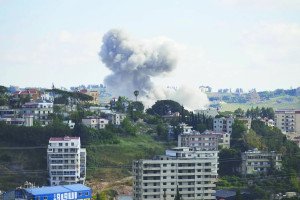
By mid-2026, however, United Nations officials and independent monitors describe this architecture as tenuous at best. Nearly the entirety of Gaza’s population, some 1.8 million people, remained displaced, with roughly 80 percent of buildings in the territory damaged or destroyed and reconstruction not meaningfully underway despite reconstruction pledges around 17 billion dollars against an assessed need of some 71.4 billion dollars (Security Council Report, 2026). Israeli forces have continued strikes inside Gaza that officials attribute to imminent security threats, while Hamas has not completed the disarmament required under the ceasefire framework, and hundreds of Palestinian civilians have been killed since the ceasefire nominally took hold (Security Council Report, 2026; OHCHR, 2026). The Office of the United Nations High Commissioner for Human Rights has reported that living conditions in Gaza have shown no significant improvement since the ceasefire began, citing continued sewage contamination, unexploded ordnance, and the deaths of children from exposure during the winter of 2025-2026 (OHCHR, 2026).
Conditions in the West Bank, meanwhile, are widely described by United Nations officials as “unravelling,” characterized by rising settler violence, accelerating settlement expansion including the contested E1 corridor plan, demolitions, and new administrative mechanisms that the Palestinian Authority regards as steps toward de facto annexation (UN News, 2026; House of Commons Library, 2026). The Palestinian Authority itself is described in independent assessments as financially and politically weakened, having not held national elections since 2006, its legitimacy further eroded by its limited role in the emerging Gaza governance structure even as some coordination continues between the Board of Peace’s transitional Gaza committee and Palestinian Authority officials (J Street, 2026). Israeli representatives at the UN Security Council maintain that the central obstacle to progress remains Hamas’s refusal to disarm, framing continued military operations as a necessary response to an organization they describe as preparing for renewed conflict rather than peace, while Arab and Palestinian representatives counter that reconstruction and a credible political horizon toward statehood cannot be made conditional on disarmament alone (Security Council Report, 2026).
This is the actual terrain onto which any discussion of convivencia would be projected: not a blank slate awaiting a cultural framework, but an active, contested, and only partially implemented ceasefire architecture, a devastated and undergoverned Gaza, and a West Bank whose trajectory, in the assessment of the UN’s own Middle East peace coordinator, is actively undermining rather than advancing the prospects for the two-state solution that remains the internationally endorsed framework (UN News, 2026). Any normative contribution convivencia might make has to operate within, not instead of, this political reality.
9. Translating Convivencia into Policy: Six Domains of Application
Read with appropriate modesty, the Moroccan record suggests six domains in which its normative content, rather than its political form, could plausibly inform current efforts, several of which already have partial analogues in existing Israeli-Palestinian civil society work.
9.1 Protection of Religious Heritage and Holy Sites
Morocco’s model of investing state resources and royal patronage in the restoration and protection of a minority religious community’s heritage, exemplified by the Bayt Mal Al-Quds Asharif Agency’s restoration work in Jerusalem’s Old City and by the kingdom’s synagogue restoration program at home, offers a transferable principle: that protection of holy sites and heritage should be treated as a shared responsibility rather than a zero-sum claim (Temsamani, 2025; Jerusalem Story, 2025). Applied to Jerusalem specifically, and to religiously significant sites in the West Bank, this principle would require guarantees, credible to both communities, that the status quo governing access to and stewardship of shared holy places be preserved and, where damaged, jointly restored, rather than treated as instruments of unilateral assertion by either side.
9.2 Educational Reform and Counter-Narrative Pedagogy
The Mimouna Association’s model of Muslim-led education about Jewish heritage, and its co-organization of the first Holocaust remembrance conference in the Arab world, illustrate how curricular and civil society initiatives can normalize knowledge of the other’s history and suffering without requiring political agreement on final-status issues (Distinctions Journal, 2023). Existing Israeli-Palestinian dialogue and education organizations already pursue analogous work, and grassroots peacebuilding scholarship has emphasized that sustainable coexistence requires investment in the everyday, cumulative interactions that education and youth programming can provide, alongside, rather than as a substitute for, political negotiation (LSE Middle East Centre, 2025; USIP, 2021).
9.3 Grassroots and Track II Dialogue
The Moroccan case suggests that intercommunal familiarity sustained over generations, through markets, neighborhoods, and shared urban space, produces habits of coexistence that formal diplomacy alone cannot manufacture. This is precisely the theory underlying existing Israeli-Palestinian grassroots peacebuilding organizations, whose work researchers describe as historically underestimated and even caricatured, but which encompasses dialogue, joint advocacy, and people-to-people programming intended to build durability into any eventual political settlement (USIP, 2021). The binational organization Combatants for Peace, for example, has been highlighted by researchers as an example of grassroots, bi-national peacebuilding that seeks to address the conflict’s underlying asymmetries directly rather than assuming they will be resolved by elite negotiation alone (LSE Middle East Centre, 2025). A convivencia-informed approach would argue for scaling and sustaining this work as a necessary complement to, not a replacement for, the political process, particularly given that recent international funding initiatives, such as the joint Gaza-focused peacebuilding fund launched by the United Kingdom, Australia, and Canada in mid-2026, have been explicitly designed to fill funding gaps left by the withdrawal of previous donors (Haaretz, 2026).
9.4 Shared Economic Space and Interdependence
The dense commercial interdependence of the Moroccan mellah economy, in which Muslim and Jewish tradesmen relied on each other for credit, craft, and commerce, suggests that economic interdependence, rather than economic separation, was itself a stabilizing mechanism of coexistence (Chtatou, 2022; Gottreich, 2007). Applied to Gaza’s reconstruction, this principle would favor development models that create durable economic interdependence between Israeli and Palestinian economies, rather than reconstruction financed and managed in ways that further isolate Gaza’s economy from both the West Bank and Israel. The scale of the challenge is sobering: assessed Gaza recovery needs of some 71.4 billion dollars against roughly 17 billion dollars in pledges illustrate that economic development in the absence of a credible political horizon risks becoming, in the words voiced by several state representatives at the UN Security Council, an attempt to “buy the goodwill of the Palestinians” through commercial projects rather than a genuine foundation for self-determination (Security Council Report, 2026).
9.5 Inclusive, Symbolically Legible Governance
The Moroccan monarchy’s chairmanship of the Al-Quds Committee illustrates the value of investing symbolic and institutional leadership in a figure or body that both communities can, at least provisionally, credit with even-handed concern, however contested that even-handedness may be in practice (Temsamani, 2025; Middle East Monitor, 2020). No precise Israeli-Palestinian analogue to a single trusted monarch exists, nor should one be invented; but the underlying principle — that governance transition structures require broadly credible leadership recognized by all relevant parties — bears directly on the current difficulties facing Gaza’s transitional National Committee for the Administration of Gaza, whose members, as of mid-2026, had not yet been permitted entry into Gaza itself, and whose relationship to the weakened Palestinian Authority remains unresolved (J Street, 2026).
9.6 Cultural Diplomacy and Popular Sentiment
Finally, the informal register of Moroccan convivencia, visible in phenomena such as the dual sympathies expressed by supporters of the Moroccan national football team, suggests that cultural and popular sentiment can hold space for both historical affinity with Jewish heritage and solidarity with Palestinian national aspirations without requiring these to be resolved into a single ideological position (Faouzi, 2026). Cultivating similar cultural space, through joint arts, sports, and heritage programming, is unlikely by itself to move a political process, but it can help sustain public constituencies for peace at a moment when, according to grassroots peacebuilding researchers, sustained civil society engagement remains essential to keeping a negotiated two-state outcome viable at all (LSE Middle East Centre, 2025; Geneva Initiative, n.d.).
10. Limits of the Analogy and Risks of Instrumentalization
Several risks attend any invocation of Moroccan convivencia in this context, and intellectual honesty requires naming them. The first is the risk of using a cultural narrative to substitute for, or distract from, the political questions that alone can resolve the conflict: borders, security arrangements, the future of settlements, the status of Jerusalem, and the rights and remedies owed to refugees on both sides. Cultural coexistence in Morocco emerged and persisted within an already-settled sovereign order; it was never asked to do the work of settling a sovereignty dispute, and it would be a category error to ask a coexistence-based framework to accomplish, on its own, what only a negotiated political settlement, addressing these core issues, can achieve (Baker Institute, 2018).
The second risk is that of asymmetric instrumentalization: because Morocco’s convivencia narrative has itself become entangled with the kingdom’s own diplomatic normalization with Israel, invoking the Moroccan model risks being read, particularly by Palestinian and pro-Palestinian audiences, as an implicit argument for normalization without preconditions, an argument some critics have explicitly leveled against Morocco’s own posture as chair of the Al-Quds Committee even as it deepened security and economic ties with Israel (Middle East Monitor, 2020). A responsible application of the Moroccan model must therefore explicitly decouple its cultural and institutional lessons, such as heritage protection, educational reform, and economic interdependence, from any implication that they require, or substitute for, unconditional political normalization on the Israeli-Palestinian axis specifically.
Third, the revisionist historiography discussed in Section 4 warns against romanticizing the Moroccan case itself. If convivencia in Morocco coexisted with legal subordination, periodic violence, and a docile historiography that long obscured both, then invoking it uncritically in the Israeli-Palestinian context risks importing the same tendency to aestheticize coexistence at the expense of confronting the power asymmetries, military occupation, and blockade conditions that define the Palestinian experience in Gaza and the West Bank today (Boum, 2013). A convivencia-informed approach to peacebuilding must therefore explicitly foreground, rather than obscure, the asymmetries of power between an occupying and an occupied population, in a way that the celebratory popular literature on Moroccan tolerance has not always done for the Muslim-Jewish relationship it describes.
11. Toward a Synthesis: Cultural Ethos and Political Architecture
The most defensible conclusion is a layered one. Sustainable peace between Israelis and Palestinians requires, as an irreducible core, a negotiated political settlement addressing the issues that convivencia, whatever its Moroccan pedigree, cannot resolve: agreed borders, mutually acceptable security arrangements, an accountable and legitimate Palestinian governing authority, a resolution or accommodation of the refugee question, a shared or divided arrangement for Jerusalem’s holy sites, and a credible path to Palestinian self-determination consistent with the two-state framework that remains, notwithstanding its current fragility, the only internationally endorsed political horizon (UN News, 2026; Security Council Report, 2026).
Around that irreducible political core, however, the Moroccan experience offers a defensible normative supplement: a demonstrated repertoire of practices, heritage protection, educational reform, grassroots dialogue, economic interdependence, symbolically credible leadership, and cultural space for dual sympathies, that has sustained a durable, if hierarchical and imperfect, coexistence across centuries in one Muslim-majority society, and that overlaps substantially with practices that existing Israeli-Palestinian civil society organizations, from the Geneva Initiative’s Two-State Coalition to Combatants for Peace, are already attempting to build under far more adverse conditions (Geneva Initiative, n.d.; LSE Middle East Centre, 2025). The contribution of Moroccan convivencia, properly bounded, is to lend these efforts a historical demonstration that religiously plural coexistence is not a utopian abstraction but a documented, if contested, human achievement, sustained under conditions of asymmetric power not wholly unlike, even if not equivalent to, those any interim Israeli-Palestinian arrangement will also have to manage.
12. Conclusion
Moroccan convivencia cannot be applied to Gaza and the West Bank as a political solution, and any argument claiming otherwise misunderstands both the Moroccan case and the nature of the Israeli-Palestinian conflict. Morocco’s centuries-long Jewish-Muslim coexistence unfolded within a settled sovereign order, under conditions of minority subordination that recent historiography has taken pains to document rather than romanticize, and it never had to resolve a contest over territorial sovereignty between two national communities. The Israeli-Palestinian conflict, by contrast, remains, as of mid-2026, an unresolved struggle over borders, security, refugees, settlements, and Jerusalem, unfolding atop a fragile and only partially implemented Gaza ceasefire and a rapidly deteriorating West Bank, in which both Israelis and Palestinians can point to legitimate grievances, security concerns, and historical claims that a cultural framework alone cannot adjudicate.
What Moroccan convivencia can offer, modestly but genuinely, is a normative and practical vocabulary: evidence that religiously plural societies can sustain durable coexistence, an institutional template for combining heritage protection with political advocacy, and a set of concrete practices in education, grassroots dialogue, economic interdependence, and symbolic leadership that align with, and could reinforce, the civil society peacebuilding efforts already under way between Israelis and Palestinians. Deployed with this modesty, and with explicit attention to the asymmetries of power that both the Moroccan case and the contemporary conflict involve, the ethic of convivencia can serve as a moral and cultural resource that complements, without substituting for, the political agreements on which the security, dignity, and future development of both Palestinians and Israelis ultimately depend.
References
- Association Mimouna. (n.d.). Preserving Jewish heritage. https://www.mimouna.org/
- Baker Institute for Public Policy. (2018, December 18). The Israeli-Palestinian two-state solution model: An Israeli perspective. Rice University. https://www.bakerinstitute.org/research/two-perspectives-two-state-solution
- Boum, A. (2013). Memories of absence: How Muslims remember Jews in Morocco. Stanford University Press.
- Castro, A. (1948). España en su historia: Cristianos, moros y judíos. Losada.
- Chtatou, M. (2022, December 29). Jewish-Muslim conviviality in Morocco – Analysis. Eurasia Review. https://www.eurasiareview.com/29122022-jewish-muslim-conviviality-in-morocco-analysis/
- Chtatou, M. (2026, March 2). Sacred thresholds, shared saints: Religious pilgrimage across communities, biblical personalities, and intermingling of cults in Morocco – Analysis. Eurasia Review. https://www.eurasiareview.com/02032026-sacred-thresholds-shared-saints-religious-pilgrimage-across-communities-biblical-personalities-and-intermingling-of-cults-in-morocco-analysis/
- Chtatou, M. (2026, June 22). From coexistence to strategic partnership: Morocco–Israel relations in historical and contemporary perspective – Analysis. Eurasia Review. https://www.eurasiareview.com/22062026-from-coexistence-to-strategic-partnership-morocco-israel-relations-in-historical-and-contemporary-perspective-analysis/
- Distinctions Journal. (2023, July 21). Morocco: A modern-day model for convivencia in the Arab world. https://www.distinctionsjournal.org/morocco-a-modern-day-model-for-convivencia-in-the-arab-world/
- Faouzi, A. (2026, July 8). Morocco, the team both Israelis and Palestinians won’t fight over [Blog post]. The Times of Israel. https://blogs.timesofisrael.com/morocco-the-team-both-israelis-and-palestinians-wont-fight-over/
- Geneva Initiative. (n.d.). Two-state coalition. https://geneva-accord.org/two-state-coalition/
- Gottreich, E. (2007). The mellah of Marrakesh: Jewish and Muslim space in Morocco’s red city. Indiana University Press.
- Haaretz. (2026, June 11). U.K., Australia and Canada unveil joint fund for Israeli-Palestinian peacebuilding. https://www.haaretz.com/middle-east-news/palestinians/2026-06-11/ty-article/.premium/u-k-australia-canada-unveil-joint-fund-for-israeli-palestinian-peacebuilding/
Most read



Read also