Poetry… Does It Contain Philosophical Depths?

Does poetry have a philosophy, I wonder? Does it contain philosophical depths? Without a doubt. Yet poetry does not express them in a logical, rational, prose-like manner, but rather through a metaphorical, poetic, and almost mad language. I say this despite the fact that some philosophers are more poetic than poets themselves. One of the most famous examples in the West is Nietzsche. Thus Spoke Zarathustra is more poetic than all poetry because, in a single stroke, it combines the genius of poetry with the genius of thought. In it, Nietzsche soars to the highest heights or descends to the deepest depths. He plays with language and thought as he pleases when his madness takes hold and his genius begins to glow.
And what about Jean-Jacques Rousseau? Does his extraordinary Confessions not contain poetry? Does it not contain poetry that is artistically and aesthetically greater than much of what has been written as poetry? The same can be said of others… but not Kant. Do not expect Kant to be a poet. Impossible. Compared with Nietzsche in this respect, Kant is nowhere near him. The same can be said of Habermas, the Kant of the modern age. He has a difficult, cumbersome, exhausting style. You need to exercise the patience of Job to reach his conclusions—assuming you reach them at all. Consequently, there is little pleasure in reading him, and neither water nor life flows through his prose.
In the Arab world, Abu Hayyan al-Tawhidi was described as “the man of letters among philosophers and the philosopher among men of letters” because he combined beauty of style with depth of thought. One need only immerse oneself in his works to recognize this. Al-Muqabasat, Al-Basa'ir wa al-Dhakha'ir, Al-Imta' wa al-Mu'anasa, Al-Sadaqa wa al-Sadiq, Al-Isharat al-Ilahiyya… masterpieces beyond masterpieces, jewels beyond jewels.
As for al-Ma'arri, he was described as “the poet of philosophers and the philosopher of poets.” The name could not be more fitting. Is there anyone whose poetry is intellectually deeper than his? “Non-beneficial in my doctrine and belief” is considered one of the deepest and most magnificent philosophical poems, not only in Arabic literature but in world literature as a whole.
The French critic Henri Lemaître once published a book entitled The Romantic Explosion and Poetic Modernity. Notice how beautiful the title is: “The Romantic Explosion.” Great poetry emerges in a burst, or explodes—and if it does not, it is not poetry.
The eminent critic Jean-Pierre Richard also published a highly important and fascinating book entitled Poetry and Depth. In it, he devoted an extensive chapter to Baudelaire entitled “The Depth of Baudelaire.” According to Richard, Baudelaire was a poet of profound depths, of bottomless abysses.
Who knew into what terrifying chasms Baudelaire descended when madness seized him in his solitude? Who knew the extent of his poetic discoveries and innovations? Who knew the vastness of the infinite horizons he reached?
That is why René Char mourned him, saying:
Do not search for the boundaries of the sea
They are yours, within your hands
You were given, in that very instant
Like your fleeting, vanishing life
Passion, as you know
Is the daughter of matter
It is its magnificent, undulating gaze.
A great poet speaking about another great poet: what more could one ask for?
In the same book, Jean-Pierre Richard devotes an entire chapter to Rimbaud entitled “Rimbaud and the Poetry of Wonderful Renewed Becoming.” He begins it with these words by Rimbaud:
“Three in the morning. I am alone in the room. The candle is slowly melting and is almost extinguished. Suddenly, all the birds begin chirping at once in the trees. A magnificent musical chorus. The evening is over. The work is finished. All that remains for me is to watch the trees and the sky from my window, overwhelmed by a state of astonishment and rapture that can scarcely be described. I am experiencing the decisive moment: the moment when the previous day dies and the new day is born. My God, what a beautiful moment. I am stunned by this extraordinary moment of dawn.”
Jean-Pierre Richard comments on this passage:
“This extraordinary moment, this moment in which the white thread can scarcely be distinguished from the black, this moment representing the happy and miraculous birth of the new day, is Rimbaud’s moment par excellence. He sells his entire life for it. He is willing to stay awake all night simply to witness it.”
But there is another moment that may be no less important: the one Baudelaire speaks of at the end of his collection Les Fleurs du mal. Let us listen, then, to this passage in which he expresses his longing for the moment of death after becoming weary and disillusioned with life:
Ah, Death, old captain,
The time has come! Let us raise the sails
This land wearies us, ah, Death
Let us depart.
If the sky and the sea are black as ink,
Our hearts, which you know, are filled with light.
Pour your poison upon us, that it may strengthen us.
We want, while this fire burns within our minds,
To plunge into the depths of the abyss.
Hell or Heaven?
It makes no difference.
We do not care.
We want to leave.
Ah, Death!
We long to sail into the depths of the unknown,
Perhaps to discover a new taste.
Baudelaire had tried everything in life and grown weary of everything. There was nothing left for him to experience except death. He yearned to encounter it, to taste it, to discover what it truly was. Does death have a taste, I wonder? Does it have a particular flavor? What is it like?
With Baudelaire came the transition from Romantic poetry to modern poetry: from the poetry of direct language to the poetry of symbolic or coded language; from overflowing, impassioned emotion to restrained and, at times, almost cold emotion; from subjective poetry to objective poetry.
In short, poetic modernity was born. I devoted my doctoral dissertation at the Sorbonne to this subject some time ago—by which I mean the Arab poetic modernity that followed French poetic modernity by a century. It was no less magnificent or brilliant.
The poet no longer allowed the illusion of direct, and often even sentimental, lyricism to dominate him. The poet's capital became the number of new images or metaphors he introduced or created out of nothing.
Every poet who followed him became dependent upon him or upon his extraordinary metaphors, until another great poet arrived capable of “killing” him—that is, transcending him and breaking away from his influence by opening up new spaces for poetry and creating metaphors and images that had never occurred to anyone before.
This is where the miracle of poetry lies.
Rimbaud did not become a great poet until he “killed” Baudelaire—that is, until he freed himself from his influence and flew on his own wings, independently of him.
The same can be said of al-Mutanabbi in relation to Abu Tammam, or al-Ma'arri in relation to al-Mutanabbi.
But who can kill al-Mutanabbi?
His mother has not yet given birth to him.
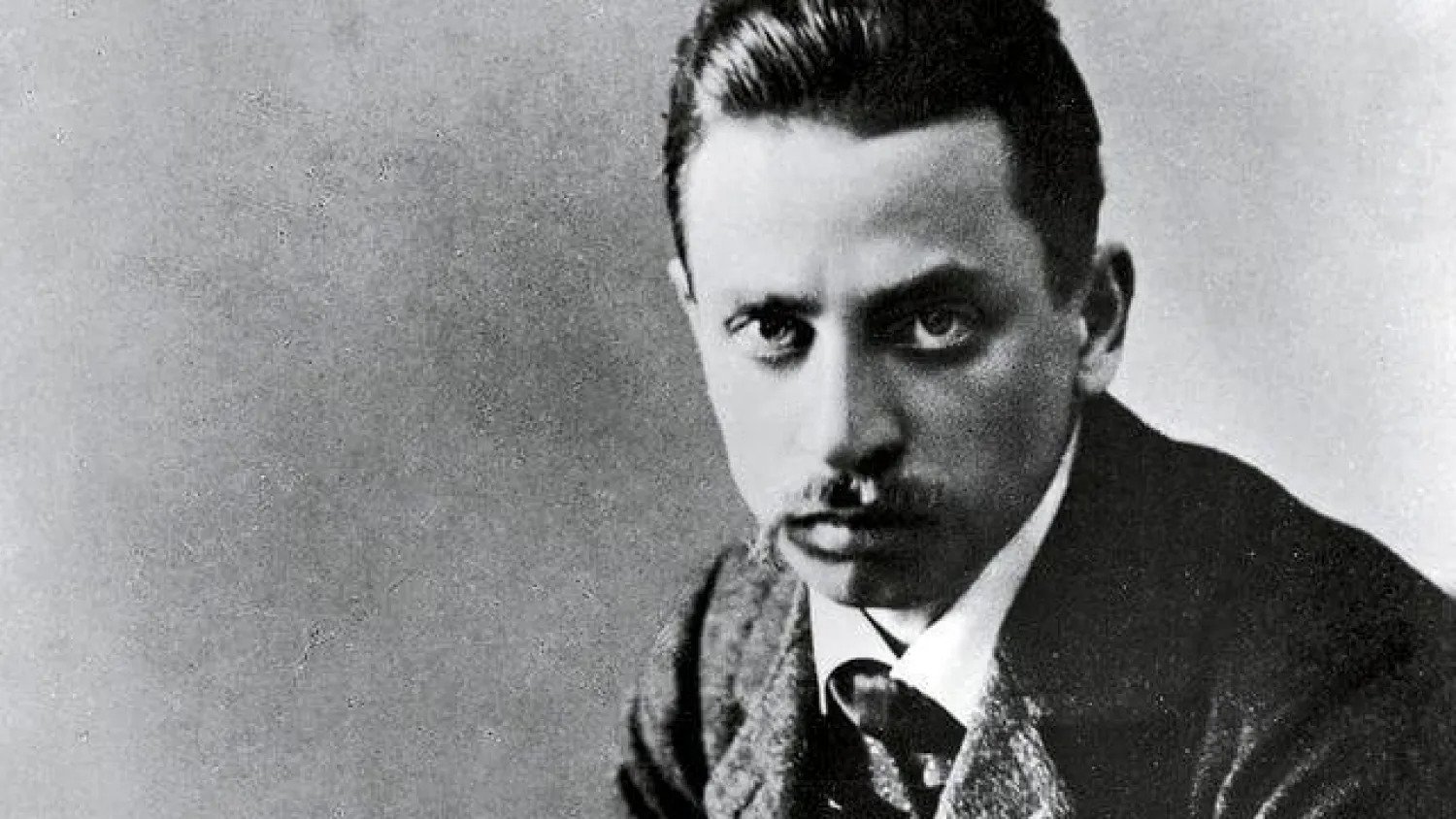
Finally, among the most important works ever written on the philosophy of poetry are Rilke's famous Letters to a Young Poet, written to a young man who had sought his advice. These letters penetrate to the essence of poetry, to its depths, to its workshop—to the magical chemistry that generates poetic energy.
Rilke told him, in essence: If poetry is not a matter of life or death for you, there is no reason to torment yourself or devote your life to something for which you were not created.
In this sense, and in the simplest possible terms.
Who could forget Rilke's voice, Rilke's longing, Rilke's inner madness?
And yet Rilke never received the Nobel Prize. Instead, it was awarded to a French poet named Sully Prudhomme.
Have you ever heard of him?
Certainly not.
Who is this fool who knows nothing of Rilke's greatness, of Rilke's genius?
It was certainly not Heidegger. The great philosopher devoted an extensive study to Rilke in his well-known book Paths of the Forest. Indeed, its title is taken literally from the title of one of Rilke's poems. Thus, contrary to what we might think, the title is not Heidegger's own invention.
Finally, perhaps the most important work on the philosophy of poetry is the extensive studies Heidegger devoted to Hölderlin's poetry, collected under the title Elucidations of Hölderlin's Poetry—or, more literally, reflections and illuminations cast upon Hölderlin's poetry.
From these studies, we can draw the following conclusion:
For Heidegger, poetry is not merely a literary art among other arts. Rather, it is the essence of language and the place in which the truth of Being and the essence of existence reveal themselves.
Poetry allows human beings to escape the technological sterility of the modern world. It enables them, in Heidegger's words, “to dwell poetically upon the earth.”
And because Heidegger admired Hölderlin's poetry so deeply, he asked that several poems by Germany's greatest poet be read over his grave before he was buried.
Source: Asharq Al-Awsat newspaper
Most read