
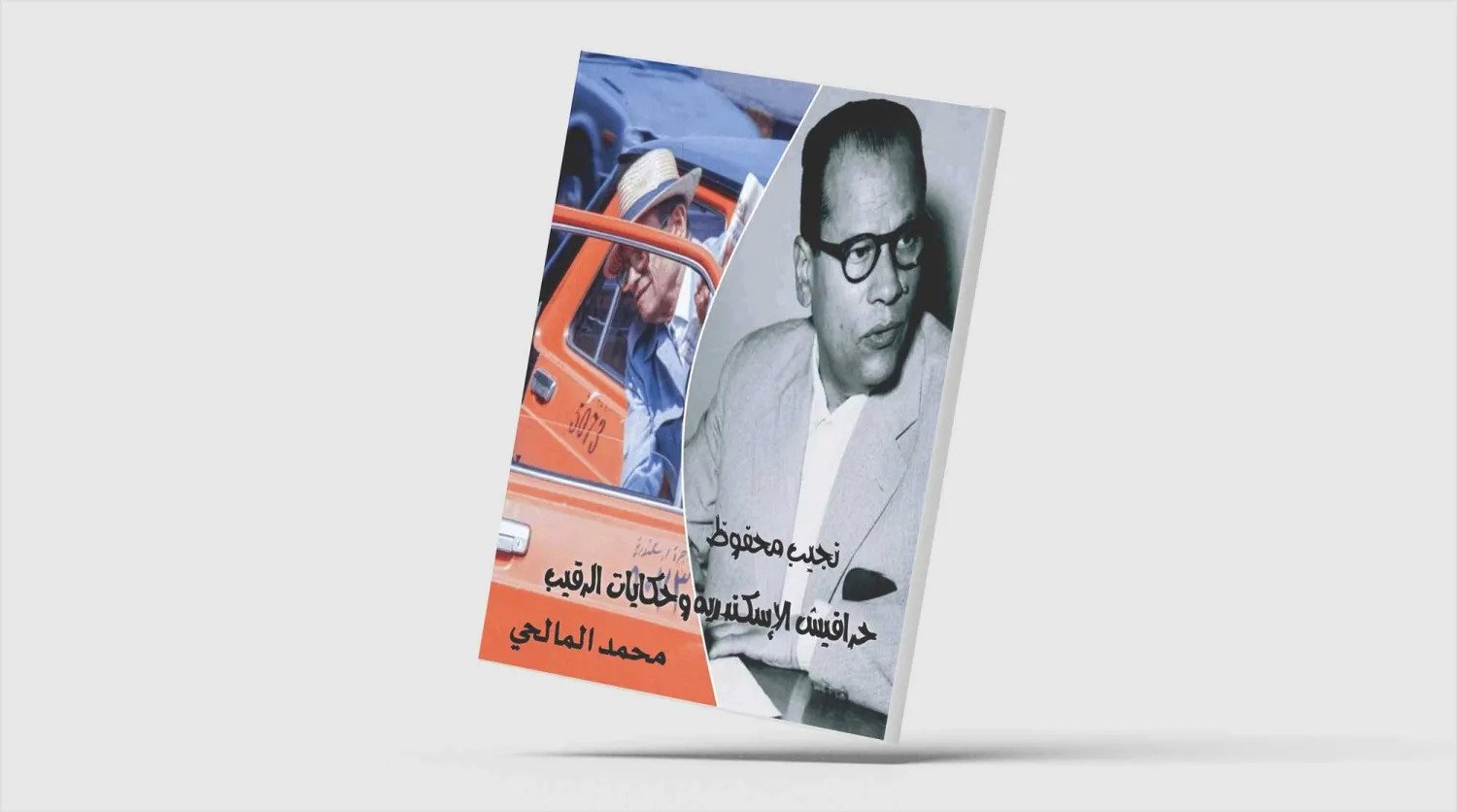
In his book Naguib Mahfouz: The Harafish of Alexandria and Tales of the Censor, published by Dar Al-Badee Al-Arabi, researcher Mohamed Al-Malhi ventures into lesser-explored areas of the Nobel laureate’s life, particularly his experience of Alexandria and the world he inhabited there among friends, cafés, and memories. The book also sheds light on Mahfouz the civil servant, who worked as a censor of artistic works and left behind his observations on a number of film scripts.
The author draws on numerous photographs, handwritten letters, testimonies, and other rare documents in an attempt to chronicle this relatively overlooked aspect of Mahfouz’s biography. His starting point is the idea that the image of Mahfouz’s famous “Harafish” circle has long been associated in the cultural memory with his celebrated gatherings in Cairo, while another, lesser-known circle existed in Alexandria.
Mahfouz used to spend several consecutive months each year in the Mediterranean city, away from his family, in a tradition that continued for nearly a quarter of a century, from the 1970s until 1994, when his regular trips to Alexandria came to an end following the attempt on his life.
This is where the story of the “San Stefano Circle” begins—the group with which the dean of the Arabic novel associated during his summer stays in Alexandria. Its members would meet every evening in the garden of the old San Stefano Hotel, usually between six and nine o’clock.
The author also draws on the testimonies of four members of this circle, along with rare photographs and letters in Mahfouz’s own handwriting, to reconstruct the atmosphere of gatherings that remained largely beyond the media spotlight, particularly when compared with the attention devoted to the Qasr El-Nil Harafish circle in Cairo.
These testimonies are especially significant because they offer a portrait of Mahfouz in his everyday life: his relationships with his friends, the way he conducted conversations, his habits while on holiday, and his ties with people who were not necessarily writers or celebrities.
Among the figures who emerge in these accounts is accountant Sayed Qenawy, whose friendship with Mahfouz began at Cairo’s famous Café Riche in 1969 before continuing in Alexandria.
Al-Malhi does not rely solely on the testimonies of the circle’s members. He also draws on the memory of place: the cafés and restaurants Mahfouz frequented, the second-hand booksellers on Al-Nabi Daniel Street, and the recollections of elderly Alexandrians who witnessed his presence in the city.
In its second half, the book turns to a figure who appears to be the complete opposite of the man sitting among his friends in the garden of San Stefano: Naguib Mahfouz the censor.
The writer celebrated for his creative rebelliousness and literary audacity was, at the same time, a government employee committed to regulations and administrative rules. He worked in the field of artistic censorship, where his responsibilities included reviewing cinematic works.
In this section, Al-Malhi examines a number of film scripts bearing Mahfouz’s comments in his capacity as a censor, including works by prominent directors such as Salah Abu Seif and Hassan Al-Imam.
These scripts become historical documents in their own right, revealing the nature of Mahfouz’s work within the censorship apparatus and allowing readers to explore a professional dimension of his life that has received far less attention than his image as a novelist and short-story writer.
The censorship documents reveal that Mahfouz did not inhabit a single world. His mornings were governed by the routines of public service and official regulations, while his other world was shaped by writing, cinema, friends, and cafés.
It is precisely this duality that makes the book’s second half a complement to its first, despite the apparent difference in subject matter. In both cases, we encounter Naguib Mahfouz beyond the familiar image cemented by his literary fame.
Most read