Managing Wars Between Personality and Strategy: A Study of the Impact of Individual Leadership on U.S. Foreign Policy Under Donald Trump

Abstract
This study examines the impact of political personality on the management of wars and strategic decision-making by analyzing President Donald Trump’s approach to U.S. foreign policy, particularly toward Iran. The study is based on the hypothesis that the growing role of individual leadership may shift foreign policy away from an institutional framework toward a personalized model driven by political emotion, media-image management, and strategic uncertainty.
The study also examines the characteristics of Trump’s political personality, the policy of “maximum pressure,” and the use of ambiguity and unpredictability as tools of deterrence and crisis management, applying this framework to the cases of North Korea, Afghanistan, and China.
The study concludes that although this leadership style may achieve certain short-term tactical gains, it may also undermine U.S. international credibility and contribute to greater instability in the international system.
Keywords: Political personality – Strategy – U.S. foreign policy – Donald Trump – Iran – Maximum pressure policy – Strategic uncertainty.
Introduction
In modern international relations, military power alone is no longer sufficient to explain state behavior or the outcomes of wars. Rather, political strategy has become the decisive factor in translating the elements of power into tangible outcomes. War is no longer merely a military act, but a complex political process in which leadership, institutions, decision-making mechanisms, and the image of the state at home and abroad all intersect.
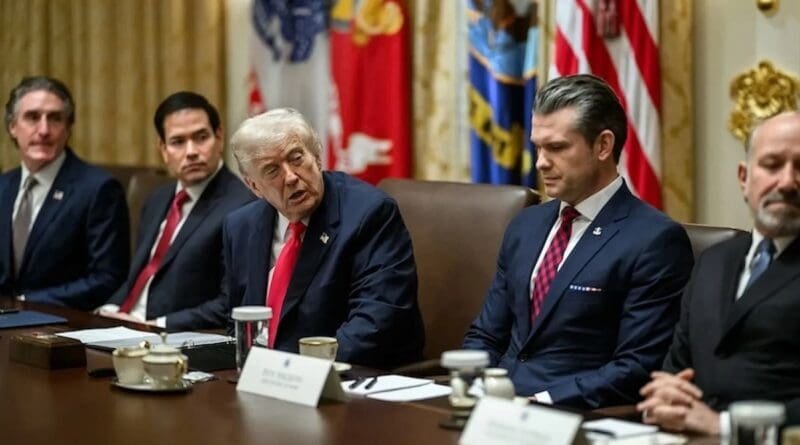
In this context, debate has emerged over Trump’s approach to foreign policy, particularly toward Iran. A number of researchers and analysts argue that this approach largely reflects the characteristics of his political personality, as well as mechanisms of image management and political emotion, rather than representing a long-term institutional state strategy. Trump tends to manage crises through a logic of media impact and rapid political reactions, which can sometimes lead to unintended consequences despite U.S. military superiority.
The study is based on the hypothesis that the growing role of individual leadership in political decision-making may reshape foreign policy, moving it from its institutional and strategic framework toward a personalized framework in which decisions become more closely associated with the leader’s personal characteristics—such as political emotion, media-image management, and strategic uncertainty—rather than with the state’s long-term strategic planning.
First: Political Personality as an Approach to Strategic Decision-Making
Trump represents an exceptional case for studying the relationship between political personality and strategic decision-making. The president’s individual characteristics became intertwined with the functioning of the U.S. state to an unprecedented degree, making the boundary between the “institution” and the “individual” more blurred than in the traditional model of the U.S. presidency, which is based on institutional bureaucracy and a balance among centers of power.
The school of Political Personality Analysis argues that a leader may become a decisive variable in shaping foreign policy when he possesses a charismatic or populist personality, or a tendency to bypass traditional institutions. (1)
1. Confrontational Negotiating Pragmatism
Trump relied on what could be described as “confrontational pragmatism,” using maximum threats, economic sanctions, and media escalation before shifting toward negotiations from a position of strength. This approach was evident in the policy of “maximum pressure” against Iran following the U.S. withdrawal from the nuclear agreement in 2018. (2)
2. A Predilection for Quick Victories
Trump’s personality was characterized by a tendency to achieve rapid accomplishments that could be leveraged for media and popular purposes. This was evident in his handling of the Iranian and North Korean files through a form of “spectacle diplomacy” based on direct summits and sharply worded statements. (3)
3. The Centrality of Political Image
During Trump’s presidency, military power became a tool for producing political prestige and projecting the image of a “strong president.” This was exemplified by the decision to assassinate Qasem Soleimani, commander of Iran’s Quds Force, in early 2020, a decision that carried symbolic and deterrent dimensions extending beyond its immediate military dimension. (4)
4. Managing Politics Through the Logic of the Deal
Trump’s view of international relations was influenced by his business background, leading him to approach foreign policy through the logic of the “deal,” based on direct calculations of gains and losses. He reassessed alliances according to a cost-benefit criterion. (5)
5. The Individualistic Orientation of Political Decision-Making
Trump’s experience reflected a shift in decision-making from an institutional framework toward an individual framework linked to the leader’s personal characteristics. This generated a degree of uncertainty within the international system because of the difficulty of predicting U.S. behavior. (6)
Second: Image-Making Rather Than Strategy
The writer and political analyst David Frum argues that one of the most dangerous transformations in U.S. politics during the Trump era was the shift from “strategy-building” to “political image-making,” whereby power came to be used primarily to generate media impact and project resolve rather than as part of a coherent strategic vision. (7)
This was reflected in the U.S. approach toward Iran, where American policy combined direct threats, sanctions, and military displays while lacking a clear conception of what the desired regional order should look like following escalation. (8)
The intensive use of the media and social media also blurred the distinction between foreign policy and domestic electoral campaigning. As a result, some decisions were shaped as much by their value in enhancing the president’s image before public opinion as by their contribution to U.S. strategic interests. (9)
Third: The Policy of Strategic Uncertainty and Its Practical Applications
The Trump administration relied on what is known as “Strategic Unpredictability,” an approach based on deliberately creating ambiguity and uncertainty regarding the state’s political and military behavior in order to confuse adversaries. (10)
This approach is associated with what is known as the “Madman Theory,” which former U.S. President Richard Nixon employed during the Cold War to convince adversaries that he might take irrational or extremely dangerous decisions. (11)
This approach became particularly evident in several international cases:
1. U.S. policy shifted from direct nuclear threats to unexpected diplomatic summits in its dealings with North Korean leader Kim Jong Un. This demonstrated the Trump administration’s reliance on a policy combining sharp escalation with sudden diplomatic engagement, within a strategy based on uncertainty and psychological pressure intended to confuse adversaries and achieve rapid political gains. (12)
2. In the Middle East, the assassination of Soleimani represented a model of calculated escalation, demonstrating the U.S. administration’s effort to employ military power as an instrument of deterrence and to restore strategic prestige without escalating into a full-scale war with Iran. (13)
3. In Afghanistan, the U.S. administration combined military escalation with negotiations with the Taliban, ultimately leading to the Doha Agreement. This reflected the adoption of a pragmatic approach based on the simultaneous use of military force and pressure alongside political negotiations to achieve strategic objectives at the lowest possible direct cost. (14)
4. In relations with China, the policy of uncertainty assumed an economic dimension through repeated waves of trade escalation followed by periods of de-escalation. This reflected the Trump administration’s reliance on managing conflict through gradual pressure and economic bargaining, with the aim of reshaping the terms of the trade balance without sliding into a comprehensive confrontation with China. (15)
Fourth: The Strategic Confrontation Between Iran’s “Long Game” and U.S. “Maximum Pressure”
Iran has relied in managing its conflict with the United States on a strategy of “the long game,” or “strategic patience,” an approach based on gradually exhausting the adversary and avoiding direct and comprehensive military confrontation, while treating time itself as an element of strategic power. By contrast, the Trump administration adopted a policy of “maximum pressure,” based on economic sanctions and political and media escalation, with the aim of compelling Tehran to rapidly alter its regional and strategic behavior. (16) (17)
The Iranian strategy is centered on prolonging the conflict, exploiting the factor of time, and employing regional allies and non-state actors to broaden the scope of pressure and reduce the likelihood of direct war. This gives Tehran greater room for maneuver and long-term attrition. (18) Iran also relies on asymmetric means of confrontation, including missile capabilities, cyber warfare, and hybrid warfare, with the aim of increasing the costs of confrontation for the United States without engaging in a large-scale conventional war. (19)
By contrast, during the Trump era, Washington sought to achieve rapid results through economic pressure, political isolation, and media escalation. This reflected an approach based on rapid resolution and compelling the adversary to make direct concessions. (20) However, this divergence between “long-term attrition” and “rapid pressure” transformed the conflict between the two sides beyond the traditional military dimension, turning it into a confrontation between two different approaches to managing power, time, and strategy. (21)
Fifth: The Impact of Trump’s Policies on International System Stability and the Reshaping of the Balance of Power
The approach adopted by the Trump administration generated extensive debate within academic and strategic circles regarding its long-term implications for the position of the United States and its leadership role in the international system. Although the policy of pressure and strategic unpredictability gave Washington tactical room for maneuver and enabled it to unsettle adversaries in certain cases, a number of researchers argue that this approach contributed to deeper transformations in the structure of the international system, whether in terms of the balance of power, the nature of international alliances, or the degree of global geopolitical stability. (22)
1. Declining International Credibility
The growing reliance on unexpected decisions and rapid shifts in political positions created doubts regarding the stability of U.S. policy and the continuity of its international commitments. This resulted in a decline in the predictability of U.S. behavior, which relatively weakened the image of the United States as a power capable of leading the international system according to stable rules and strategies. (23)
2. Confusion Among Allies and the Reassessment of Alliances
Repeated shifts in U.S. policy prompted a number of traditional allies to reassess the extent to which they could rely on Washington, particularly amid the growing rhetoric of reassessing alliances according to a cost-benefit logic. Consequently, some countries moved to strengthen their own capabilities or diversify their international partnerships in anticipation of sudden changes in the U.S. position. (24)
3. Benefits for Rival Powers
International powers competing with the United States, such as China, Russia, and Iran, benefited from volatility in U.S. policy to expand their regional and international influence. They also sought to exploit differences between the United States and its allies to strengthen their presence within the international system and reshape some of the traditional balances of power. (25)
4. Rising Geopolitical Fluidity
Policies of sudden escalation, trade wars, and recurrent tensions with both allies and adversaries contributed to increasing “geopolitical fluidity” within the international system. International relations became more volatile and less conducive to long-term stability. The likelihood of political and strategic miscalculation also increased as the ability to anticipate the direction of U.S. policy declined. (26)
Accordingly, the impact of this approach was not limited to crisis management during Trump’s presidency. It extended to raising deeper questions about the future of U.S. leadership of the international system and whether the United States will remain an institutional power capable of managing global balances in a stable manner, or whether the international system is gradually moving toward a more multipolar phase characterized by greater fluidity in the distribution of international power.
Conclusion
This study demonstrates that political personality may become a decisive variable in shaping strategy itself, rather than merely in implementing it. In the case of Trump, the interaction between personal characteristics and the instruments of governance produced an unconventional model of foreign-policy management based on escalation, strategic unpredictability, and media image-making.
The study has shown that this approach provided the United States with tactical room for maneuver and enabled it to unsettle adversaries, but it also contributed to increasing uncertainty within the international system and raised profound questions about the stability of U.S. decision-making and the future of Washington’s leadership role. The study also revealed a conflict between two different philosophies of power management: the first is based on rapid resolution and direct pressure, while the second relies on strategic patience, gradual attrition, and the management of time as a strategic instrument.
This, in turn, raises the central question: Can a great power maintain long-term strategic stability when its decisions become a direct reflection of the leader’s personality rather than an expression of a stable institutional vision?
Footnotes
- Margaret G. Hermann, *Political Psychology and Foreign Policy Decision Making*, Palgrave Macmillan, New York, 2013, p. 56.
- Richard Nephew, *The Art of Sanctions: A View from the Field*, Columbia University Press, New York, 2018, p. 214.
- John Bolton, *The Room Where It Happened: A White House Memoir*, Simon & Schuster, New York, 2020, p. 327.
- Kenneth M. Pollack, *The Persian Puzzle: The Conflict Between Iran and America*, Random House, New York, 2004, p. 412.
- Henry Kissinger, *World Order*, Penguin Press, New York, 2014, p. 301.
- Bob Woodward, *Rage*, Simon & Schuster, New York, 2020, p. 221.
- David Frum, *Trumpocracy: The Corruption of the American Republic*, HarperCollins, New York, 2018, p. 144.
- Joseph S. Nye Jr., *The Future of Power*, PublicAffairs, New York, 2011, p. 89.
- Francis Fukuyama, *Identity: The Demand for Dignity and the Politics of Resentment*, Farrar, Straus and Giroux, New York, 2018, p. 173.
- Graham Allison, *Destined for War: Can America and China Escape Thucydides’s Trap?*, Houghton Mifflin Harcourt, Boston, 2017, p. 183.
- Jeffrey Kimball, *Nixon’s Vietnam War*, University Press of Kansas, Lawrence, 1998, p. 214.
- Michael Wolff, *Fire and Fury: Inside the Trump White House*, Henry Holt and Company, New York, 2018, p. 305.
- David Frum, op.cit,p. 144.
- Carter Malkasian, *The American War in Afghanistan: A History*, Oxford University Press, New York, 2021, p. 389.
- Henry M. Paulson Jr., *Dealing with China: An Insider Unmasks the New Economic Superpower*, Twelve Publishing, New York, 2015, p. 276.
- Graham Allison, op.cit,, 2017, p. 145.
- Richard Nephew, The Art of Sanctions: A View from the Field. New York: Columbia University Press, 2018, p. 84.
- Anthony H. Cordesman, Iran’s Military Forces and Warfighting Capabilities. Washington D.C.: CSIS Press, 2007, p. 92
- Michael Eisenstadt, Iran’s Evolving Military Strategy. Washington D.C.: Washington Institute for Near East Policy, 2019, p. 37.
- David Frum, op.cit, p. 56.
- Fareed Zakaria, Ten Lessons for a Post-Pandemic World. New York: W.W. Norton & Company, 2020, p. 67.
- Richard Haass, *The World: A Brief Introduction*, Penguin Press, New York, 2020, p. 256.
- Graham Allison, * op.cit,, 2017, p. 183.
- Fareed Zakaria, *Ten Lessons for a Post-Pandemic World*, W.W. Norton & Company, New York, 2020, p. 118.
- Fawaz A. Gerges, *Making the Arab World: Nasser, Qutb, and the Clash That Shaped the Middle East*, Princeton University Press, Princeton, 2018, p. 267.
- Francis Fukuyama, *Liberalism and Its Discontents*, Farrar, Straus and Giroux, New York, 2022, p. 119.
Most read


Read also