

Juhayman al-Otaibi, the figure who led the seizure of the Grand Mosque in Mecca in 1979, underwent a profound radical transformation. He began on the margins of society, starting his life as a petty smuggler, trafficking cigarettes across the border and chasing fleeting pleasures in Kuwait. He later joined the Tablighi Jamaat, or the Society for the Propagation of Faith, before eventually distancing himself from it and rising as the charismatic father figure of a fundamentalist group captivated by visions and legends. His journey culminated in the defining moment when he led an assault on the Grand Mosque and pledged allegiance there to the purported Mahdi, between the Black Stone and the Maqam Ibrahim, where, according to the group’s narrative, the veil had been lifted from him, heralding the final apocalyptic drama.
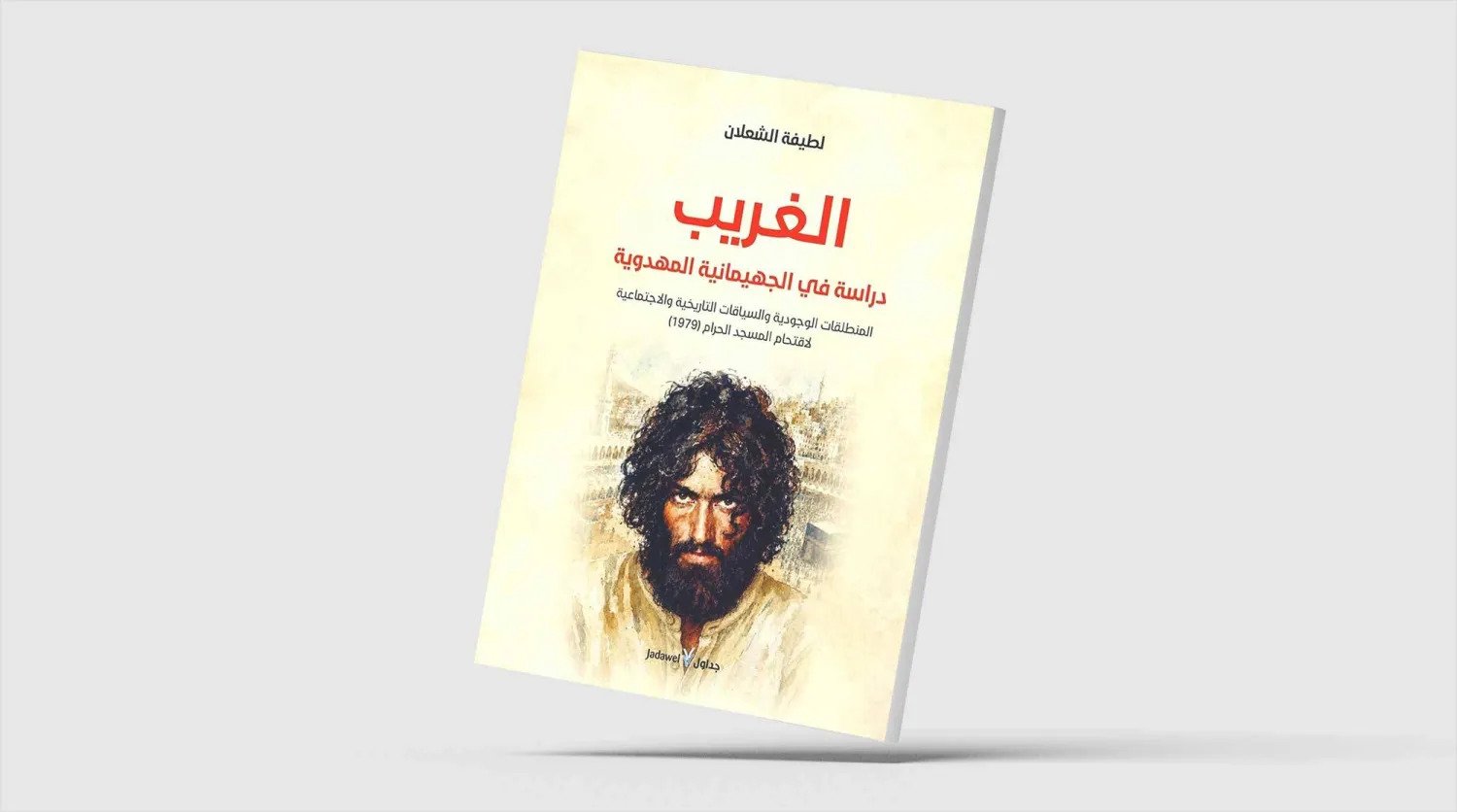
The book The Stranger: A Study of Juhaymanism and Mahdism, published by Jadawel Publishing and Translation and written by Dr. Latifa Al-Shaalan, a professor of psychology at Princess Nourah bint Abdulrahman University in Riyadh and a member of the Saudi Shura Council, offers a critical approach and a different deconstructive reading of Juhayman’s life. It moves beyond conventional reductions that confine the analysis to political interpretations or clinical pathological diagnoses of Juhayman al-Otaibi, delving instead into the depths of the “psychology of Mahdist consciousness” and tracing the trajectories of existential anxiety and the search for meaning in the life of this tragic figure.
The Limits of Reductionism
The researcher does not place all the responsibility on “Mahdist certainty,” which naturally played a decisive role in the movement that culminated in the seizure of the Grand Mosque. Yet this conviction provides only half the answer to the puzzling historical question. The other half lies in the structure of the self that allowed such a belief to take shape with all its sincerity and internal coherence, ultimately leading to the decisive moment and its consequences.
Juhayman’s upbringing, particularly during childhood and adolescence, involved the internalization of feelings associated with the Battle of al-Sabala (1347 AH/1929), sentiments that permeated his social environment—from the family and mosque to the tribe. It is possible that he was drawn by nostalgia toward the past of his ancestors, through narratives oscillating between veneration and sorrow.
Yet the researcher argues that these emotional recollections remained marginal within the context of the overwhelming drama that eventually reached its climax in the seizure of the mosque.
“A Community of Delusions”
The book reveals how a fully developed “community of delusions” emerged within the group, as narratives of apocalyptic tribulations and the signs of the Hour became part of daily life, consuming the emotional world of its members and gradually causing reality to contract in favor of a parallel universe.
“Dreams and visions” played a pivotal role in feeding this illusion. The group documented and classified files containing no fewer than 270 dreams, which evolved from mere psychological flights of fancy into “supernatural confirmations” upon which its members relied.
The tragedy lay in the fact that the Mahdist idea initially emerged in a marginal environment through jokes and playful exchanges before being absorbed into an atmosphere saturated with signs and symbols. A deceptive feedback loop subsequently took shape: Muhammad ibn Abdullah proclaimed himself to be the Mahdi on the basis of prophecies and visions; Juhayman endorsed these claims and passed them on to his followers, who in turn returned to the purported Mahdi with their own visions as evidence confirming his status. Each individual thus became a mirror reflecting the delusion of the other and, in doing so, granting it legitimacy.
These beginnings, initially marked by fleeting frivolity, soon found fertile ground in an environment of signs, symbols, and dreams, where they became intertwined and developed into an epic narrative. Juhayman was ultimately responsible for transforming them from hesitant whispers into a claim of “cosmic truth,” which eventually produced that historical tragedy.
The researcher writes: “As a result of this immersion, reality gradually contracted and narrowed until it closed in upon a parallel world, governed by a strange atmosphere fixated on the unseen. This world consumed the emotional lives of these men and removed them from the context of reality into a realm of epic expectation. Nevertheless, certainty regarding the appearance of the Mahdi was not equally stable among all of them. Some remained apprehensive about the claim even as they continued within the orbit of the group, driven either by their commitment to an ideology aimed at religious and moral transformation or by their attraction to the power and charisma of the leader.”
Rupture and Denial
The book traces several pivotal moments that shaped Juhayman’s activist consciousness, most notably the incident in Medina in 1965 involving the smashing of mannequins and photographs. This was not merely an act of physical protest; rather, it represented a definitive rupture with his existing world and the death of his political innocence. A year later, in 1966, the Salafi religious-observance group was established, from which Juhayman himself eventually broke away, pursuing an even more rigid and uncompromising path.
By 1978, the idea of Mahdism had become firmly established in his mind, and he began moving toward acquiring weapons through smugglers in preparation for the advent of the new Hijri century.
Despite the siege and the developments on the ground during the confrontation inside the Grand Mosque, Juhayman remained under the grip of his irrational certainty. He displayed a textbook case of “detachment from reality.” When doubts spread among his followers following the death of the “purported Mahdi,” he responded with intense anger, dismissing their doubts as the spreading of defeatist rumors and insisting that the Mahdi could not be killed, but was awaiting the “swallowing up of the army by the earth.”
The researcher writes: “Eschatological visions provide those who believe in them, in the short term, with a sense of comfort and tranquility, as well as hope that meaning will ultimately be fulfilled. Yet this stability is quickly disrupted when the days pass without the promised salvation materializing. At that point, frustration intensifies and feelings of emptiness and alienation accumulate, transforming these very supernatural visions into a dynamic force that drives their adherents toward catastrophe.”
Spiritual Alienation and the Search for Meaning
A profound symbolic dimension emerged in Juhayman’s obsessive concern with the temporal and spatial sequencing of the signs associated with the emergence of the Mahdi, and with his attempts to forcibly reconcile those signs with the reality of Saudi Arabia as it existed during the 1970s.
Driven by alienation and a narrowing horizon, Juhayman leapt toward the irrational, consumed by an overwhelming existential anxiety through which he sought to restructure existence itself. He attempted to accelerate the violent transition from a troubled present toward an anticipated supernatural future. The tragedy ultimately ended with his exhausted surrender and his grim silence during his final journey toward execution, leaving behind one of the harshest messianic narratives in modern history.
Drawing on her sources, including a security official familiar with the details of the case, the researcher reports that Juhayman offered no resistance at the moment of his arrest, as exhaustion had already taken its toll. During the investigation, he appeared composed, reducing the entire operation to an act of personal judgment that had ultimately proved mistaken.
On his final journey toward the implementation of his death sentence, accompanied by Said bin Abdullah—the brother of the “Mahdi”—and four other condemned men, Juhayman remained grim and silent throughout the journey. Like his five companions, he did not utter a single word.
The researcher argues that “Juhayman remains an exceptional and singular case in the absolute certainty with which he believed that he was living through the end times. This certainty took complete possession of his faculties and dominated them, shaping his existential choices and determining both his own fate and the fates of those around him. This belief transcended every conceivable boundary until it became a major historical force, producing profound and multidimensional consequences.”
Most read