
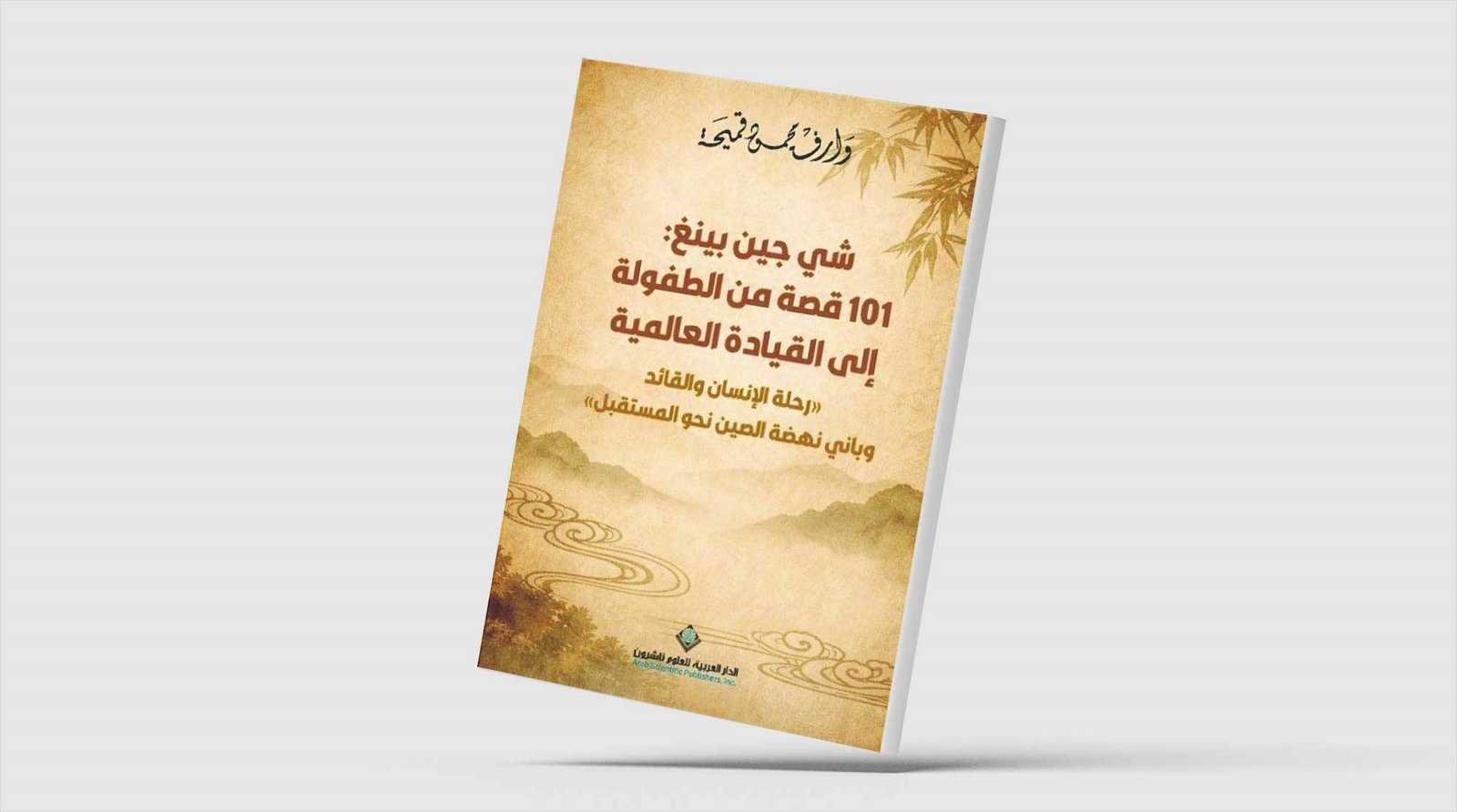
A new book by Lebanese writer and researcher Warf Qmiha has recently been published under the title Xi Jinping: 101 Stories from Childhood to Global Leadership, with the subtitle The Journey of the Man, the Leader, and the Architect of China's Renaissance Toward the Future. The book presents an intellectual and human portrait of Chinese President Xi Jinping through one hundred and one stories that combine literary narrative, historical documentation, and political analysis.
Rather than offering a conventional biography that merely chronicles chronological milestones or catalogs achievements, the book seeks to explore the human experience that shaped Xi Jinping's character. It traces the various influences that accompanied his journey from a childhood marked by hardship, through the difficult years he spent in rural China, to positions of public responsibility, and ultimately to the leadership of China during a period of profound transformation.
Qmiha begins from the premise that writing about great leaders is no easy task, as it requires an attempt to understand both the spirit of their human experience and the circumstances that shaped it. He argues that writing about Xi Jinping presents the author with two interconnected challenges: the challenge of understanding and the challenge of fairness, particularly because Xi's leadership emerged within a distinctly Chinese context whose intellectual, historical, and political roots differ fundamentally from prevailing Western models.
Accordingly, the book returns to the earliest stages of Xi Jinping's life, examining his family environment and the values instilled in him before turning to the formative experience of his relocation during his youth to the rural village of Liangjiahe. There, he confronted poverty, arduous labor, and harsh natural and social conditions, while gaining firsthand knowledge of the daily lives of farmers and the aspirations of China's most disadvantaged communities.
The stories illustrate how Xi Jinping's childhood and youth forged the resilience and determination that enabled him to overcome adversity and persevere throughout his political career. They also explore his early involvement in public affairs, the beginnings of his career within the Communist Party of China, and the administrative responsibilities he assumed at the local level, where he became intimately familiar with the challenges of economic development, poverty alleviation, infrastructure, education, and public administration.
The book follows Xi Jinping's progression through successive leadership positions across several Chinese provinces, demonstrating how his vision of governance and reform evolved through practical field experience and direct engagement with farmers, craftsmen, and small business owners.
According to the author, although the book focuses on the life of a leader, it does not portray leadership as an isolated individual endeavor, nor does it regard history as the product of a single person. Instead, the experience it examines unfolded within a broad collective framework in which the Communist Party of China served as the organizational and ideological force guiding the country's modernization, while the Chinese people acted as active participants in the nation's construction and transformation rather than passive recipients of government policies.
From this perspective, the author presents China's development as the product of continuous interaction between leadership and vision, on the one hand, and between party organization and the collective will of the people, on the other.
Beyond recounting Xi Jinping's personal journey, the book also examines the defining features of his philosophy of governance. Particular attention is devoted to concepts such as the Chinese Dream, national rejuvenation, common prosperity, and social justice. It further analyzes his views on modernizing governance, strengthening Party discipline, and combating corruption.
The book also highlights Xi Jinping's efforts to integrate elements of traditional Chinese thought with the requirements of a modern state. His political discourse frequently incorporates concepts drawn from China's civilizational heritage—including harmony, moral responsibility, respect for knowledge, and the primacy of the public interest—while simultaneously embracing modern approaches to governance, economics, technology, and strategic planning.
The author also sheds light on the relationship between the wisdom of China's cultural heritage, the revolutionary spirit, and the demands of the modern era. He explains how the Chinese leadership has sought to preserve the essential elements of the nation's cultural identity while simultaneously embracing scientific and technological innovation and modernizing the country's governance mechanisms.
A substantial portion of the book is devoted to the profound transformations China has experienced in the New Era. These include the nationwide campaign to eradicate poverty, improve living standards, revitalize rural communities, modernize infrastructure, strengthen education and scientific research, promote innovation and digital transformation, and advance industry, technology, and clean energy.
The book also examines China's efforts to achieve a more balanced pattern of development between urban and rural areas by supporting local enterprises, modernizing agriculture and manufacturing, strengthening food security, improving natural resource management, and enhancing environmental protection. It argues that genuine development should not be measured solely by the size of an economy, but by its capacity to improve people's quality of life, expand opportunities, and enhance their sense of security and stability.
Qmiha pays particular attention to China's transformation from what was once described as the world's "factory" into a major scientific and technological power and a laboratory for a distinctive model of civilizational and developmental progress that seeks to present its own vision to the world. Rather than portraying China's experience as a model to be copied, the author presents it as a unique path that emerged outside the conventional Western paradigm and therefore deserves to be understood within its own historical and cultural context.
The book also explores China's growing international stature and examines how, under Xi Jinping's leadership, the country has assumed a more influential role in shaping discussions about the future of the international order. In this context, it discusses the five major global initiatives introduced by the Chinese president:
- The Belt and Road Initiative (BRI);
- The Global Development Initiative (GDI);
- The Global Security Initiative (GSI);
- The Global Civilization Initiative (GCI); and
- The Global Governance Initiative.
Through these initiatives, the book presents Xi Jinping's vision of China's future and its international role—not merely as a nation pursuing its own development, but as a global power advocating cooperation, mutual benefit, and the sharing of development opportunities, particularly with countries of the Global South.
Alongside its portrayal of Xi Jinping as a statesman and policymaker, the book also offers insights into Xi the individual. Through a series of stories, it explores his relationship with the Chinese people and his family, his field visits across the country, his passion for reading and history, and his style of communicating with both ordinary citizens and government officials.
The narratives are based on documented events, official speeches, and firsthand testimonies. The author has reworked this material into a reflective, story-driven style that maintains a careful balance between engaging literary narration and rigorous historical documentation.
Originally published by Asharq Al-Awsat.
Most read