Hormuz as a Gateway to Negotiations: Are Washington and Tehran Moving Toward an Interim Deal?

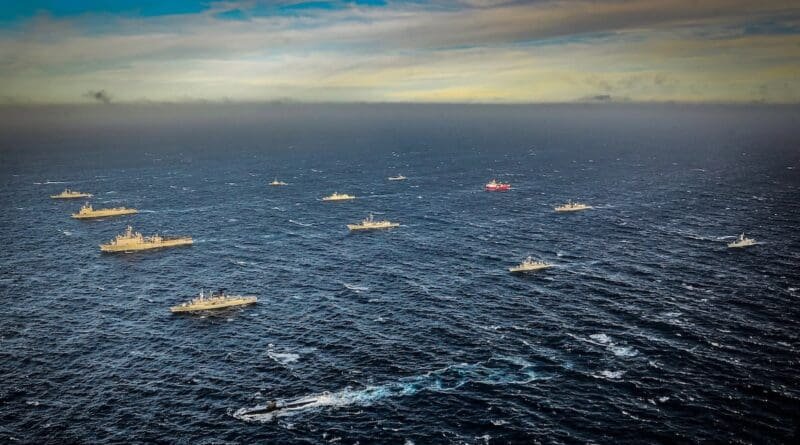
The Strait of Hormuz is no longer merely one of the arenas of confrontation between the United States and Iran. It has become the most sensitive bargaining chip in the ongoing conflict between the two sides. While Washington seeks to use military and economic pressure to push Tehran toward concessions, Iran is attempting to leverage its ability to influence maritime traffic and global energy flows in the opposite direction. Between these two tracks, Qatar-led mediation efforts are seeking an interim formula that could halt the fighting and reopen the strait without necessarily resolving the most complicated issues, foremost among them Iran’s nuclear program.
Signals emerging from New York suggest that active indirect contacts are underway, but they have not yet developed into full-fledged political negotiations. Iranian Foreign Minister Abbas Araghchi’s meeting with the Qatari mediator, the exchange of messages through intermediaries, and reports of a revised version of Iran’s seven conditions all indicate that channels of communication remain open, despite continued tough rhetoric from both sides.
The central paradox, however, is that the two parties continue to approach the crisis with different priorities. Iran wants the fighting to stop, the blockade lifted, and sanctions eased, while also seeking the release of frozen assets. It would then use the reopening of the Strait of Hormuz as a reciprocal step. Washington, by contrast, appears intent on turning any interim arrangement into an entry point for obtaining Iranian concessions on the nuclear file, including the resumption of international inspections and monitoring.
Who Holds the Stronger Bargaining Chip?
The nature of the proposals under discussion reveals that the core dispute is no longer simply about a ceasefire. It is increasingly about who moves first and who pays the initial price for de-escalation.
Tehran wants to secure economic and political gains before making a strategic concession on the nuclear issue. Washington, meanwhile, appears less willing to return to the framework of the June understanding, which separated the reopening of the strait from subsequent negotiations over the nuclear program.
This is where the Strait of Hormuz becomes crucial. For Iran, the strait represents a bargaining instrument whose significance extends beyond its immediate military value because of its connection to global energy flows and Tehran’s ability to influence international markets. For the United States, continued disruption of maritime traffic creates economic costs that cannot be ignored, while simultaneously giving Washington a basis for maintaining pressure on Iran.
The result is a complicated bargaining environment: each side can impose costs on the other, but the costs of prolonging the confrontation are not necessarily equal, nor are their limits easy to predict.
Why Do the Talks Look More Like Crisis Management Than Conflict Resolution?
One of the most striking features of the current contacts is that they appear to focus on an interim de-escalation arrangement rather than a comprehensive settlement.
The formula reportedly under discussion involves reciprocal steps: reopening the strait, lifting the blockade, and then easing sanctions, followed by movement toward the nuclear issue. This suggests that mediators are attempting to break the crisis into stages rather than resolve every issue simultaneously.
Such an approach is understandable given the deep lack of trust between Washington and Tehran. A comprehensive agreement would require the parties to address interconnected issues including the nuclear program, sanctions, maritime security, guarantees against renewed attacks, and frozen Iranian assets. A phased arrangement, by contrast, would allow both sides to test the other’s compliance before moving to the next stage.
Yet phased diplomacy can itself become a source of renewed disagreement. Who guarantees that Washington will lift the blockade and sanctions after the strait is reopened? Who guarantees that Iran will honor its nuclear commitments after receiving economic benefits? And who can ensure that a political change in either capital will not cause the arrangement to collapse once again?
The Nuclear File Returns to the Heart of the Crisis
Perhaps the most important development in the current contacts is the effort to link the de-escalation around Hormuz to the nuclear issue.
Tehran wants to treat the nuclear program as a separate negotiating track that can be addressed after the fighting stops and economic pressure is eased. Washington, according to the available indications, is seeking to make any interim arrangement the first step toward a broader nuclear agreement.
The dispute therefore goes beyond questions of enrichment or international inspections to a deeper issue: strategic distrust.
Iran wants assurances that any concession it makes will not be followed by a new attack or a rapid return of sanctions. The United States, meanwhile, wants guarantees that the economic and security concessions it provides will not enable Tehran to rebuild its nuclear or military capabilities and return to the starting point.
The real obstacle to an agreement, therefore, is not the absence of communication channels, but rather the lack of a mechanism capable of ensuring that both sides fulfill their commitments in successive stages.
Domestic Pressure in Iran Narrows the Room for Maneuver
Iran’s leadership is not operating in a political vacuum. The call by more than 30 former Iranian officials for Tehran to withdraw from the Nuclear Non-Proliferation Treaty reveals the presence of a domestic current that views external pressure as grounds for reconsidering the constraints Iran has imposed on itself.
The significance of this demand lies not only in the possibility that it could eventually be implemented, but also in the fact that it creates additional domestic pressure on Iranian decision-makers. Any concession at the negotiating table can be portrayed internally as a response to American pressure, while maintaining a hard line on the nuclear issue can be presented as a means of strengthening deterrence.
This leaves Iran’s leadership facing a more complicated task: it must preserve its deterrent capabilities against external threats while preventing the confrontation from turning into a prolonged military and economic war of attrition.
The IRGC and the Maritime Front
The military dimension is becoming increasingly important as Iranian rhetoric regarding Hormuz shifts from threats to close the strait toward portraying it as an active military theater.
Statements attributed to Islamic Revolutionary Guard Corps commanders regarding the targeting or seizure of U.S. equipment in the region, alongside messages attributed to Iran’s leadership concerning operations near Hormuz, indicate that Tehran does not want to appear to be backing down under pressure.
This helps explain the difficulty of the current negotiations. For Iran, reopening the strait is not simply a technical decision concerning maritime navigation. Domestically, it could be portrayed as the outcome of a reciprocal agreement rather than a response to military pressure.
For Washington, meanwhile, accepting the reopening of Hormuz without securing tangible gains on the nuclear issue could be interpreted as a retreat from the pressure strategy pursued by the administration.
The Economic Factor: Oil as an Indirect Mediator
The negotiations cannot be separated from global energy markets. Continued disruption of maritime traffic through Hormuz raises the economic cost of the conflict for the global economy, while the blockade and sanctions impose direct costs on Iran’s economy.
Oil has therefore become an indirect participant in the bargaining process. Higher prices create pressure on consumers and economies worldwide, while at the same time increasing the importance of Iranian oil exports to Tehran. The longer the crisis continues, the more the question shifts from who can withstand the conflict militarily to who can bear its economic costs for a longer period.
This may explain the mediators’ interest in reaching a limited and rapid arrangement capable of preventing the crisis from evolving into a broader energy shock.
Three Possible Paths
The current situation can be viewed through three principal trajectories, none of which should be regarded as predetermined.
The first path: a phased settlement.
This would involve reopening the Strait of Hormuz, halting the fighting, and lifting or easing some economic restrictions in exchange for an Iranian commitment to enter subsequent nuclear negotiations and permit a degree of international monitoring. This approach would seek to separate the most difficult issues while keeping the broader negotiating process alive.
The second path: continued bargaining under pressure.
The two sides may continue exchanging pressure without reaching a rapid agreement, with Washington relying on sanctions, the blockade, and military pressure while Tehran uses the strait, its military capabilities, and the nuclear issue as counter-leverage. In this scenario, mediators would function primarily as instruments for crisis management rather than as brokers of a final settlement.
The third path: renewed escalation.
If the contacts fail to produce an acceptable formula, the confrontation could return to a more intense phase, particularly if either side concludes that continued pressure will force greater concessions from the other. The risks would increase further if the maritime crisis became directly linked to the nuclear issue or to a new military operation.
Conclusion: The Battle for the Negotiating Table Before the Battle for the Strait
The current developments suggest that the central question is no longer whether Washington and Tehran are willing to negotiate. The continuing exchange of messages and mediation efforts indicates that channels of communication remain open.
The more important question is: what will each side receive in return for taking the first step?
Iran wants to turn the reopening of Hormuz into a quid pro quo for lifting the blockade and easing sanctions. Washington, meanwhile, wants to use Hormuz as an entry point to a broader agreement addressing the nuclear program. Between these competing demands, mediators are attempting to construct a formula that allows each side to make concessions without appearing to retreat in front of its domestic audience.
The prospects for an understanding, therefore, will depend not only on the scale of the concessions Washington or Tehran can make, but also on the mediators’ ability to establish a sequence of reciprocal steps in which the initial concession is both verifiable and reversible if the other side fails to comply.
In this context, the Strait of Hormuz will remain at the center of the crisis—not simply because it is a strategic maritime corridor, but because it has become a test of the balance of power between Washington and Tehran. If the strait can be transformed from an instrument of pressure into a starting point for reciprocal concessions, it could provide an opening for broader de-escalation. If, however, each side continues to insist that the other must move first, Hormuz will remain open to two contradictory possibilities: becoming a gateway to negotiations or turning into a trigger for another round of escalation.
Most read



Read also