
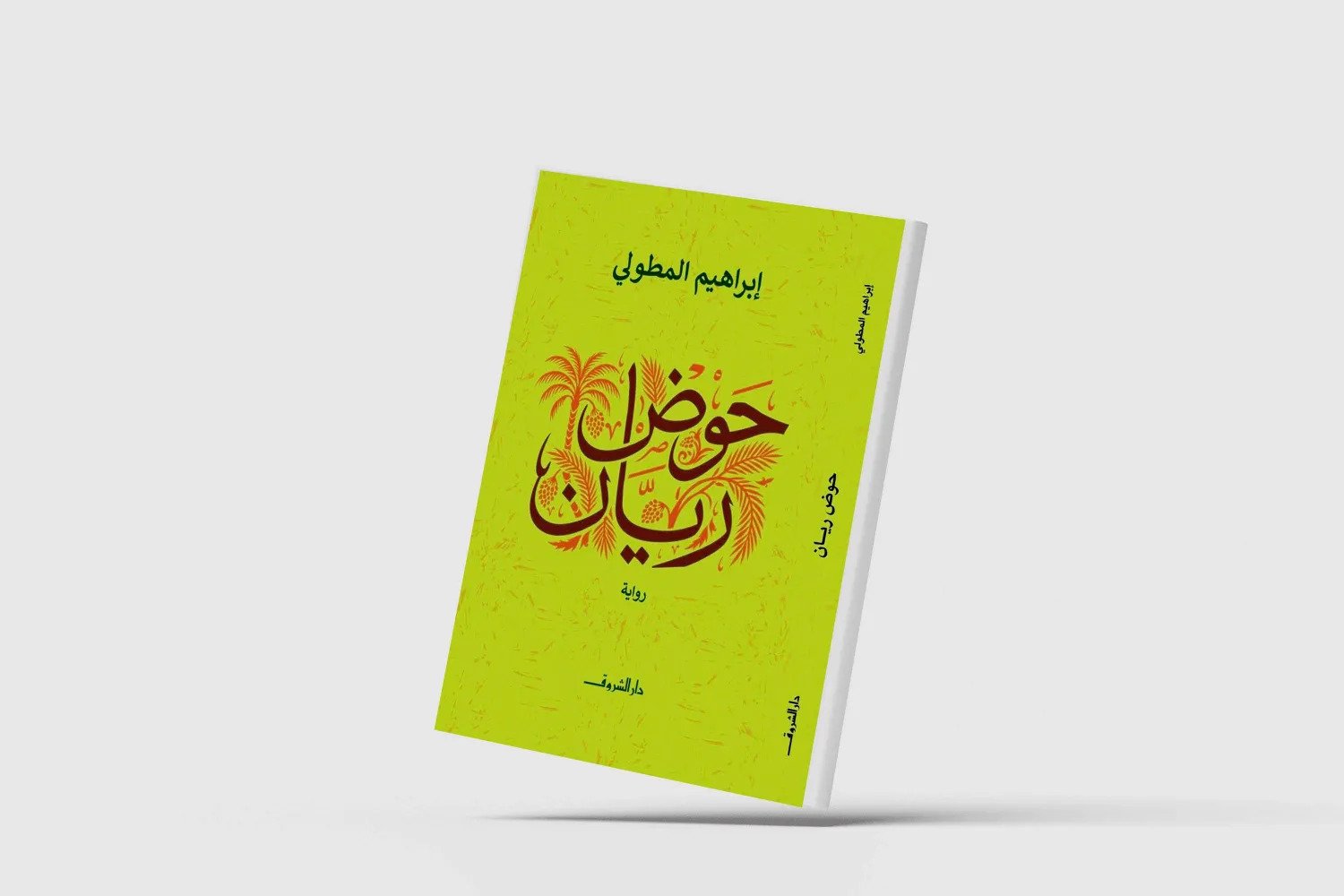
In Ibrahim El-Matouli’s novel Hawd Rayan, the Egyptian countryside is not merely a picturesque setting or a backdrop for rural life. It emerges as a living social space, carrying memory, identity, inherited traditions, and the anxieties of a community confronting forces that threaten to transform the meaning of the land itself.
The Egyptian countryside has long appeared, particularly in the eyes of visitors, as a landscape of beauty and simplicity: green fields stretching toward the horizon, irrigation canals crossing the cultivated land, and villages whose rhythms seem governed by the changing seasons. Yet beneath this seemingly tranquil image lies another reality—one shaped by struggles over land, ownership, memory, and the future.
In Hawd Rayan, the land occupies the center of this tension. It is not simply an economic asset. It represents a form of belonging, a family inheritance, and a repository of collective memory. This is why the attempts of “outsiders” to penetrate the rural space under various pretexts, including the search for buried treasures, acquire a significance that goes beyond the immediate plot. They become a challenge to a social order built over generations.
The novel’s treatment of the land also evokes an ancient Egyptian awareness of its importance. The boundaries of agricultural property were never merely lines on a map; they were closely connected to social stability and the organization of life along the Nile. The memory of the land, therefore, is also a memory of the community itself.
The Land as a Character
One of the most striking aspects of Hawd Rayan is the way the countryside is transformed from a background into an almost independent presence. The land has its own rhythms, colors, smells, and seasonal transformations. It changes with water, crops, and cultivation, while retaining traces of those who have worked it before.
“Across its level fields, the waterways and irrigation channels run like lines in the palm of a hand. Its crops change with the seasons, and so does the face of the land, shifting from green to yellow, and only rarely becoming black as it waits for water.”
This description captures one of the novel’s central ideas: the land is not static. It is constantly changing, yet this change is part of a natural and familiar cycle. The threat presented by outsiders is different because it introduces another kind of transformation—one driven not by seasons or cultivation, but by interests seeking to extract something from the land.
Here, the novel establishes a subtle contrast between two different perceptions of time. There is the slow, cyclical time of agriculture, in which generations inherit the land and leave something behind for those who follow; and there is a faster, more extractive time, in which the land becomes a resource to be exploited.
A Community Built on Memory
The characters of Hawd Rayan—including Said al-Deeb, al-Hajj Maawad, and Salah al-Bahhar—are not presented simply as individuals. Each is connected to a broader social network of memory, reputation, relationships, and inherited knowledge.
Salah al-Bahhar, in particular, is constructed through small but revealing details. His amber prayer beads, blue galabeya, white kaftan, and black shoes contribute to a visual portrait that immediately places him within his social environment. Even the stories surrounding him—such as the rumor of his tattoo or the tale of his encounter with a donkey—become part of the collective memory through which the village perceives its people.
This method of characterization is important because rural society in the novel is not portrayed as an anonymous or homogeneous community. It is a space in which people observe one another, remember one another, and preserve stories about one another. Reputation becomes a form of social currency, while memory functions as a mechanism through which the community defines itself.
Between Beauty and Anxiety
The cultural significance of Hawd Rayan lies partly in its ability to move beyond the familiar romantic image of the Egyptian countryside. The novel does not deny the beauty of rural Egypt; rather, it places that beauty alongside an underlying sense of vulnerability.
The green fields and irrigation channels are therefore more than decorative elements. They represent a way of life whose continuity cannot be taken for granted. The beauty of the landscape becomes inseparable from the question of who owns it, who protects it, and what happens when its meaning changes.
The “outsider” in the novel consequently remains more than a conventional antagonist. The figure embodies a broader anxiety about the arrival of forces that do not share the community’s relationship with the land. What matters is not merely what these outsiders seek to take from the countryside, but the possibility that their presence may alter the community’s understanding of its own space.
The Changing Meaning of the Land
At its deeper level, Hawd Rayan can be read as a novel about transformation: the transformation of place, of social relationships, and above all of the meaning of land.
For the villagers, land is memory, livelihood, inheritance, and identity. For those who approach it from outside, it may represent something entirely different: an opportunity, a resource, or a hidden value waiting to be extracted.
This tension gives the novel its cultural depth. The conflict is not simply between characters; it is also between different ways of seeing the same place. One sees the land as a living inheritance, while another sees it as something that can be possessed, exploited, or converted into value.
In this sense, Hawd Rayan offers a portrait of the Egyptian countryside at a moment of latent change. Beneath the apparent calm of fields, canals, villages, and familiar faces lies a question that is both simple and profound: what happens when the land that has long defined a community begins to acquire a different meaning?
That question allows the novel to move beyond the boundaries of a rural narrative and into a broader reflection on memory, belonging, and the struggle over place. The land in Hawd Rayan is not merely where the story happens. It is part of the story itself—and perhaps its most important character.
Most read