

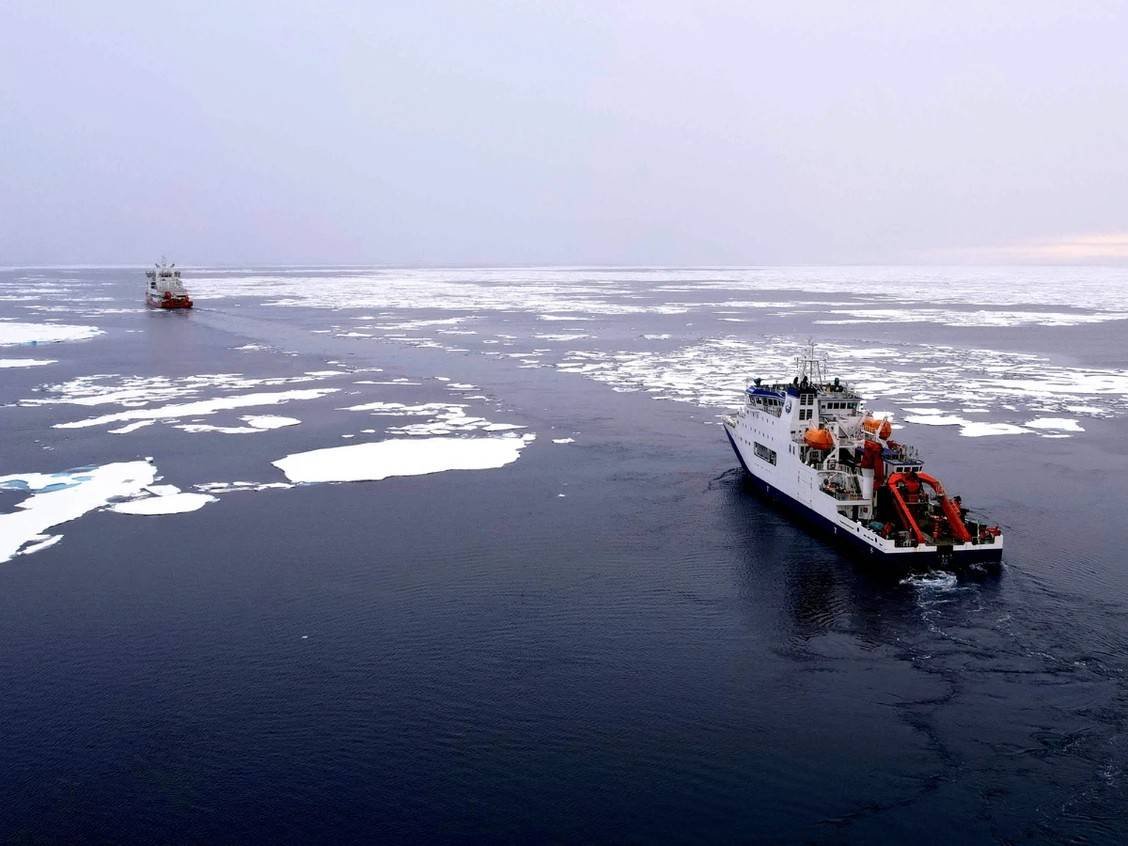
A Chinese container ship has departed from the port of Ningbo in eastern China, bound for Europe via the Arctic Ocean, in a move reflecting the rise of a new maritime route that Beijing is seeking to develop as an alternative to traditional trade corridors, foremost among them the Suez Canal, the Strait of Hormuz, and the Red Sea.
The voyage comes at a time when geopolitical tensions and wars have disrupted shipping through some of the world’s most important maritime chokepoints, prompting shipping companies to search for routes that are safer and less vulnerable to disruption.
The voyage is part of China’s “Polar Silk Road” initiative and uses the Northern Sea Route, which runs along Russia’s northern coastline through Arctic waters before reaching Europe. The Chinese company Sea Legend has launched the new service, which is expected to become weekly during the Arctic shipping season, in an attempt to establish a regular trade route between China and Europe that avoids geopolitical bottlenecks in South Asia and the Middle East.
From 40 Days to Around 20
The appeal of the Arctic route lies primarily in distance and time. According to Chinese estimates, a voyage between East Asia and Europe via the Northern Sea Route can take around 18 to 20 days, compared with approximately 40 to 50 days on traditional routes, depending on ice conditions and the course of the voyage.
Sea Legend says the new service aims to reduce transit time to Europe to around 20 days—roughly half the time normally required via the Suez Canal, according to CNN.
This means that, if the route proves capable of operating regularly, it could offer an important advantage to Chinese companies exporting products to Europe, including electric and hybrid vehicles, batteries, and solar-energy-related products.
But the time advantage does not mean that the Arctic route can currently compete with the Suez Canal on a large scale. Its capacity remains limited, while operations are restricted to a short season and exposed to harsh climatic conditions.
How Does the New Route Work?
Ships depart from China’s eastern coast and head north through the Bering Strait before entering the Northern Sea Route along Russia’s Arctic coastline and continuing westward toward Europe.
On the current voyage, the vessel is scheduled to arrive at the British port of Felixstowe on September 7, before continuing to Hamburg in Germany and Gdynia in Poland.
The Northern Sea Route extends for roughly 3,500 miles along Russia’s Arctic coast, and most of it is under Russian control and administration. This makes any expansion of commercial activity along the route closely linked to relations between Moscow and Beijing.
Why Now?
The renewed interest in the Arctic route has not emerged in a vacuum.
Disruptions in the Red Sea and the Strait of Hormuz have interfered with the movement of oil and gas tankers and cargo vessels, while increasing the risks associated with some traditional shipping corridors.
The Strait of Hormuz is particularly important because it is one of the world’s most critical chokepoints for energy trade. Any prolonged disruption there can increase transportation and insurance costs while raising supply risks.
Against this backdrop, China is not necessarily seeking a route that would completely replace Hormuz or the Suez Canal. Rather, it is looking for a backup corridor that can be used when southern routes become more expensive, dangerous, or vulnerable to closure.
Developments in recent years suggest that diversifying trade routes has become part of a broader strategy among both companies and governments to reduce dependence on any single maritime corridor, particularly when trade involves strategic commodities such as energy, semiconductors, batteries, and automobiles.
China and Russia: A Partnership Moving North
The Northern Sea Route gives China and Russia a shared interest in developing the Arctic region.
Russian President Vladimir Putin has long sought to transform the route along Russia’s northern coast into a major commercial corridor, supporting investment in ports, oil and gas fields, and infrastructure across the region.
Chinese President Xi Jinping, meanwhile, introduced the concept of the Polar Silk Road in 2018 as an extension of China’s Belt and Road Initiative into the northern regions.
Although the massive Chinese investments in Arctic ports and infrastructure that had once been anticipated have not materialized on the expected scale, recent geopolitical developments have reopened an opportunity for Beijing to strengthen its presence in the region.
Shipping data indicate that China has become the most prominent foreign user of the route since Russia’s war in Ukraine, although trade remains heavily concentrated between China and Russia.
More Than a Route for Cargo
The importance of the new route extends beyond container shipping.
It has become an important corridor for transporting Russian oil and gas to China, including shipments of liquefied natural gas.
Shipping data show that several Chinese companies have expanded their activities in the region, while at least six Chinese shipping companies are expected to conduct more than 50 voyages along the route during the 2026 season, using container ships, cargo vessels, and multipurpose vessels.
China’s imports of Russian liquefied natural gas across all routes also increased by around 28 percent during the first half of the year, at a time when the US-Iran war froze LNG exports from the Middle East.
The Arctic is therefore gradually transforming from a remote geographical region into an energy and trade corridor serving the economic interests of both China and Russia.
The Fastest Route, But Not the Easiest
Despite these advantages, the Arctic route still faces major obstacles.
The passage cannot currently be used throughout the year in the same way as traditional maritime routes. The navigable window remains limited, ice conditions can change rapidly, and ships may sometimes require assistance from icebreakers.
Search-and-rescue services, ports, and logistical infrastructure in the region are also far less developed than those available along traditional trade routes.
This makes the ability to predict voyage duration a major challenge for shipping companies. Delays caused by ice, weather, or the need for assistance can erode the route’s time advantage.
The Environmental Cost
Arctic shipping also faces growing environmental criticism.
An increase in the number of vessels operating in an environmentally fragile region raises concerns about the consequences of accidents and oil spills, as well as the impact of shipping activity on sea ice and Arctic ecosystems.
Several major international logistics companies have pledged to stay away from the route because of what they describe as potential environmental risks associated with increased shipping activity in the region.
The spread of what is known as the “shadow fleet,” particularly older vessels that use methods to circumvent sanctions, further increases the environmental and operational risks along the route.
Melting Ice Changes the Equation
The paradox, however, is that climate change and the melting of Arctic sea ice could open the way to a longer shipping season in the coming decades.
As the extent of sea ice continues to decline, longer periods of the year could become navigable, while new routes may emerge, including a potential route crossing directly through the Arctic and avoiding Russia’s coastline.
For China, this could eventually mean the creation of a fast corridor to the North Atlantic, significantly altering the calculations surrounding trade between Asia and Europe.
Not a Complete Alternative
Despite its ambitious plans, the volume of trade through the Northern Sea Route remains very small compared with the Suez Canal and other major maritime corridors.
Moreover, most transit traffic currently consists of trade between China and Russia, particularly Russian oil and gas shipments bound for China.
But the importance of the route should not be measured solely by the volume of current trade. Its significance lies in the role it could play as a backup option when traditional routes are disrupted.
That is precisely what makes the new Chinese voyage noteworthy.
Beijing is not waiting until southern maritime routes become unusable. It is instead building an alternative capability that can be expanded when necessary.
A New Geopolitical Arena
The significance of the route extends beyond economics and trade into geopolitics.
The expansion of Chinese and Russian activity in the Arctic has attracted the attention of the United States, Europe, and NATO, amid concerns that a commercial route could become a platform for broader strategic influence.
EU foreign policy chief Kaja Kallas has warned that China could use Arctic routes and supply chains for strategic purposes, while NATO Secretary General Mark Rutte has said that the alliance needs to address the risks arising from Russia’s and China’s growing access to the Arctic.
The region has also witnessed signs of expanding security cooperation between Moscow and Beijing, alongside China’s growing investment in scientific research programs and its Arctic fleet.
Beijing rejects these concerns, saying that its activities in the Arctic are aimed at supporting peace, stability, and sustainable development in accordance with international law.
An Arctic Race Beyond China
China does not appear to be the only Asian country beginning to test the potential of the route.
South Korean shipping company Pan Star is reportedly preparing for a trial voyage from Busan to Europe via the Northern Sea Route on August 22, indicating that interest in the corridor is beginning to extend beyond China.
Other Chinese companies are already expanding their activities.
Sea Legend is expected to operate a regular seasonal service between China and Europe, while NewNew Shipping has launched a route between Tianjin and the Russian port of Murmansk, alongside its existing services transporting Chinese industrial goods and Russian raw materials.
Sea Legend aims to achieve year-round navigation within the next decade, although that goal will remain dependent on developments in climate conditions and infrastructure, as well as companies’ ability to manage operational risks.
A Competitor to the Suez Canal?
In the near term, the answer is no.
The route does not yet possess the infrastructure, capacity, or operational consistency required to compete with the Suez Canal on a large scale.
But the comparison itself may be misleading.
The strategic value of the Arctic route does not lie in replacing the Suez Canal. Rather, it lies in giving China another option when traditional routes become disrupted.
As crises repeatedly affect major maritime chokepoints—from the Red Sea to the Strait of Hormuz—the existence of an alternative route becomes increasingly valuable, even if its use remains seasonal and limited.
The Chinese vessel crossing the Arctic toward Europe is therefore testing more than a new shipping service. It is testing a new conception of the global trade map: a network of multiple maritime corridors in which the Arctic becomes part of the calculations of energy security, trade, and supply chains—not merely a remote region of ice.
Most read



Read also