Introduction
Egyptian President Abdel Fattah el-Sisi’s visit to Seoul carries significance that extends beyond its protocol dimension. It is the first presidential visit by an Egyptian head of state to South Korea in a decade and comes at a time of growing disruptions to global supply chains, a restructuring of international trade and investment patterns, and the rising importance of Asia in the economic and geopolitical calculations of states.
The agenda of the visit—particularly its emphasis on investment, manufacturing, technology, energy, and infrastructure—suggests an Egyptian effort to move relations with South Korea beyond a traditional framework of economic cooperation toward a more integrated partnership based on production localization and Egypt’s integration into Asian value chains and regional markets.
For Seoul, meanwhile, Egypt offers an opportunity to expand the presence of Korean companies in a large regional market while leveraging Egypt’s geographic position and network of trade agreements linking it to Arab, African, and European markets.
I. The Visit in the Context of Egypt’s Evolving Foreign Policy
President el-Sisi’s visit to Seoul cannot be separated from his broader Asian tour, which also includes Malaysia and Indonesia. The choice of these destinations reflects Egypt’s growing interest in diversifying its international economic and investment partnerships rather than concentrating exclusively on its traditional European and American relationships.
This approach comes amid an international environment in which reliance on traditional supply chains has become increasingly uncertain as a result of geopolitical tensions, wars, trade restrictions, and the redistribution of global production centers.
From this perspective, Egypt’s opening toward South Korea represents an effort to build a network of flexible economic partnerships capable of helping Cairo attract technology and investment while strengthening its ability to serve as a regional hub for manufacturing and exports.
The tour also reflects a growing Egyptian recognition of the importance of Asia as a strategic dimension of its foreign policy—not as a substitute for relations with Europe and the United States, but as an additional layer of strategic diversification.
II. From Trade to Investment and Manufacturing
One of the most significant features of the visit is Cairo’s emphasis on moving from conventional trade relations toward investment and joint production.
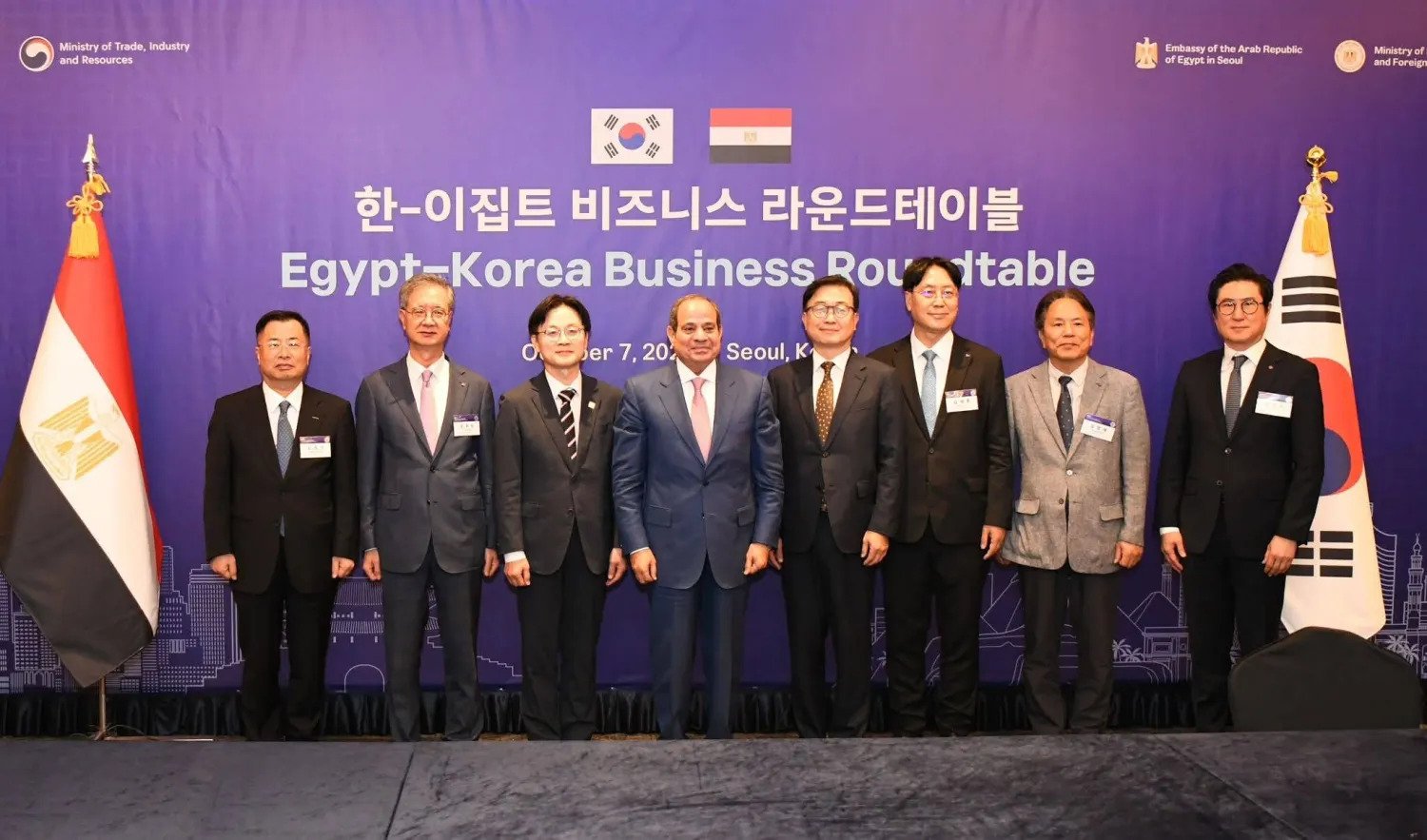
During a roundtable attended by 23 Korean companies, the Egyptian president encouraged Korean businesses to expand their investments across several sectors and renewed Egypt’s proposal to establish an integrated Korean industrial zone within the Suez Canal Economic Zone.
The strategic significance of this proposal extends beyond the establishment of another industrial zone. Its practical objective is to transform Egypt from a destination for Korean products into a production and export base for Korean companies operating in the region.
This vision rests on three principal Egyptian advantages:
-
The size of the domestic market.
-
Egypt’s geographic position between Asia, Europe, and Africa.
-
Its network of free-trade agreements providing access to a broad range of external markets.
If Cairo succeeds in converting these advantages into a competitive production environment, Egypt could present itself to Asian companies not merely as a consumer market but as a regional industrial platform.
III. The Suez Canal as a Tool for Attracting Asian Investment
The Suez Canal Economic Zone is becoming increasingly important in this context.
For several years, Egypt has sought to transform the Suez Canal’s strategic location from merely a maritime transit route into an integrated system encompassing ports, logistics services, manufacturing, and energy.
Korean companies are particularly relevant to this model because of their experience in manufacturing, technology, infrastructure, and large-scale industrial projects.
If an integrated Korean industrial cluster is established, its value should not be measured solely by the volume of direct investment. Its broader significance would lie in its potential to integrate Egyptian companies into Korean supply chains, facilitate technology transfer, and develop the local workforce.
This is where the partnership will face its real test: will Korean investment remain concentrated on assembly and distribution, or will it evolve toward higher-value manufacturing and genuine technology transfer?
IV. Energy and the Green Transition
Energy occupies an important place on the bilateral agenda, with Egypt encouraging Korean companies to invest in oil, gas, and mining, alongside renewable-energy projects involving solar and wind power, green hydrogen, smart grids, and energy-storage technologies.
This diversification reflects a broader transformation in the nature of investment opportunities in Egypt.
While conventional energy has long been a major pillar of Egyptian-Korean cooperation, the global transition toward cleaner energy is opening new areas for partnership in technology and renewable power.
South Korea possesses advanced capabilities in batteries, smart grids, engineering manufacturing, and hydrogen technologies—areas that intersect with Egypt’s ambitions to develop the energy system of the future.
The success of this trajectory, however, will depend on Egypt’s ability to provide a stable regulatory and financing environment and to transform green-energy initiatives from individual projects into an integrated industrial ecosystem encompassing production, storage, transportation, industrial applications, and exports.
V. The African and Arab Dimensions of the Partnership
One of the most important elements of Egypt’s approach is its effort to involve Korean companies in projects beyond the Egyptian market.
Cairo has proposed partnerships between Egyptian and Korean companies to implement construction and infrastructure projects across Arab and African countries.
This approach gives the partnership a three-way dimension: Korean capital and technology, Egyptian experience and networks, and broad Arab and African markets.
If developed institutionally, this model could generate a shared competitive advantage. Korean companies possess advanced technology and extensive experience in major infrastructure projects, while Egyptian companies have accumulated experience in regional markets and established networks across Africa and the Arab world.
Egypt should therefore not be viewed solely as the final destination for Korean investment, but also as a platform through which Korean companies can access wider markets.
VI. South Korea and the Diversification of Supply Chains
From the Korean perspective, Egypt represents a potentially important market at a time when global supply chains are being reconfigured.
Geopolitical tensions in East Asia, Europe, and the Middle East have encouraged global companies to reconsider the geographic distribution of production, sources of raw materials, and export hubs.
In this environment, Egypt can offer Korean companies a combination of a large domestic market, a strategic geographic location, port infrastructure, and access to multiple external markets.
Yet this role cannot be taken for granted. Competition for Asian investment is intensifying across the Middle East and Africa, including among countries offering competing logistical advantages and investment incentives.
Geographic location alone is therefore no longer sufficient. It must be transformed into a productive advantage by reducing operating costs, improving the regulatory environment, increasing logistics efficiency, and developing human capital.
VII. Trade Figures Reveal a Gap Between Ambition and Reality
Despite the ambitious political rhetoric, Egyptian-Korean trade relations remain relatively limited compared with the potential outlined by both sides.
According to data from Egypt’s Central Agency for Public Mobilization and Statistics, bilateral trade reached approximately $874 million during the first eight months of 2026, compared with around $920 million during the same period in 2025.
These figures suggest that the central challenge is not simply declaring an intention to strengthen bilateral relations, but translating political will into sustainable investment and trade flows.
In other words, the partnership needs to move beyond agreements and memoranda of understanding toward measurable projects, supported by clear indicators for investment volumes, local-content ratios, job creation, export performance, and technology transfer.
VIII. Political Continuity After a Decade
The visit also carries symbolic importance. President el-Sisi’s last visit to Seoul took place in March 2016, when he held talks with then-South Korean President Park Geun-hye. The two sides signed several agreements and memoranda of understanding and elevated bilateral relations to the level of a comprehensive partnership.
A decade later, the current visit takes place in a fundamentally different international environment.
The world in which Egyptian-Korean relations operated in 2016 was relatively more stable, whereas today international relations are shaped by challenges involving maritime security, supply chains, energy, technology competition, and the repositioning of global investment.
The partnership being discussed today therefore requires an agenda different from the one envisioned ten years ago.
IX. The Strategic Dimension of Egyptian-South Korean Relations
South Korean President Lee Jae-myung described Egypt as an important partner and expressed hope that the “Miracle on the Han River” and the “Miracle on the Nile” could combine to generate greater shared prosperity.
Behind the symbolic language lies a more consequential reality: both countries view the other as a potential model or platform upon which a new phase of cooperation can be built.
South Korea represents a successful experience of industrialization and technological transformation—from a resource-constrained economy into a global industrial and technological power.
Egypt, by contrast, possesses a different set of strengths, particularly its geographic position, large domestic market, and ability to connect Africa, the Arab world, and other international markets.
Yet the success of the partnership will not result simply from combining these advantages in theory. What is required is their conversion into genuine economic complementarity.
Conclusion: From Political Partnership to Productive Partnership
President el-Sisi’s visit to South Korea reflects an effort to redefine the relationship between Cairo and Seoul on a more ambitious basis than conventional trade cooperation.
Egypt’s stated objectives include attracting Korean investment, establishing an industrial base, expanding cooperation in energy and technology, and connecting Egyptian companies with Korean counterparts through regional projects.
For South Korea, Egypt offers access to a large market and a strategic location linking Asia with Africa, Europe, and the Arab world at a time when global companies are reconsidering production networks and supply chains.
The success of this transformation, however, will depend on the ability of both sides to move from the language of partnership to the economics of partnership.
This means that the real measure of the visit’s success will not be the number of agreements signed or statements exchanged, but the ability of the two countries over the coming years to establish sustainable productive projects, increase Korean foreign direct investment, localize technology, raise domestic value-added, and expand Egyptian exports to regional markets.
If this occurs, Egypt could become more than a market or trading partner for South Korea; it could emerge as an Asian production and export platform at the heart of the Middle East and Africa. At the same time, South Korea could become one of the principal partners in Egypt’s industrial and technological transformation.
This, ultimately, is the strategic significance of the visit: not simply to revive a decades-old relationship, but to formulate a new model of Egyptian-South Korean partnership suited to a global economy that has become more volatile, competitive, and fragmented. :::
Most read




Read also