Drone Warfare and Shifting Frontlines in Sudan: A Military Conflict Redrawing the Map of War

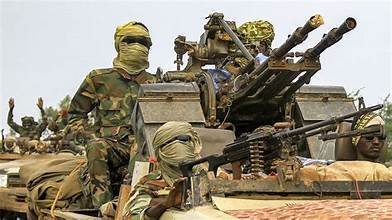
More than three years after the outbreak of the war in Sudan, the confrontation between the Sudanese Armed Forces (SAF) and the Rapid Support Forces (RSF) is no longer governed by the same military dynamics that shaped its early stages. As territorial control has shifted and the center of military operations has moved from Khartoum and Darfur toward Kordofan and Blue Nile, a new factor has emerged to reshape the nature of the conflict: the growing use of long-range drones.
The Sudanese army’s announcement that it had shot down a Chinese-made FH-95 drone northwest of Al-Khuway in West Kordofan State should not be viewed as an isolated incident. In recent weeks, the army has reported intercepting several drones of the same type in Kordofan, coinciding with the expanding use of unmanned aerial vehicles in military operations.
These developments suggest that the war is entering a phase in which air superiority, technological capabilities, and the ability to strike distant targets are becoming increasingly influential in determining the course of operations, even as conventional ground warfare continues.
The more consequential transformation, however, is not limited to the weapons themselves. It lies in the expanding geographical reach of both sides and what this means for civilians, infrastructure, and humanitarian corridors.
Drones Are Changing the Geography of the War
Since fighting erupted in April 2023, Sudan’s war has passed through several distinct phases. The main battles initially centered on Khartoum, before the conflict expanded across Darfur and Kordofan gradually emerged as one of its most important theaters.
Kordofan’s significance stems from its geographical position between central Sudan and Darfur. It is not merely another battlefield, but a strategic corridor whose control can affect the ability of both sides to move troops and supplies between eastern and western parts of the country.
As the confrontation has intensified, drones have gained increasing importance because they allow supply lines, bases, and facilities to be targeted without requiring direct ground control of the surrounding territory.
This is altering one of the traditional rules of warfare: controlling territory no longer necessarily means being able to protect areas behind the frontlines.
A long-range drone can carry the war to a city or facility located tens or even hundreds of kilometers away from active ground combat.
The implications are particularly visible in Kordofan, where drones have become a recurring element of military operations, while international reports have documented civilian casualties and damage to public infrastructure during air attacks carried out by parties to the conflict.
The FH-95 and the Significance of the Technological Race
The repeated appearance of FH-95 drones carries significance beyond the interception of any single aircraft.
This type of drone is designed for multiple missions, including reconnaissance, surveillance, and electronic warfare, and can remain airborne for extended periods. The presence of such systems on the battlefield therefore reflects the increasing technological sophistication of the capabilities being deployed in Sudan’s war.
More importantly, both sides have worked throughout the conflict to strengthen their unmanned aerial capabilities.
This transformation is making the war increasingly dependent on military technology supply chains and on the ability of the warring parties to obtain drones, components, communications systems, jamming equipment, and surveillance technologies.
As a result, the balance of power is no longer determined solely by the number of fighters or military vehicles. It also depends on the ability to monitor an adversary’s movements, strike positions behind enemy lines, and defend airspace against unmanned aircraft.
Sudan’s conflict is therefore gradually evolving from a war heavily dependent on direct confrontation into a hybrid conflict combining ground forces, conventional weapons, aerial capabilities, and long-range technologies.
Kordofan: The War’s New Strategic Pivot
If Darfur represented a major center of the conflict during earlier stages, Kordofan has now become one of the regions most likely to shape the direction of the next phase.
The army is seeking to expand its control westward, while for the RSF, Kordofan represents strategic depth that helps protect its areas of influence and connect them with other theaters of operation.
The battles in North, West, and South Kordofan therefore cannot be understood as separate local confrontations.
Control over roads, cities, and strategic corridors is linked to the larger question of whether forces can move between central Sudan and Darfur, and consequently to each side’s ability to maintain the geographical cohesion of the territories under its control.
The more entrenched the frontlines become between areas controlled by the army and those dominated by the RSF, the greater the risk that Sudan could evolve into separate de facto military zones of influence.
The struggle for Kordofan therefore extends far beyond control of individual towns and cities. At its core, it is a struggle over geographical connectivity between different parts of the country.
Blue Nile and the Opening of a Different Front
Alongside the fighting in Kordofan, escalating violence in Blue Nile represents another significant strategic development.
The region lies in southeastern Sudan near the Ethiopian border, giving military developments there geographical and security dimensions different from those in Darfur and Kordofan.
In recent months, the region has witnessed an escalation in military operations and shifts in control over several areas, coinciding with movements by the RSF and its allies against the army and forces supporting it.
Regardless of conflicting claims over control of individual locations, the broader trajectory is clear: the war is expanding geographically rather than contracting.
The opening of an active front in Blue Nile means that the army must deal with simultaneous pressure from multiple directions, while forces opposing it seek to widen the theater of operations and compel it to disperse its military resources.
This strategy, however, carries an immediate humanitarian cost. As fighting spreads into new areas, it generates additional waves of displacement rather than allowing residents to return to areas where violence has subsided.
Civilians Within Range of the New War
One of the most dangerous consequences of the proliferation of drones is the erosion of the distance between the frontline and civilian areas.
In conventional warfare, it is possible, at least to some extent, to identify frontlines and areas at greatest risk. Long-range weapons, however, expose cities, markets, roads, airports, and critical infrastructure to attack even when they are far removed from ground combat.
International organizations documented civilian deaths in drone attacks and damage to civilian infrastructure in conflict-affected areas during 2026.
The danger is particularly acute in a country already suffering from the widespread collapse of health and food systems.
Every strike on a road, warehouse, or transport vehicle can affect far more than the immediate target. It can disrupt an entire network on which thousands of civilians depend.
Drones therefore cease to be merely military instruments and become a factor that further intensifies civilian vulnerability.
Humanitarian Aid Enters the Line of Fire
The attack on two trucks contracted by the World Food Programme in South Kordofan provides a direct example of these risks.
The trucks were carrying food assistance from Dilling to Kadugli when they came under an aerial attack on October 3, killing one of the drivers, according to the World Food Programme.
The significance of such incidents extends beyond the immediate casualties.
Humanitarian organizations depend on corridors and routes where risks can be assessed with a reasonable degree of predictability. When humanitarian transport itself becomes vulnerable to attack, operational costs rise and organizations may find it increasingly difficult to reach besieged or isolated communities.
Control over humanitarian corridors thus indirectly becomes another factor in the military balance.
Any actor capable of disrupting roads or making them unsafe can affect entire regions’ access to food and medicine without necessarily exercising military control over those areas.
Displacement Reflects the Movement of the Frontlines
Sudan’s displacement map can also be read as an indicator of where the war is heading.
The International Organization for Migration recorded significant waves of displacement from Blue Nile during 2026. In early October alone, it reported that approximately 2,800 people were displaced from ten villages in Wad Al-Mahi locality in a single day as security conditions deteriorated.
These population movements are not merely a side effect of the war. They reveal the transition of new areas from conditions of instability into zones of direct confrontation.
Each new frontline generates additional demand for food, water, shelter, and healthcare, while humanitarian organizations operate with limited resources in an increasingly dangerous environment.
United Nations estimates for 2026 indicate that approximately 33.7 million people inside Sudan require humanitarian assistance, while around 13 million people have been displaced either within the country or across its borders.
The humanitarian crisis is therefore no longer simply accompanying the war; it has become one of its structural characteristics.
From Military War to the Erosion of Social Security
The insecurity and criminal activity affecting several Sudanese cities reveal another dimension of the conflict’s consequences.
Prolonged wars typically contribute to the proliferation of weapons, weakening of security institutions, deterioration of public services, and loss of employment opportunities—all factors that create fertile conditions for crime and localized violence.
The threat facing Sudan therefore extends beyond battles between two military forces.
Even areas where direct fighting has diminished may face a different challenge: restoring effective policing, judicial institutions, public services, and civilian administration while bringing the spread of weapons under control.
In this sense, retaking a city militarily does not necessarily mean restoring the state within it.
Stability requires institutions capable of providing everyday security for the population, not merely removing opposing forces from a particular area.
Is the War Moving Toward Entrenched Zones of Influence?
More than three years into the conflict, the operational map raises a question that goes beyond the outcome of any individual battle: Are the frontlines gradually becoming de facto boundaries between different zones of influence?
The expansion of one side’s control in certain regions and the other’s advances elsewhere, combined with the multiplication of active fronts, could produce a reality in which reunifying Sudan’s political and security space becomes increasingly difficult even if the intensity of military operations eventually declines.
This does not mean that Sudan’s partition has become inevitable. It does, however, mean that preserving the unity of state institutions and the country’s political geography becomes more difficult the longer the conflict continues.
Protracted wars do more than redraw maps of military control. They reshape economic and trade networks, population movements, administrative centers, and local allegiances.
The longer these networks remain separated, the greater the cost of reintegrating them in the future.
A War Changing Faster Than the Prospects for Ending It
Recent developments in Kordofan and Blue Nile suggest that Sudan’s war is entering a more complex phase, not necessarily one closer to a decisive conclusion.
Drones provide the warring parties with a greater ability to strike deep behind enemy lines, but they do not guarantee control of territory. Ground advances can alter maps of influence, but they also open new fronts that require troops and supplies. Expanding military operations can increase pressure on an adversary, but at the same time they produce more displacement and place additional civilian areas at risk.
The downing of an FH-95 drone is therefore significant not merely as a military incident. Its deeper importance lies in what it symbolizes: Sudan’s war is becoming increasingly technology-dependent, more geographically dispersed, and less able to maintain a distinction between the frontline and the civilian hinterland.
As the center of fighting shifts among Kordofan, Blue Nile, and Darfur, the greatest risk is that military transformations will not bring the conflict to an end, but instead reproduce it in a broader and more complex form.
The central question may then no longer be simply: Who will control the next city? Rather, it will be: What will remain of the state, society, and economy when the fighting finally ends?
Most read



Read also