
David’s Corridor: An Israeli Plan to Redraw the Map of the Middle East

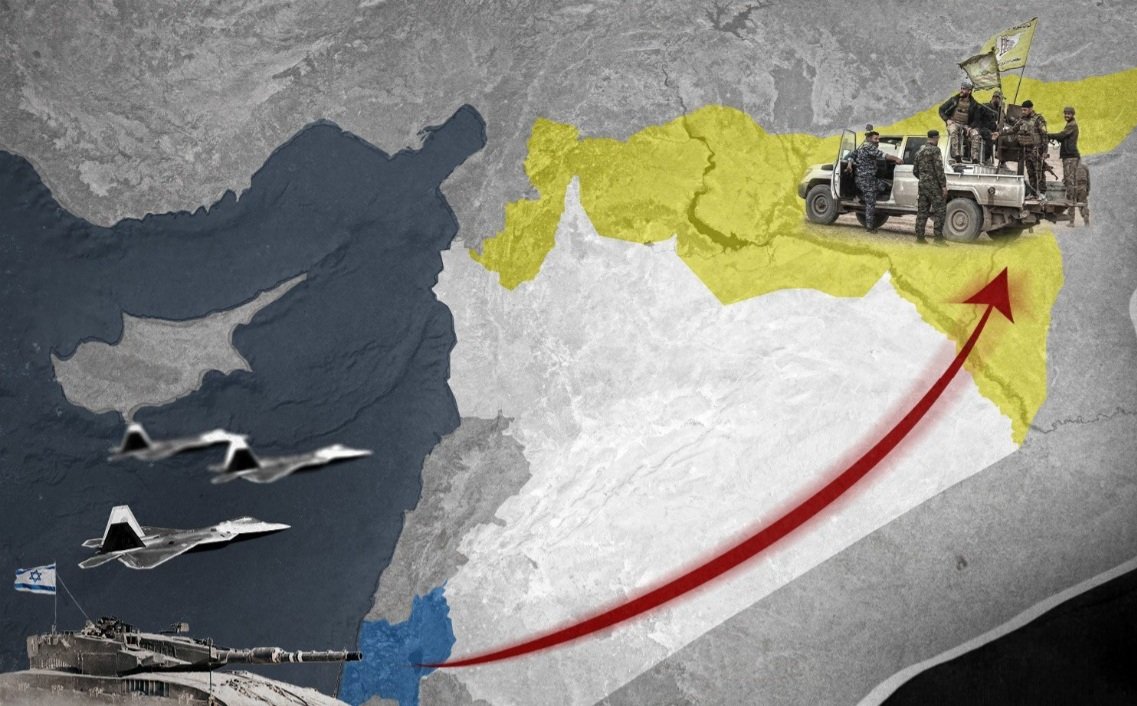
Amid the rapidly unfolding regional transformations, the strategic projects of the Israeli occupation entity are emerging as instruments for reshaping the geopolitics of the Arab Levant according to an expansive security and settlement-oriented vision. Among these projects is what has come to be known as “David’s Corridor,” a quiet plan that extends beyond the borders of historical Palestine into the depths of Syria, as part of a strategic effort to encircle the Resistance Axis and redraw new sectarian and geopolitical lines of separation.
The significance and danger of this vision have become particularly apparent amid the escalating developments in Syria’s Suwayda Governorate, where the region has witnessed and continues to witness security disturbances and intermittent clashes. Although these events are framed in local terms, they form part of a broader process of geopolitical repositioning unfolding alongside the emerging Israeli project.
The connection became increasingly evident with the visit of Israeli Prime Minister Benjamin Netanyahu to Washington, where he reportedly brought with him a security agenda that included implicit U.S. approval for expanding what the Israeli occupation entity describes as its “security depth,” whether in Lebanon or Syria, even after the change of the Syrian regime, under the pretext of confronting the Iranian threat.
These developments are not isolated from one another. Rather, they complement each other amid an Israeli effort to exploit the regional and international moment and reconstruct the surrounding environment in accordance with its security and strategic interests, under diplomatic cover from the United States and with implicit support from regional powers that are betting on the fragmentation of the Syrian central state.
Hence, the importance of examining David’s Corridor not merely as a security vision, but as part of a deeper political engineering project aimed at further dismantling the region and transforming crises into opportunities for Israeli expansion and control.
What Is David’s Corridor? From Herzl’s Dream to Modern Control Maps
David’s Corridor, or David’s Corridor, is a strategic concept attributed to Israeli political and security elites. It seeks to establish a land corridor extending from the occupied Syrian Golan Heights through the southern Syrian governorates of Quneitra, Daraa, and Suwayda, reaching the Syrian desert and ultimately the Al-Tanf border crossing at the Syria-Iraq-Jordan tri-border area.
In the new phase following the fall of the previous regime in Damascus, the Israeli occupation entity is exploiting institutional disorder and territorial divisions to establish a deep foothold in southern Syria, in a project that goes beyond conventional security considerations to encompass the reshaping of the regional order.
The concept draws its roots from the literature of the Zionist movement, particularly the ideas of Theodor Herzl, who discussed the importance of establishing an extended sphere of influence from the sea toward strategically important inland areas as part of the vision of Greater Israel.
The corridor can therefore be interpreted as a practical continuation of the principle of geographic security control and the achievement of a form of defensive depth beyond the borders of historical Palestine. This vision has been supported by studies from Israeli research centers such as the Jerusalem Center for Public Affairs and the Begin–Sadat Center, which have argued that instability in Syria represents a historic opportunity to reshape regional balances.
The project is no longer aimed solely at containing Iranian or resistance influence, as was previously promoted. Rather, it increasingly reflects an Israeli desire to fill the political and administrative vacuum resulting from the absence of a centralized state in Syria.
It relies on emerging relationships with local forces and seeks to create a contiguous security-political sphere of influence linked to the U.S. base at Al-Tanf in the east and the Golan Heights in the west.
The corridor passes through areas characterized by considerable sectarian diversity, making it an instrument for reshaping internal divisions and strengthening indirect control through the support of local networks of influence. Its implementation also depends on the worsening economic and service-sector collapse in these areas, potentially pushing local populations toward dependence on foreign actors under the slogans of protection, support, and development.
The corridor is therefore presented as one of the instruments for fragmenting Syria’s territorial unity through policies of geographic isolation and selective connectivity. It is associated with alliances with emerging local actors within a new post-regime Syrian landscape, where the Israeli occupation entity seeks to exploit geopolitical opportunities and expand its sphere of influence behind the scenes.
Strategic Objectives of the Project
The David’s Corridor project represents one of the most prominent manifestations of the Israeli security and political doctrine based on the principles of “dismantling the adversary from within” and “expanding the strategic security belt beyond the borders.”
The project cannot be separated from the broader Israeli vision of the Middle East after more than a decade of wars and instability that have weakened the structure of nation-states in the Arab Levant.
The project’s strategic objectives can be summarized as follows:
1. Dismantling the Syrian State and Ending Political Centralization in Damascus
One of the principal objectives of the Israeli project is to undermine the currently weakened authority of the Syrian central state and prevent its reconstitution by applying security, demographic, and economic pressure to the state’s peripheries.
The extension of the corridor through southern Syria toward the east seeks to create a “geographic and demographic vacuum” between Damascus and its southern and eastern borders, thereby weakening the ability of the Syrian authorities to control developments in those areas.
This form of fragmentation would not necessarily take place through direct occupation, but rather through the encouragement of sectarian conflicts and the creation of de facto authorities linked to external actors.
2. Establishing an Advanced Israeli-American Security Corridor
David’s Corridor would allow the Israeli occupation entity to exercise direct or indirect control over a vast area extending from the Golan Heights to Al-Tanf.
This would create a “security buffer” protecting the northern borders of the Israeli occupation entity and establishing an advanced defensive belt against any movements by Iran or its allies in Syria and Lebanon.
The corridor’s proximity to the U.S. bases at Al-Tanf, together with the presence of the Kurdish-led Syrian Democratic Forces in northeastern Syria, links a network of security interests between Washington and Tel Aviv.
This would enable the Israeli occupation entity to participate in managing the future Syrian landscape without bearing the full cost of direct involvement.
3. Advancing Elements of the Greater Israel Vision
The project is not exclusively security-oriented. It also contains an ideological dimension consistent with the biblical vision of Greater Israel, extending from the Nile to the Euphrates.
Within this framework, control over a geographic corridor linking the Golan Heights to the Syrian desert and then toward the Euphrates is viewed as a geostrategic prelude to expanding influence eastward.
Controlling this corridor—or at least ensuring its neutralization—would contribute to severing what remains of the geographic axis linking Iran, Iraq, Syria, and Lebanon, thereby serving the interests associated with the Greater Israel vision through fragmentation mechanisms rather than necessarily through direct military action.
4. Reshaping the Ethnic and Sectarian Map of Southern Syria
The project relies on encouraging separatist tendencies or demands for autonomy among local communities, such as the Druze in Suwayda and the Kurds in northeastern Syria.
Israeli security circles have reportedly considered the possibility of supporting these communities financially, logistically, or politically in exchange for separating their territories from the authority of a weakened Damascus.
Such a development could create an “arc of fragile entities” dependent on external support and more willing to establish future security and economic understandings with Tel Aviv.
5. Containing and Landlocking Iranian Influence
Through David’s Corridor, the Israeli occupation entity seeks to tighten the encirclement of Iranian and Hezbollah supply lines running through Iraq and Syria, even after the fall of the previous regime, particularly those reaching southern Lebanon through the Bekaa Valley.
The project’s broader objective is therefore to deprive the Resistance Axis of logistical freedom of movement and establish “geographic ambushes” along the routes extending from Tehran to Beirut.
6. Creating a New De Facto Order That Institutionalizes Syrian Fragmentation
Completing David’s Corridor would mean consolidating a new map of Syria divided among three principal forces:
- Areas under the authority of the Syrian state;
- Areas under Kurdish-American influence;
- Areas subject to undeclared Israeli security and intelligence influence.
Under such an arrangement, southern Syria would become almost isolated from Damascus, institutionalizing de facto separation and weakening the prospects for preserving Syrian state unity in the future.
Practical Steps on the Ground
David’s Corridor is no longer merely a geopolitical concept or a theoretical proposition within Israeli national-security literature. According to the report, it has moved toward practical implementation through a series of carefully planned steps being gradually carried out on the ground, either directly by the Israeli military or indirectly through local allies and international powers whose interests intersect with the project.
The practical steps can be summarized as follows:
1. Ground Incursions into Southern Syria
Recent years have witnessed a notable increase in Israeli incursions across southern Syria, particularly around Quneitra and western Daraa.
Periodic reports issued by the United Nations Disengagement Observer Force (UNDOF) have documented what they described as “serious violations” of the ceasefire line established under the 1974 agreement. These have reportedly included the installation of surveillance devices, construction of permanent observation posts, and deployment of drones conducting continuous intelligence missions up to 20 kilometers inside Syrian territory.
There have also been reports of Israeli foot patrols and vehicles operating in demilitarized areas. This suggests, according to the report, a security plan that goes beyond conventional defensive deterrence toward establishing a stable security sphere of influence on the ground.
These movements are not aimed solely at securing the border. Rather, they seek to establish an advanced security depth that could subsequently serve as the foundation for a permanent land corridor or a functional buffer zone operating under informal Israeli influence.
2. Inciting the Druze Community and Reproducing the Sectarian Landscape
Following the fall of the previous Syrian regime, Israeli statements repeatedly claimed concern for the “safety of the Druze community” in Suwayda Governorate, particularly whenever the possibility was raised that the new Syrian army and allied armed groups might enter areas outside the control of the new state, as indicated by Syria’s new leaders.
These statements, issued at the highest political and security levels in Tel Aviv, were widely interpreted as an attempt to encourage the Druze to oppose the new Syrian state and transform them into a local balancing force serving a broader partition-oriented vision.
These statements were accompanied by media reports suggesting indirect contacts through intermediaries and undeclared support for certain armed factions in Jabal al-Arab.
This contributed to tensions between Suwayda and Damascus before clashes erupted between the two sides, as signs of a breakdown in the relationship became increasingly visible amid political tensions, deteriorating economic conditions, and growing insecurity.
The report further argues that armed factions outside the authority of the new Damascus government had expressed their intention to enter Suwayda and other predominantly Druze areas, issuing threats reminiscent of what occurred against the Alawites in the coastal region and elsewhere.
According to the report, this did in fact occur, with these armed factions engaging in killings, arson, and captivity, which the report states continue to the present day amid the weakness of the new Syrian state and its limited ability to control the security situation or hold perpetrators and lawbreakers accountable, despite transitional President Ahmed al-Sharaa having repeatedly pledged to do so in several speeches and statements.
Through this process, the Israeli occupation entity seeks to reshape the sectarian landscape of southern Syria by using the Druze as a “buffer belt” separating them from the central state, in a manner comparable to the use of Kurdish forces in northeastern Syria.
3. A Strategic Alliance with Kurdish Forces in Northeastern Syria
The relationship between the Israeli occupation entity and certain Kurdish leaders is not new. What has changed in recent years, however, is the increasing openness of statements and symbolic support, as well as proposals for future commercial cooperation.
Israeli officials have expressed appreciation on several occasions, through official and semi-official articles and analyses, for the role played by the Kurds in “maintaining regional balance” and “countering Iranian influence.”
Documents have also reportedly been leaked suggesting proposals for opening trade routes, potentially through third parties, between the autonomous administration areas in Hasakah and Deir ez-Zor on one side and areas under Israeli influence through the Syrian desert on the other.
According to the report, the objective is to transform the corridor from a military-security entity into a logistical-economic corridor linking the Kurdish-American northeast with the Israeli-American southeast.
This would form part of a strategic encirclement project designed to prevent the emergence of a strong centralized Syrian state, choke off Iranian supply lines supporting the resistance in Lebanon even after the fall of the Syrian regime, and create a network of local allies possessing a minimum level of economic viability without depending on Damascus.
Challenges and Criticism
Despite the apparent long-term strategic ambitions of David’s Corridor, its implementation faces a broad range of structural challenges and geopolitical objections that could turn the project into a strategic burden rather than a battlefield gain for the Israeli occupation entity.
These challenges range from direct regional opposition and complex international pressures to internal obstacles that could undermine the sustainability of any territorial gains.
1. Turkish Opposition: A Red Line Not to Be Underestimated
Turkey views the project as a direct threat to its national security, particularly if it is accompanied by Kurdish expansion in Syria backed by the United States or the Israeli occupation entity.
Ankara considers that any geographic connection between southern Syria—Suwayda and Al-Tanf—and the Kurdish northeast would create a hostile buffer zone separating Turkey from its Arab strategic depth and granting the Kurds unprecedented influence.
Turkish diplomatic sources have repeatedly warned that “any new drawing of influence boundaries in southern Syria without consultation with Ankara will face a direct response.”
This has been interpreted as a possible signal of direct Turkish military intervention through the desert front lines or indirect targeting of the Syrian Democratic Forces and Israeli allies.
2. Financial Realities and Domestic Pressures within the Israeli Occupation Entity
The Israeli occupation entity is facing a deep economic crisis amid the continuation of the Gaza war, reflected in recession indicators, unemployment rates, rising living costs, and the heavy burden of a wartime economy.
The war economy has consumed state resources, particularly in military production and compensation, while investor confidence has also declined.
Implementing a major project such as David’s Corridor would require enormous logistical and security financing, including infrastructure, logistical support for local factions, and the costs of controlling areas characterized by hostility.
Under these circumstances, the question becomes increasingly important: Can the Israeli occupation entity bear the cost of a long-term, multi-front project while Israeli society is experiencing sharp political divisions and declining confidence in the government?
These pressures could turn the project into a domestic burden and push the Israeli political elite to reconsider its priorities within the post-Gaza agenda.
3. Expected Internal Resistance and a Logistical Crisis
The Israeli occupation entity does not possess an international or local mandate to redraw the boundaries of control in southern Syria.
Any practical incursion into these areas would sooner or later encounter popular and armed resistance from local forces that regard Israeli intervention as a direct threat to their identity and interests.
The difficult geography—mountains, desert, and rugged roads—could also make the project a potential logistical disaster, particularly if supply lines were disrupted or attacked by resistance factions.
Furthermore, reliance on certain local forces—Druze, Kurds, and tribes resembling the Sahwa forces in Iraq—does not guarantee permanent loyalty, particularly given the complexity of the sectarian and tribal landscape.
This reality could produce what geopolitical literature describes as “strategic attrition,” whereby the cost of maintaining territorial gains becomes far greater than the cost of acquiring them.
Future Prospects of the Project
Despite the structural challenges confronting the implementation of David’s Corridor, certain Israeli and Western decision-making circles reportedly view the project as an instrument that could be employed at a later stage if regional tensions ease or geopolitical balances in the Middle East are redrawn.
The project’s future prospects can be divided into several possible trajectories:
1. Transforming the Corridor into Enclaves of Influence under U.S.-Israeli Cover
Given the presence of the U.S. military base in the Al-Tanf area at the Syria-Iraq-Jordan tri-border point, the project could potentially evolve into a network of geographically connected “security enclaves” operating under indirect protection from the Israeli occupation entity and the United States.
These enclaves could include areas of Suwayda, Daraa, and Quneitra. They could be administered through local Druze, tribal, or even civilian fronts while operating under an Israeli-American intelligence and security umbrella.
The objective of this model would be to achieve strategic depth without formally declaring direct control, allowing the Israeli occupation entity greater room for maneuver without directly colliding with international law or provoking severe international and regional reactions.
2. Controlling Trade Nodes and Economic Influence over Jordan and Iraq
Given its geographic location, the corridor could constitute a land artery directly connecting the Israeli occupation entity with the Jordanian and Iraqi markets, particularly if the project were subsequently supported by an internationally sponsored secure commercial corridor.
Such a scenario could open the door to “alternative regional integration” projects outside the framework of the official Syrian state.
This could weaken the central government in Damascus and redirect trade, energy, and transportation through new routes controlled by Tel Aviv.
The corridor could also eventually be transformed into a logistical platform for expanding trade with the Gulf through routes intersecting with the India–Middle East–Europe Economic Corridor, which is supported by Washington.
3. Reshaping Demographic Maps
According to certain perspectives cited by the report, the Israeli occupation entity could seek to gradually alter the demographic reality in areas through which the corridor passes, whether by encouraging mass displacement or forced displacement, supporting sectarian-national entities, or promoting economic settlement that creates new facts on the ground.
Potentially targeted areas include:
- Afrin: As a Kurdish area rich in water and natural resources.
- Raqqa: Because of its important location at the intersection between the eastern Euphrates region and the northern Syrian desert.
- The vicinity of Suwayda: To exploit its Druze particularity in creating a model of “decentralized independence” or even a “directed federal model.”
This transformation would not necessarily be direct. Instead, local actors could be structured and empowered to carry out the process through development and service projects that appear local in nature but serve the broader Israeli vision.
4. Regional and International Interaction: Normalization as a Geopolitical Lever
The long-term success of the project would depend on the extent of Gulf engagement in normalization with the Israeli occupation entity.
The broader the scope of normalization—whether with Saudi Arabia or through renewed engagement with the United Arab Emirates and Bahrain—the more likely projects such as David’s Corridor would become part of a broader process of “Middle East re-engineering.”
Egypt, by virtue of its borders with the Israeli occupation entity and Jordan, could also become a party to any regional arrangement that legitimizes or turns a blind eye to Israeli expansion into the Syrian interior.
This interaction would also need to be accompanied by an implicit understanding with the United States, whether concerning management of the Syrian issue or within the framework of regional energy and trade projects.
Conclusion
David’s Corridor cannot be viewed merely as a temporary security initiative or a passing episode of territorial expansion. Rather, it represents, according to the report, an advanced manifestation of a complex Israeli geopolitical doctrine combining military, ideological, and strategic dimensions.
It intersects with three principal themes that collectively constitute a core element of Israeli strategic thinking in the post-Arab Spring era:
The Military-Geographic and Settlement-Oriented Mindset
The idea of the corridor reflects the Israeli occupation entity’s continued adherence to the “defensive depth doctrine,” which holds that security can only be achieved by possessing a geographic space broader than its internationally recognized borders.
This helps explain its continuing efforts to expand into Syrian territory, particularly in the southeast, and to create buffer zones either through direct military presence or alliances with supportive local groups.
The Expansionist Vision of Greater Israel
The project forms part of a biblical-ideological narrative asserting that the natural boundaries of the Israeli occupation entity should extend “from the Nile to the Euphrates,” as repeatedly expressed by Zionist leaders, including Benjamin Netanyahu in his book A Place Among the Nations.
This project does not necessarily imply direct occupation. Rather, it involves indirect control over key geographic points, crossings, and borders through modern instruments encompassing security, economics, technology, and demographic alliances.
Exploiting the Post-Syrian-War Chaos to Reconstruct Maps
Decision-makers in Tel Aviv recognize that what has occurred in Syria since 2011 has created unprecedented opportunities to redraw the country’s geopolitical landscape.
David’s Corridor therefore represents, according to the report, a step toward preventing the emergence of a “centralized Syrian state,” or toward dismantling the state’s central structure if it exists, and transforming Syria into weak cantons susceptible to external influence, while strengthening local forces aligned with the Israeli or Western orbit.
In this context, the project should not be measured solely by its immediate outcomes, but by its ability to gradually impose new realities in geography, demography, and sovereignty.
Despite the major challenges it faces—including fierce Turkish opposition, Russian caution, and high financial costs—David’s Corridor could constitute a decisive turning point in the new geopolitical engineering of the region.
It represents an instrument for reshaping influence maps across the Arab Levant, extending beyond the Syrian conflict itself into Iraq and Jordan, and potentially the Gulf, through security and economic networks managed behind the scenes.
More dangerously, it could become a replicable model in other areas experiencing similar fragility, thereby threatening the territorial and political unity of the Arab world as a whole.
Source: Hammurabi Center for Research and Strategic Studies
Most read


Read also