
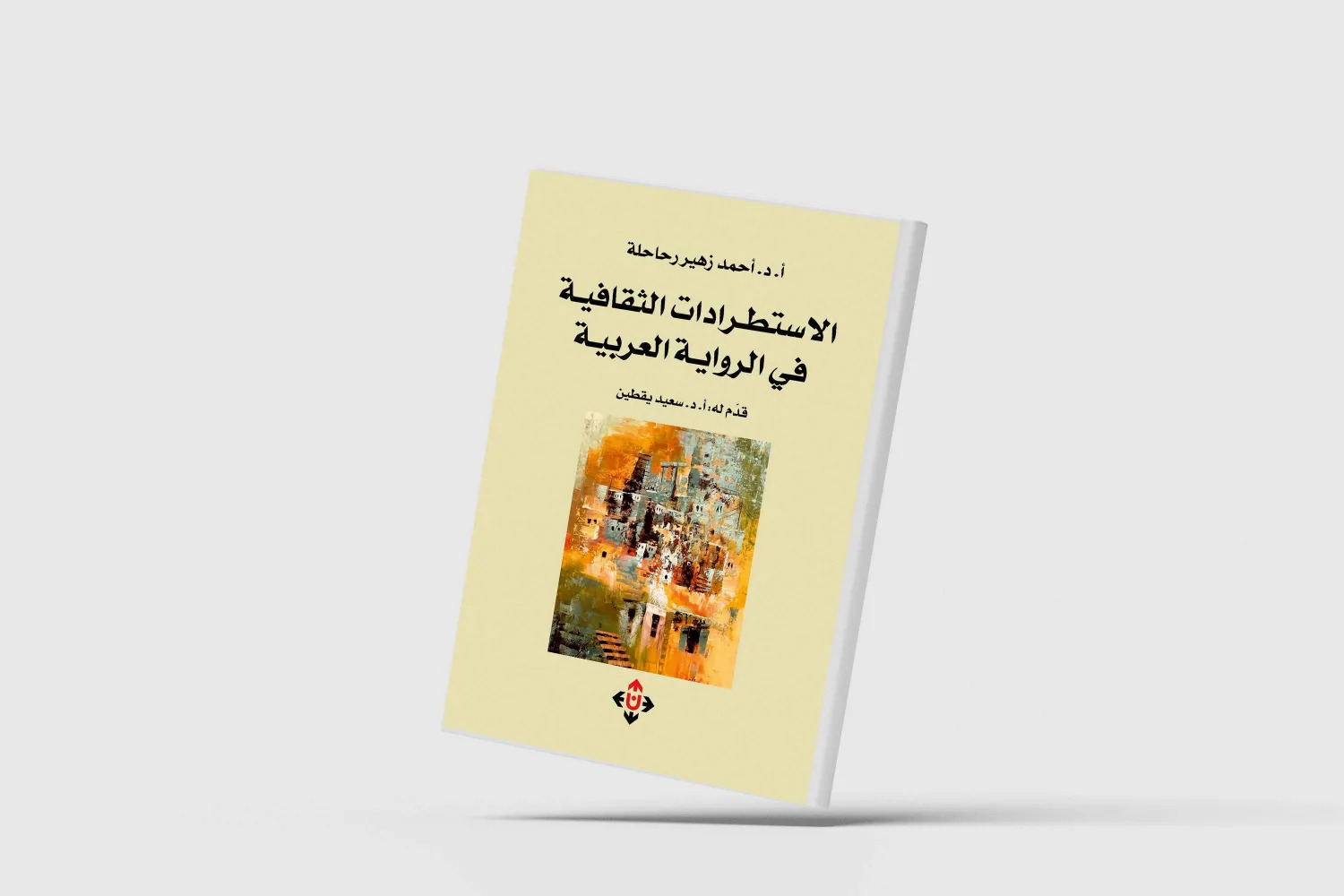
The book Cultural Digressions in the Arabic Novel, by Jordanian researcher and academic Dr. Ahmad Zuhair Rahahleh, offers a new approach to the criticism of the Arabic novel by focusing on a stylistic and narrative dimension that has received relatively little attention in independent studies. In doing so, it opens the way for new readings concerned not only with what the novel says, but also with how it says it, and with the ways in which its relationship with the reader, culture, and the text itself is shaped.
In his introduction to the book, published by Alaan Publishers and Distributors in Jordan in 2026, Moroccan critic and academic Dr. Said Yaktine observes that Rahahleh has distinguished himself through his examination of developments in the Arabic novel since the beginning of the new millennium, particularly its increasing abundance of cultural digressions and displays of erudition.
Yaktine notes that the book proceeds from a precise conception of the novel, examining what may be excessive or superfluous within it and what may fail to serve the fictional text in a manner appropriate to its artistic integrity — one that makes it worthy of reading without unnecessary digressions or excessive displays of knowledge.
According to Yaktine, the study’s distinctive quality lies in its ability to move beyond readings that focus primarily on the intellectual or cultural content associated with the novel. Instead, it examines how such elements function within the text and the extent to which they contribute to the construction and aesthetics of the fictional work.
He also points out that, in pursuing his objectives, the researcher draws on structural analysis of narrative as well as reception aesthetics. The study thus emerges as a “narrative-stylistic” approach that could provide a useful entry point for advancing the understanding and analysis of narrative through the stylistic techniques employed by fictional texts.
Rahahleh’s book proceeds from the view that the novel is a literary genre inherently open to experimentation and transformation. Yet its freedom to absorb a wide range of discourses and fields of knowledge does not eliminate the need for artistic awareness. The success of any narrative technique depends on its ability to perform a meaningful function within the creative work, rather than merely on its presence or abundance.
The book investigates the phenomenon of “cultural digressions,” which has become increasingly evident in some contemporary Arabic novels. Writers may incorporate a variety of intellectual and cultural subjects — including history, philosophy, the arts, sciences, and broader ideas — into the fabric of the novel.
At the heart of the study lies a fundamental question: When does this cultural presence become an artistic contribution to the text, and when does it turn into an excess that distracts the reader and weakens the narrative flow?
The book consists of three main chapters combining theoretical and applied approaches.
The first chapter, titled “Cultural Digressions in the Arabic Novel: Theoretical Framework,” lays the conceptual foundations of the study by examining the notion of cultural digression, tracing its origins, and reviewing the critical approaches through which it has been understood.
The chapter is divided into three sections. The first, “Cultural Digressions: Foundation and Conceptual Grounding,” examines the concept of the phenomenon, traces its emergence in the novel, and explores both its positive and negative dimensions, ultimately arriving at a definition of “cultural digression in the novel.”
The second section, “Between Cultural Digressions and Generic Interpenetration,” explores the relationship between the incorporation of different genres and discourses into the novel, on the one hand, and the phenomenon of cultural digression, on the other. It clarifies the similarities and differences between the two concepts and examines their impact on the formation and structure of the fictional work.
The first chapter concludes with a section titled “Between Cultural Digressions and Intertextuality,” in which the book examines the relationship between intertextuality and cultural digression. It investigates how earlier texts and discourses are incorporated into the novel and the extent to which this practice affects the construction of the narrative.
The second chapter moves from theory to application under the title “Cultural Digressions in the Arabic Novel: Applied Framework.” Here, the researcher analyzes selected novels in order to identify different levels and modes in which cultural digressions are employed.
This chapter is divided into two sections. The first, “Cultural Digressions as a Narrative Structure: Representative Models,” focuses on works that have successfully integrated knowledge into the narrative in ways that serve the novel’s artistic construction.
The second section, “Cultural Digressions as Intellectual Ornamentation,” examines cases in which knowledge becomes excessive or detached from the actual needs of the text, turning into a burden on the narrative rather than an integral part of its aesthetics.
The third and final chapter is devoted to examining the relationship between cultural digressions and the various participants in the creative process. Titled “Cultural Digressions and the Participants in the Creative Process: Analysis and Synthesis,” it explores the relationship between cultural digression and the writer’s intellectual background, as well as the writer’s role in directing and integrating these elements within the novel.
The chapter also investigates the relationship between cultural digressions and the reader’s cultural background, particularly the reader’s ability to engage with texts carrying a substantial intellectual and cultural load.
It concludes with a section titled “Cultural Digressions and the Text,” which discusses the extent and forms of cultural presence in the Arabic novel since the beginning of the new millennium, and how this presence relates to transformations in novelistic writing and the evolving tastes and expectations of readers.
Source: Asharq Al-Awsat
Most read