China’s Nuclear Ambiguity: How Beijing Is Redefining the Global Balance of Deterrence

China’s accelerating expansion of its nuclear capabilities is no longer merely a question of warhead numbers or arsenal size. Rather, it has become one of the clearest indicators of the profound transformation unfolding within the international system as it shifts from a unipolar order toward an increasingly multipolar one. For decades, Beijing cultivated the image of a restrained nuclear power, emphasizing a doctrine of minimum deterrence and portraying its nuclear arsenal as a purely defensive instrument. Today, however, China appears to be quietly reshaping its strategic doctrine in line with its emergence as a global power determined to challenge the United States for long-term influence over the international order.
Although Chinese officials continue to insist that the country's nuclear policy remains unchanged and that Beijing remains firmly committed to its long-standing No First Use (NFU) doctrine, developments on the ground suggest a more complex reality. The rapid construction of missile silo fields, the steady expansion of China's nuclear warhead inventory, the completion of a fully operational nuclear triad, and increasingly sophisticated long-range missile demonstrations all point to a strategic transition from symbolic deterrence toward a comprehensive and survivable nuclear posture capable of sustaining prolonged strategic competition with the United States.
This evolution cannot be understood in isolation from China's deteriorating security environment. Intensifying strategic rivalry with Washington, persistent tensions over Taiwan, disputes in the South China Sea, and the growing American military presence across the Indo-Pacific have fundamentally altered Beijing's threat perceptions. From the perspective of Chinese policymakers, a relatively modest nuclear arsenal is no longer sufficient to guarantee credible deterrence, particularly as the United States continues to advance missile defense systems and long-range precision strike capabilities that could threaten China's strategic forces during the opening stages of a conflict.
Against this backdrop, China's massive investment in new missile silo complexes should be viewed as part of a broader effort to strengthen its second-strike capability—the ability to absorb a nuclear attack while retaining sufficient retaliatory power to inflict unacceptable damage on an adversary. This capability constitutes the cornerstone of strategic nuclear deterrence because it eliminates any incentive for an opponent to launch a preemptive strike by ensuring that such an attack could never eliminate the prospect of devastating retaliation.
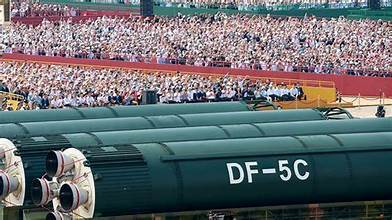
What makes China's nuclear strategy particularly distinctive, however, is its simultaneous reliance on strategic ambiguity and carefully calibrated signaling. On one hand, Beijing refuses to disclose the true size of its nuclear arsenal or reveal the long-term trajectory of its modernization program, routinely dismissing Western estimates as politically motivated speculation. On the other hand, it has become increasingly willing to showcase elements of its strategic capabilities whenever geopolitical circumstances demand it. The launch of an intercontinental ballistic missile over the Pacific Ocean and the public unveiling of China's fully developed nuclear triad during a major military parade were not merely displays of military technology; they were carefully crafted political messages directed at Washington and its allies, signaling that China now possesses the strategic tools necessary to sustain long-term great-power competition.
In this context, China's declared nuclear doctrine appears considerably more sophisticated than official statements alone might suggest. The No First Use policy does not necessarily imply strategic passivity. Rather, it provides Beijing with significant diplomatic and moral legitimacy while allowing it to continue strengthening the military capabilities required to make such a pledge credible. Ultimately, nuclear deterrence is defined not by declaratory policy but by a state's ability to convince potential adversaries that it will retain the capacity to retaliate under virtually any circumstances.
This strategic logic also explains China's consistent refusal to participate in trilateral nuclear arms control negotiations alongside the United States and Russia. From Beijing's perspective, the numerical disparity between China's arsenal and those of Washington and Moscow remains so substantial that any agreement imposing equal restrictions on all three powers would merely institutionalize American and Russian nuclear superiority rather than promote strategic stability. Consequently, Chinese officials continue to argue that the primary responsibility for meaningful nuclear reductions rests with the two countries that still possess the overwhelming majority of the world's nuclear weapons.
Washington interprets these developments rather differently. American strategic assessments increasingly view China's nuclear modernization as extending well beyond defensive requirements. Instead, it is seen as an integral component of Beijing's broader ambition to reshape the global distribution of power. A larger and more resilient nuclear arsenal would provide China with greater strategic freedom in regional crises—particularly over Taiwan and the South China Sea—while diminishing the credibility of conventional American deterrence and significantly increasing the military and political costs of any future U.S. intervention in East Asia.
Consequently, the central issue is no longer the absolute number of nuclear warheads China possesses, but the broader strategic environment Beijing seeks to create. Chinese leaders appear to recognize that competition with the United States will not be decided through a single military confrontation, but through a prolonged contest encompassing economic strength, technological innovation, geopolitical influence, industrial resilience, and military power. Within this framework, nuclear capabilities serve as a strategic insurance policy, protecting China's broader national power while granting policymakers greater confidence to pursue regional objectives without excessive concern over American military coercion.
At the same time, China's nuclear policy reveals a striking paradox. While Beijing continues to reassure the international community by emphasizing defensive deterrence and adherence to the No First Use principle, it is simultaneously constructing a nuclear infrastructure that increasingly resembles that of the world's two largest nuclear powers. This apparent contradiction should not necessarily be interpreted as policy inconsistency. Rather, it reflects China's effort to reconcile two strategic objectives: projecting the image of a responsible global power while acquiring the military capabilities expected of a nation aspiring to shape the future international order.
Yet this trajectory also carries significant strategic risks. Every Chinese advance in nuclear modernization encourages further American investment in missile defense systems, nuclear force modernization, and military alliances throughout the Indo-Pacific. These measures, in turn, reinforce Beijing's perception of strategic encirclement, prompting additional military expansion. The result is an increasingly self-reinforcing cycle of strategic competition that bears important similarities to the Cold War arms race, while simultaneously differing from it in one crucial respect: today's two principal competitors remain deeply interconnected economically, technologically, and financially. Their rivalry extends far beyond military power to encompass artificial intelligence, semiconductor technology, space capabilities, critical supply chains, and global industrial leadership.
Ultimately, China's objective does not appear to be achieving numerical nuclear superiority over the United States in the foreseeable future. Rather, Beijing seeks to eliminate any possibility of strategic coercion while ensuring that no external power can constrain its freedom of action within its regional sphere of influence. China's nuclear expansion should therefore be understood not simply as a military modernization program but as a central pillar of a much broader project aimed at redefining the global balance of power. As strategic competition between Washington and Beijing continues to intensify, China's evolving nuclear posture is likely to become one of the defining features of the emerging international order—not because nuclear war is inevitable, but because the evolution of China's deterrence strategy is reshaping the fundamental rules governing great-power competition in the twenty-first century.
Most read