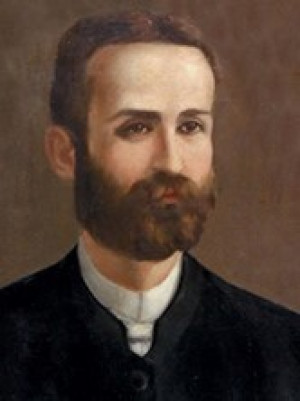


While his contemporary Victor Hugo sat enthroned at the pinnacle of French classicism as the greatest poet of the nineteenth century, Charles Baudelaire remains the true spiritual father of poetic modernity—a rebel who dared to articulate the complexities of the human psyche and dissect the anxieties of the modern age with unparalleled artistic mastery and classical precision.
From the heart of this creative contradiction, Baudelaire ignited a literary revolution that shocked both the cultural elite and society at large, boldly venturing into subjects that were considered taboo at the time, including death, decay, and the realms of the body. Through his iconic collection Les Fleurs du mal (The Flowers of Evil), the poet succeeded in fusing beauty and terror within a single crucible, drawing on Symbolist philosophy to redefine the poem, transforming it from a mere collection of verses into a kind of magical instrument for existential discovery beyond tangible reality.
Baudelaire’s genius, however, was not confined to rhyme and meter. He also distinguished himself in French literature as an exceptional prose writer whose abilities rivaled those of his poetry. He left an enduring mark through a short novel, thought-provoking personal writings, penetrating art criticism, and, above all, his influential translations of works by the American writer Edgar Allan Poe.
Despite his relatively modest poetic output, Baudelaire’s influence on subsequent generations was immense. His impact transcended the boundaries of local talent, establishing him as one of the great pivotal figures in the history of world literature.
Baudelaire left this world in Paris on August 31, 1867, at the age of 46, leaving behind a scattered literary legacy. Most of his writings remained unpublished, while those that had been published had completely disappeared from the market. Yet, at the dawn of the twentieth century, his works rose from the ashes of oblivion, and he was eventually crowned one of the greatest literary figures in the history of France.
From this obscure legacy, which came to light only after his death, emerged rare masterpieces that transformed the face of literature. Foremost among them was his extraordinary prose-poetry collection Le Spleen de Paris (Paris Spleen), whose secrets and enchantment we explore in the following lines.
Baudelaire’s life was little more than a sequence of tragic dramas whose chapters began almost at birth. In 1819, his sixty-year-old father, François Baudelaire, married the twenty-year-old Caroline Dufaÿ, and their only child, Charles, was born in Paris on April 9, 1821. His father died when Charles was only six, setting in motion a series of profound crises that would alter the course of his life. At the age of twenty-one, he inherited a considerable fortune, which he quickly squandered. This prompted his family to impose a legal guardianship over his finances, effectively restricting his financial freedom for the remainder of his life.
The psychological divide deepened when his mother married the strict military officer Jacques Aupick, a man toward whom the poet developed a deep hostility. Out of this financial and familial alienation emerged some of the finest poems in the history of the French language.
Although the spark of poetry had already appeared in Baudelaire’s eyes during his secondary-school years, his public emergence was significantly delayed by his wandering through various pursuits and complicated romantic relationships. In the early 1850s, he became involved in a turbulent and enduring relationship with his mistress Jeanne Duval, followed by his second muse, Marie Daubrun, who inspired his famous romantic trilogy.
Meanwhile, the young poet was battling severe attacks of gonorrhea and syphilis—illnesses widely believed to have contributed to his eventual death—and his despair drove him to attempt suicide on June 30, 1845. Baudelaire’s passion for collecting works of art plunged him into an abyss of mounting debt, turning him into a perpetual fugitive who moved from one cheap hotel to another to escape his creditors. This gave him an intimate and bitter knowledge of the darker face of Paris and of its velvet-lined underworld, which would be reflected vividly throughout his poetry.
In the summer of 1866, Baudelaire suffered paralysis and a stroke that robbed him of his ability to speak. He eventually became incapacitated and resigned to a care home in Paris, where he spent his final year before taking his last breath on August 31, 1867, at the age of 46, leaving behind a literary legend written in the ink of pain.
After completing his literary revolution in Les Fleurs du mal in 1857, Baudelaire dreamed of creating a new kind of poetry characterized by extraordinary flexibility and capable of accommodating the contradictions of everyday life in great cities. The poet found his inspiration in Gaspard de la nuit by Aloysius Bertrand, who had drawn upon the tradition of prose ballads—a poetic form resembling the narrative mawwal in Arab literary heritage—and had been influenced by Scottish and German works translated into French.
Baudelaire, however, rather than immersing himself in the atmosphere of the Middle Ages as Bertrand had done, chose to dip his pen into the ink of contemporary Parisian reality. Over the final twelve years of his life, he composed fifty short prose poems.
Because the curse of fate pursued the poet until his final breath, Baudelaire was unable to publish the collection during his lifetime. Two years after his death, in 1869, his friends discovered the complete manuscript and did not dare alter a single word of it. The question of its title had long remained unresolved between two possibilities: Short Prose Poems and Paris Spleen. In his letters, Baudelaire usually referred to it simply as “prose poems.” The mystery was finally resolved in a letter he sent to the critic Sainte-Beuve on January 15, 1866, in which he combined the two titles: Paris Spleen – Short Prose Poems. This led the publisher to adopt the former as the principal title and the latter as the subtitle, presenting the collection as the culmination and distillation of Baudelaire’s creative project and allowing it to leave an enormous mark on the course of the global modernist movement across the centuries.
The title of the work points to the psychological meaning of the word “spleen,” signifying a profound aversion to the world. Through these texts, Baudelaire explores his views on good and evil, sin and pleasure, time and mortality, often employing a narrative and moral framework that concludes with a touch of irony.
Within these texts, his genius moves at times toward the delicate joy of a poor child playing with a mouse, and at other times toward the sorrow of widows or the suffering of men crushed beneath their monstrous obsessions, eventually reaching the consuming intensity of love. Another recurring principle is illumination: in the eyes of a woman, Baudelaire sees eternity; fairies appear before him and grant him the gift of admiration; the Devil and Eros also emerge. He writes, “This life is a hospital in which every patient is possessed by the desire to change beds.” One must leave—it does not matter where, provided that the destination lies outside the world.
In his profound dissection of the city of Paris, the poet turns his microscope toward poverty and class divisions through poems such as “The Poor’s Plaything,” “The Eyes of the Poor,” “Counterfeit Money,” and “Widows.” These works offer contrasting and often startling perspectives. While “The Poor’s Plaything” emphasizes the inevitability of equality among social classes, “The Eyes of the Poor” and “Counterfeit Money” overflow with profound human sympathy for the downtrodden.
Thus, the “poet of temptation” becomes, in the prose poem “The Spleen of Paris,” a fierce advocate for the city’s poor and a voice for those who have no voice in the noisy depths of the capital.
Reading Baudelaire’s Paris Spleen today is not merely an exercise in revisiting poems written in the nineteenth century. It is a profound recognition that the poet who longed to depart “outside the world” ultimately found his eternal immortality within every line of free prose through which he liberated the spirit of poetry from its ancient constraints.
Most read