Britain’s History Was Not Made by Men Alone

The Tudor era remains one of the most prominent periods of English history in the popular imagination. It was during this period that English nationalism took shape, the Church of England was established, and Shakespeare lived and wrote. Filled with political conflicts and transformations, the era has provided rich material for books and novels. Yet its most familiar image has remained centered on men, while women have been pushed to the margins of the story—even when they were active participants in shaping its course.
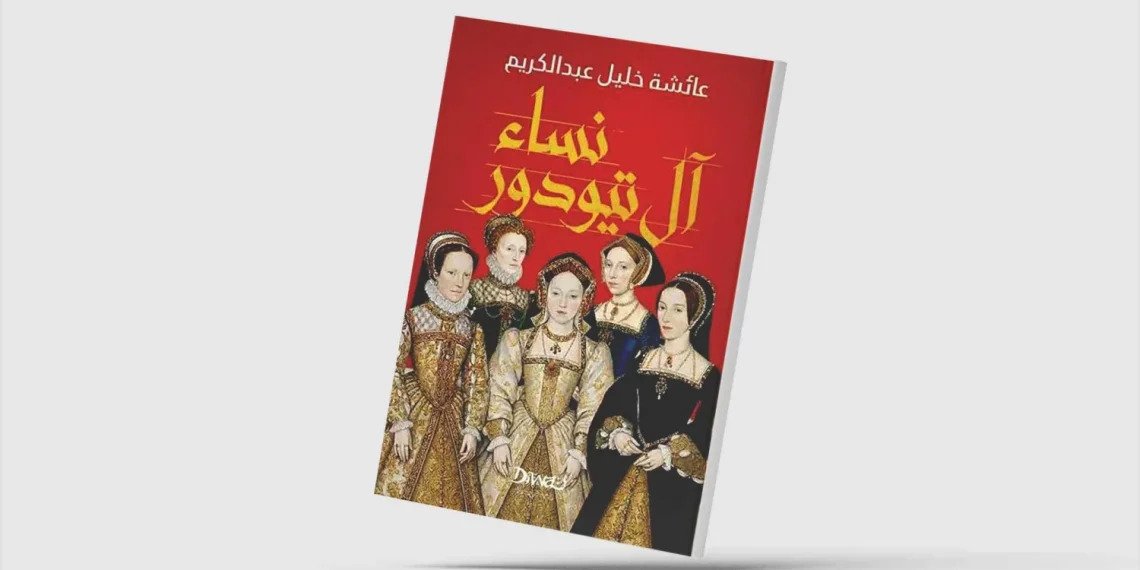
It is from this gap that writer and scholar Dr. Aisha Khalil Abdel Karim begins her book The Women of the Tudors, published by Diwan Publishing House in Cairo. She argues that it is regrettable that the voices of Tudor women have remained largely absent from narratives of the period, prompting her to propose what she describes as “a popular history of the women of the English court in the sixteenth century.”
Yet searching for women in a history written largely from the perspective of men and political power involves more than simply restoring their names to the record. Absent voices do not appear in official documents in the same way as the decisions of kings and their wars. For this reason, the author does not isolate her female subjects from the men who remained at the center of the throne. Instead, she rereads the historical context through their roles as the mothers, wives, and daughters of kings, as well as the heirs to their dynastic legacy.
From one chapter to the next, the perspective shifts, gradually revealing women who participated in creating legitimacy and preserving dynastic continuity, while also paying a heavy price for the demands of power. In this way, the book shifts the spotlight within the historical scene, revealing that the history bearing the names of kings was not made by kings alone.
The Wars of the Roses
Aisha Khalil begins her book with a personal introduction explaining her own connection to the Tudors, whom she first encountered through her studies and books before following their presence over the years in cinematic narratives and other forms of storytelling. She eventually decided to propose an alternative narrative of the period by moving away from the “celebration of men’s heroic deeds” and focusing instead on Tudor women as active agents in the turbulent historical events of the era.
To reach what she calls “the missing face of history,” Abdel Karim draws on parliamentary records, royal household archives, court documents, and diplomatic correspondence, as well as the pamphlets that proliferated with the arrival of printing in England. She also expands the concept of the historical document to include music and portraits, examining what they reveal about clothing, jewelry, and the details of everyday life.
A striking paradox runs through the structure of the book: Tudor rule began through the political efforts of a woman, Margaret Beaufort, and ended with another woman, her granddaughter Elizabeth I, the last Tudor monarch.
Henry Tudor, who became Henry VII, did not possess a particularly strong claim to the English throne. His royal blood came through his mother and through an illegitimate line of descent that was insufficient, by itself, to secure the crown. Yet his mother, Margaret, supported his accession, capitalizing on the exhaustion left by the Wars of the Roses, fought for years between the rival Houses of York and Lancaster, and transforming his weak dynastic claim into an ambitious political project.
Beaufort sought to marry her son to Elizabeth of York, the heiress of the House of York, so that the marriage would unite the rival Houses of Lancaster and York. In doing so, the author places the woman who orchestrated Henry VII’s rise at the center of the story, particularly because she helped create the alliance that gave his reign a legitimacy that his lineage alone could not provide.
Elizabeth of York, meanwhile, embodied the union of the two houses. She later became the mother of heirs, and the author moves from her political role to her relationship with her children and husband, drawing on intimate details such as the similarity between the handwriting of her son Henry VIII and her own—a resemblance that has led some historians to suggest that she may have personally taught him to write.
Birth and Dynastic Continuity
The book examines the brutal connection between childbirth, death, and dynastic survival. The queen’s body was not a private matter; the legitimacy of the throne and the future of the kingdom depended upon it. Queens were therefore expected to bear numerous children, many of whom did not survive, while the women themselves risked their lives with every pregnancy and delivery.
The author notes that roughly one in five children in that period died before reaching the age of five, while one woman in forty died in childbirth. Women therefore prepared for labor by writing wills, confessing their sins, repenting, and receiving communion. A woman entered the birthing chamber prepared to welcome her child while simultaneously confronting the possibility of her own death.
Only four of Elizabeth of York’s children survived. After the death of her son Prince Arthur, she became pregnant again, but died following the birth of her last child. Thus, childbirth became part of the architecture of political power: the death of a child or a failed pregnancy could trigger a crisis that extended beyond the palace into the political and religious spheres.
This relationship becomes even more evident in the story of Catherine of Aragon, daughter of King Ferdinand and Queen Isabella, who united Spain and brought an end to Muslim rule in Granada. Catherine received an education befitting the daughter of a powerful royal family, while her mother Isabella served as a model of a queen who ruled alongside her husband and accompanied his armies.
Catherine was betrothed in childhood to Arthur, Prince of Wales and heir to the English throne. Her connection to the Tudors helped provide the newly established dynasty with additional legitimacy and a link to an ancient royal house. After Arthur’s death, she married his younger brother, Henry VIII, and remained with him for nearly twenty years before their marriage became one of the era’s most consequential dynastic crises.
Henry wanted a male heir, and Catherine’s successive miscarriages and the loss of her children became an argument for questioning the validity of their marriage and ultimately a pretext for ending it. When the pope refused to annul the marriage, the dispute escalated into a confrontation with Rome, culminating in the English Church’s break with papal authority.
Catherine’s story demonstrates how the drama of the royal family could extend far beyond the palace. The queen’s inability to produce a surviving male heir evolved into a crisis over the legitimacy of the marriage and eventually into a religious rupture that transformed English history. Her story reveals that women and the supposedly private matters of their lives were never truly separate from politics; rather, they stood at the heart of transformations in power, religion, and dynastic succession.
If Margaret Beaufort had used her political acumen to lay the foundations of the Tudor dynasty and help her son Henry VII ascend the throne, the Tudor era ultimately came to an end with her descendant Elizabeth I, her great-granddaughter, whom the author describes as “the jewel of the Tudor dynasty.”
Elizabeth was the daughter of Henry VIII and Anne Boleyn, whom the king married amid his confrontation with the Church and his efforts to annul his marriage to Catherine of Aragon. Elizabeth received an exceptional education and became proficient in Latin, Italian, and French, in addition to English.
Most read