
Are the Heights Becoming an Alternative to an Israeli Withdrawal?

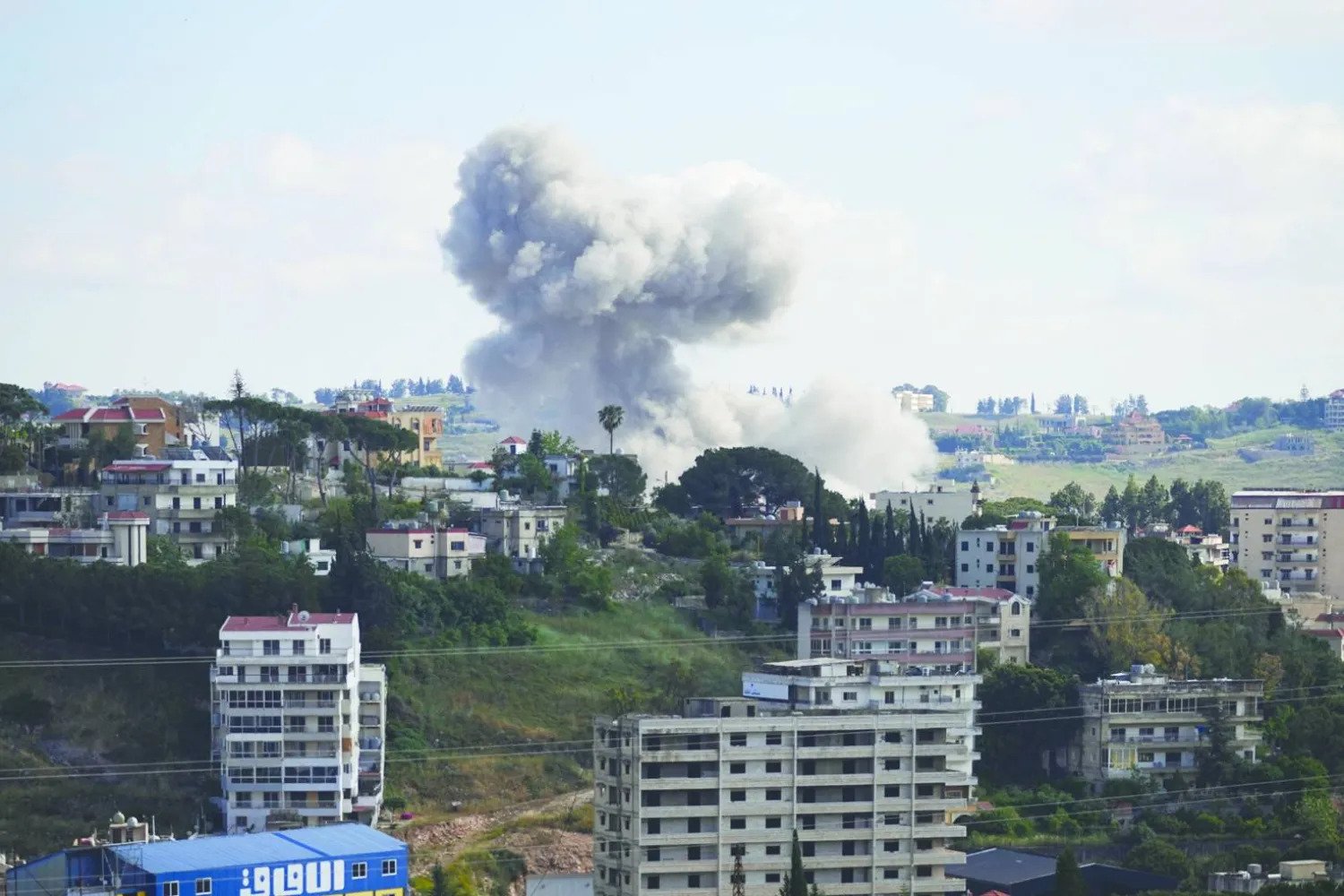
The question of an Israeli withdrawal from southern Lebanon is no longer simply about when such a withdrawal might take place or where Israeli forces might retreat. It has increasingly become a broader question concerning the nature of the geography over which Israel seeks to retain influence once military operations come to an end.
Recent developments on the ground, particularly the focus on a number of strategic heights and commanding positions in southern Lebanon, raise the possibility that Israel may be redefining the concept of a “security zone”: moving away from a contiguous geographical strip requiring a broad military deployment toward a network of elevated positions that would provide greater surveillance and fire-control capabilities while preventing Hezbollah from using those locations for military purposes.
It is important, however, to distinguish between what can be inferred from the pattern of military operations and the existence of a fully developed “Israeli doctrine.” Based on the information available in this context, there is insufficient evidence to conclude that Israel has formally announced a strategy centered on permanently controlling the heights. Nevertheless, the geographical pattern of the locations being targeted—from the Shaqif and Zawtar areas to the Ali Al-Taher heights—provides grounds for considering this possibility as an emerging operational trend.
This is precisely what makes Ali Al-Taher significant: not necessarily as conclusive evidence of an Israeli strategy, but as a test of the relationship that may develop between military geography and negotiations over an Israeli withdrawal.
From a Security Strip to Strategic Points
The difference between controlling a broad geographical strip and controlling commanding positions is fundamental in military terms.
Control of a contiguous strip requires sustained ground deployment, secure supply lines, and protection for forces spread across a relatively large area. It also entails rising military and human costs as the deployment continues.
Control of commanding positions, by contrast, follows a different logic: selecting locations whose military value is disproportionately high compared with their geographical size, allowing them to provide surveillance, oversight, and fire-control capabilities over a wider area.
Retired Brigadier General Said Qazah explains that the objective that emerged with Israel’s announcement of the “Yellow Line” was to secure the commanding heights opposite Israeli settlements. In his assessment, the line extends from Al-Bayyada in the western sector, through Rashaf, Beit Lif, and Hadatha north of Bint Jbeil in the central sector, and eastward toward Deir Siriane and Al-Taybeh, eventually reaching the eastern slopes of Mount Hermon, particularly in the direction of Ain Ata and Ain Qiniya.
According to this assessment, these positions are approximately 8 to 10 kilometers from Israeli settlements, giving them potential significance in limiting Hezbollah’s ability to use such areas to launch fire toward Israeli communities.
From this perspective, the Israeli advance toward eastern and western Zawtar and the Shaqif heights, followed by the movement toward Ali Al-Taher, can be interpreted as an attempt to secure locations of high military value rather than necessarily seeking to occupy a large swath of Lebanese territory.
Why Is Ali Al-Taher Particularly Important?
The importance of elevated terrain does not derive simply from its altitude, but from the military functions it can provide.
According to the information presented in the report, the Ali Al-Taher heights occupy a position overlooking Nabatieh and areas toward Iqlim al-Tuffah. This gives them significance within systems of surveillance and fire control, while also making them relevant to any effort to prevent Hezbollah from using the heights for military purposes.
Retired Major General Dr. Abdel Rahman Shehitleh argues that the Israeli focus on Ali Al-Taher, Al-Dabsha, and other elevated positions is linked to their commanding locations and their proximity to the area and northern Israel. In his assessment, such positions can facilitate surveillance and the use of direct-fire weapons and missiles toward northern Israel and Israeli settlements. They may also serve as support and reinforcement points and as operational command positions.
The heights thus become more than geographical features. They become military nodes—positions whose strategic value extends beyond the area they physically occupy to their ability to influence the surrounding operational environment.
This is what makes the battle for the heights fundamentally different from a conventional struggle for territorial control.
The Heights Are Not Necessarily Permanent Military Positions
At the same time, assuming that control of the heights necessarily means establishing permanent Israeli military positions on their summits would oversimplify the issue.
Major General Shehitleh points out that the highest geographical point is not necessarily the most suitable location for troop deployment. A summit may be used for observation, while defensive positions are often located below the crest and along its sides.
This observation is important when considering what a “belt of heights” might mean if the concept evolves from an analytical hypothesis into an established operational reality.
Such a belt would not necessarily consist of a continuous line of peaks occupied by Israeli forces. Rather, it could represent a network of commanding positions and strategic points designed to achieve several objectives: monitoring movements, enhancing the ability to respond with fire, preventing Hezbollah from using certain positions, and preserving Israel’s capacity to influence the area close to its border.
From this perspective, the issue may be less about “occupying the heights” in the traditional sense and more about controlling the military functions those heights provide.
The Human Cost of a Ground Operation
This approach, however, does not eliminate Israel’s central dilemma: direct ground control of these positions carries significant costs.
The commanding heights are not simply locations on a map. Reaching and securing them requires military operations and may entail clashes with armed forces and groups operating in the area.
Shehitleh notes that Israel may be using the available time to prepare for any potential operation and that negotiations could provide additional time for military preparations. At the same time, he identifies the potential human cost of a major ground operation as one of the principal difficulties facing Israel.
This reveals a central paradox in Israel’s calculations: the greater the importance of direct territorial control, the greater the cost required to maintain it.
The more attractive military option may therefore be a combination of political pressure, aerial and fire-based surveillance, and limited control of selected positions considered particularly important, rather than maintaining a broad ground deployment.
The effectiveness of such an approach, however, would depend on whether Israel could actually prevent the military reuse of these positions without maintaining a permanent ground presence.
Why Is 2026 Different from 2000 and 2006?
The current withdrawal dilemma cannot be understood without considering the experiences of 2000 and 2006. Yet invoking these precedents does not mean that history is simply repeating itself.
On May 25, 2000, Israel withdrew from southern Lebanon after roughly 22 years of occupation, without a bilateral agreement with the Lebanese government. According to retired Brigadier General Naji Malaab, the decision was essentially driven by Israeli domestic considerations, including the rising human and economic costs of the military presence, alongside UN Security Council Resolution 425, which had called for an Israeli withdrawal.
Under this interpretation, the withdrawal occurred within a different Israeli political context. Ehud Barak’s government viewed reducing the military burden and defense spending, while focusing greater attention on the economy, as important priorities.
Retired Brigadier General Fadi Daoud offers a different perspective, pointing to contacts and negotiations conducted through Germany before the withdrawal. Some aspects of that period remained outside public view, he argues, suggesting that the withdrawal was influenced by a combination of internal considerations and external contacts.
The difference between these interpretations is significant in itself. It indicates that the withdrawal cannot necessarily be attributed to a single factor, but rather emerged from the interaction of domestic political calculations, external pressures, and diplomatic contacts.
2006: Withdrawal Within an International Framework
The circumstances surrounding the 2006 withdrawal were markedly different.
Following the July War, Lebanese diplomatic activity, French efforts, Arab support, and US pressure contributed to the cessation of hostilities and the adoption of UN Security Council Resolution 1701.
The significance of the 2006 experience lies not only in the withdrawal that followed the war, but also in the international framework surrounding it: the cessation of hostilities, the reinforcement of the UN presence, arrangements relating to the Blue Line, and regular meetings in Naqoura to address outstanding disputes.
Withdrawal thus became part of a broader political and security framework rather than simply a unilateral Israeli military decision.
That framework, however, appears less clearly defined today. According to the assessment presented in the report, the role previously played by the United Nations has diminished, while the United States has emerged as the external actor with the greatest capacity to influence Israel.
This changes the nature of any potential negotiations over withdrawal.
Negotiations as Part of the Conflict
If Israel is indeed seeking to consolidate control over commanding positions in southern Lebanon, negotiations cannot necessarily be separated from military calculations.
Negotiations may give both sides time to consolidate their positions. But they can also give the party with military superiority an opportunity to improve its position before a final agreement is reached.
This raises a central question: Is Israel using the available time to prepare for a withdrawal, or to reshape the conditions under which that withdrawal would eventually take place?
The available information does not provide a definitive answer. Yet the continued focus on elevated positions raises the possibility that military geography could become part of the conditions surrounding any future political settlement.
The question may therefore evolve from “Will Israel withdraw from southern Lebanon?” to a more complicated one: “From which positions will Israel withdraw, which positions will it regard as essential to its security, and what alternative arrangements could ensure that those locations are not used militarily by the other side?”
That would represent an important shift in the nature of the negotiations.
Lebanon’s Dilemma: Withdrawal or a Redefined Withdrawal?
For Lebanon, the issue is even more complicated. Its principal demand is an Israeli withdrawal from Lebanese territory. Achieving that objective, however, requires arrangements capable of addressing the security concerns that Israel invokes to justify maintaining a presence or retaining control of particular positions.
This means that the question of the heights could become directly linked to the issue of Hezbollah’s weapons and military deployment.
Israel may regard any strategically valuable elevated position as a potential threat if it remains outside clear security arrangements. Lebanon, meanwhile, views continued Israeli control of such positions as a continuation of occupation and an infringement of Lebanese sovereignty.
This creates a difficult cycle: Israel links withdrawal to security guarantees; Lebanon links stability to Israeli withdrawal; and the issue of Hezbollah’s weapons remains one of the most sensitive elements of the equation.
Are We Seeing the Emergence of a “Belt of Heights”?
At present, there is insufficient evidence to conclude that Israel has formally decided to adopt a strategy explicitly described as a “belt of heights.” However, the operational pattern and the focus on several positions with high geographical and military value make it possible to present the concept as an analytical hypothesis rather than an established fact.
If the hypothesis proves correct, it would represent an important shift in the way Israel approaches southern Lebanon.
Rather than controlling a broad strip of territory, Israel could seek to control a limited number of positions that provide advantages in surveillance, deterrence, and fire control. The objective would not necessarily be to retain every area entered by Israeli forces, but to prevent the opposing side from restoring its ability to use the most strategically important positions for military purposes.
Such an approach, however, would face two principal tests.
The first is military: Can Israel maintain the effectiveness of such a network of positions without a broad and sustained ground deployment?
The second is political: Can Lebanon and Hezbollah accept arrangements that provide Israel with permanent or de facto influence over positions inside Lebanese territory?
In both respects, Ali Al-Taher could become one of the clearest indicators of where the equation is heading.
A Delayed Withdrawal or a Conditional Withdrawal?
Previous experiences demonstrate that an Israeli withdrawal from southern Lebanon is possible when a combination of favorable political and security conditions exists. But the circumstances of 2000 were not those of 2006, and the circumstances of 2006 do not appear identical to those of the present.
In 2000, Israeli domestic political calculations played an important role. In 2006, the international and UN framework was more prominent. Today, the equation appears to be more closely linked to direct negotiations, security guarantees, and the ability of the United States to influence Israel, alongside a significantly different military reality on the ground.
For this reason, predictions of an imminent withdrawal in the same form as those of 2000 or 2006 may be premature.
Israel may, as some of the experts cited in the report suggest, be more inclined to delay or postpone withdrawal until broader political and security arrangements become clearer.
There is, however, another and more complex possibility: that the central dispute in the next phase will not be over the principle of withdrawal, but over its scope, conditions, and the positions that would remain outside its framework.
At that point, geography becomes a negotiating instrument as much as a military factor.
Conclusion
Israel’s focus on the heights of southern Lebanon points to a possible shift in military thinking about borders and security. Rather than relying on the deployment of forces across a broad area, control over a limited number of commanding positions could provide greater surveillance and operational advantages at a comparatively lower cost than maintaining a continuous ground presence.
Turning such an approach into a stable strategy, however, would not be straightforward. Every position retained inside Lebanese territory carries a political cost; every operation to secure it carries a military cost; and every attempt to prevent Hezbollah from using it requires security arrangements that are difficult to separate from the future of its weapons and military deployment.
For this reason, the “belt of heights”—if it evolves from an operational pattern into a broader strategic concept—would represent more than a change in the military map. It would alter the meaning of withdrawal itself.
The central question may therefore no longer be simply whether Israel will withdraw from southern Lebanon. It may instead be whether Israel will accept a withdrawal that restores full Lebanese sovereignty over the territory, or seek to condition that withdrawal on a network of arrangements and guarantees that preserve its intelligence and firepower advantages at the positions it considers strategically important.
The outcome of that contest will largely shape the next phase in southern Lebanon: whether it becomes a phase of settlement that re-establishes the rules governing withdrawal, or a new period of negotiation over the territory itself, in which the heights evolve from military positions into bargaining chips.
Most read



Read also