
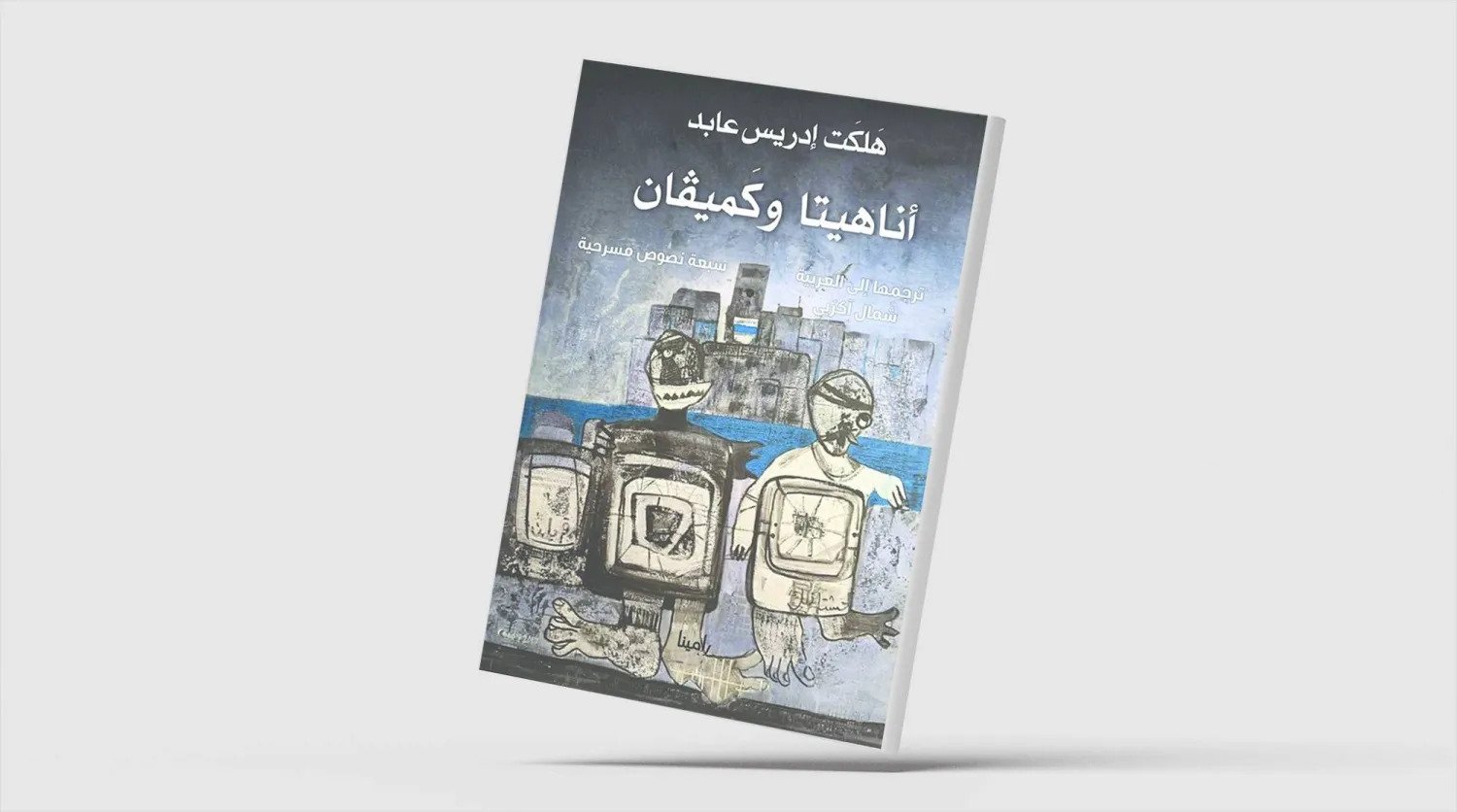
Ramina Publications in London has released the Arabic translation of Anahita and Gamivan, a collection by Kurdish playwright and writer Halket Idris Abid, translated by Shamal Akri. The volume brings together seven plays that open up a broad space for reflection on questions of memory, displacement, freedom, and power through dramatic writing that blends poetry with thought and confronts readers with some of the most pressing human issues.
The book includes the plays My Mother’s Grave, The Shoe Thief, A Painting of Murder, Surayya: A Monodrama, Waiting for Godot, Anahita and Gamivan, and Museum of Blood. These texts converge around the human being moving through devastation, resisting oblivion, and holding on to their story in the face of oppression, war, and exile. Symbolism, philosophical dialogue, and language charged with rhythm and meaning are prominent throughout the collection.
The opening play, My Mother’s Grave, takes the reader on a journey with a father and his son as they search for the mother’s grave. With every step, the journey becomes a confrontation with memory, fear, truth, and the meaning of belonging. The two carry an empty coffin weighed down by questions as they travel along roads surrounded by borders and landmines. The journey itself thus becomes a metaphor for a people carrying their memory on their shoulders and continuing forward despite devastation.
Halket Idris Abid gives symbolism considerable space in constructing his theatrical world. An entire city beats drums in praise of its leader; noise overwhelms truth; and power reshapes human beings according to its own rhythm, until thinking becomes a risk, dissent a crime, and memory an act of resistance against erasure. These scenes reveal a profound critical vision of the mechanisms of authoritarianism through condensed theatrical images that combine satire and tragedy and are sustained by vibrant dialogue.
Taken together, the plays move toward the great questions of human existence: the meaning of homeland, the value of heroism, the limits of morality, the value of freedom, and the relationship between the individual and the collective. The characters become voices carrying the experiences of peoples who have lived through war and displacement, while retaining a human dimension that gives the texts the ability to speak to readers from diverse cultural backgrounds.
The publication of Anahita and Gamivan extends the work of Ramina Publications in bringing Kurdish literature to Arabic readers and enriching the Arabic library with works representing contemporary literary voices. It also opens a new avenue for readers to discover theatrical experiences with distinctive artistic identities and intellectual perspectives.
The book runs to 224 pages in a medium format, with the cover artwork by visual artist Khidr Abdul Karim.
Idris Abid is considered one of the active literary and artistic figures in the fields of playwriting and narrative writing. He has published six works, including Xewnek ji Dervey Bazney – A Dream from Outside the Circle, published in 2011 by the Duhok Writers’ Union; Anahîta û Gemîvan – Anahita and Gamivan, published in 2013 by the Directorate of Printing and Publishing in Duhok; What Did Aristotle Say?, published in 2016 by the Artists’ Syndicate – Duhok Branch; and My Mother’s Grave, published in 2021 by Palo Publishing House. These were followed by a new edition of Anahita and Gamivan, published in 2024 by Avista Press in Turkey, as well as Dastana Kurdistanê – The Epic of Kurdistan, published in 2024 by the Prime Minister’s Office of the Kurdistan Regional Government.
He has won the Best Playwright Award four times. In 2010, he received the award in Duhok for his play The Rain; in 2011, in Sulaymaniyah, for A Dream from Outside the Circle; in 2019, in Erbil, for the monodrama Sureya – Surayya; and again in 2024 for his play Dadgeha Şahmîranê – The Court of Shahmaran, as part of the Saghez Festival in Iran.
Most read